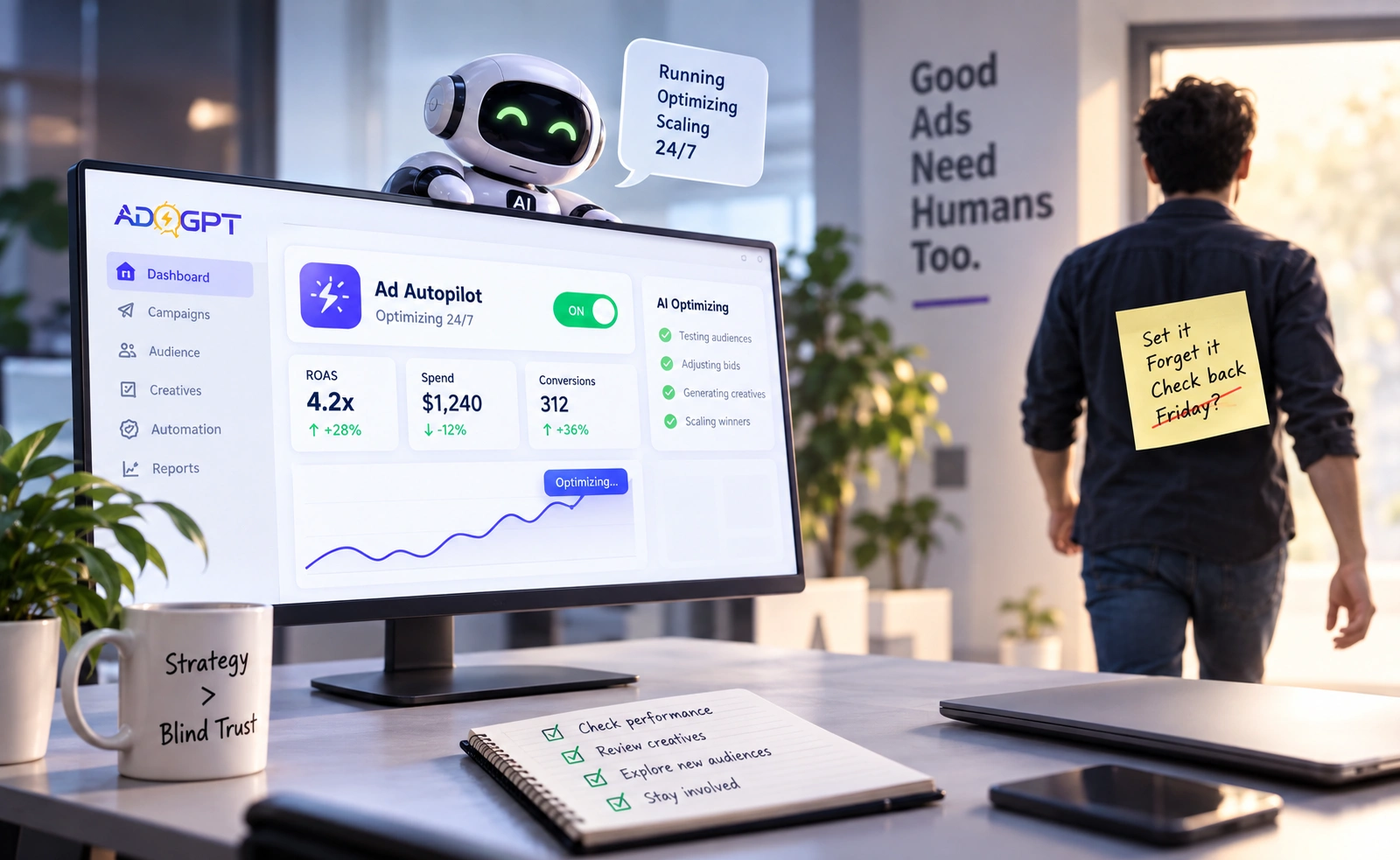
Turning on ad autopilot and walking away is not a strategy. It is a prayer, and the odds are not in your favour.
I have watched growth teams light up at “AI-optimized campaigns.” Six weeks later, they quietly shut the whole thing off. The AI had spent three days hammering one narrow retargeting audience while ignoring every cold prospecting segment that actually moved the needle. The creatives had drifted off-brand. The copy was technically compliant but tonally off. ROAS looked fine at the surface until someone pulled the breakdown.
AI ad optimization is genuinely powerful. But the version most marketers run- set it, forget it, check back Friday- is the version that causes problems. The version that works looks different. This article is about that version.
Listen to the blog.
Why AI Optimizes Ruthlessly (and Why That Is the Problem)
Research from the Berkeley Haas California Management Review puts it plainly: “AI will optimize ruthlessly for its goals unless properly guided. Left unchecked, an AI might serve sensationalistic headlines or violate brand tone just to grab clicks. Or it might overspend on one audience because the short-term ROI looks good, ignoring long-term strategy.”
That sentence should be printed above every campaign dashboard.
The optimization engine does not know your brand. It does not know that a certain audience segment is a strategic beachhead you are still building, not an ROI line item. It does not know that a headline phrased that way will generate a customer service ticket. It knows the metric it is chasing, and it will chase it without apology.
Meta’s Advantage+ is a useful illustration. As Funnel.io notes, it operates largely as a black box: the system assembles ad variants dynamically from your assets, targets dynamically, and adjusts dynamically. The result can be strong. But “marketers are uncertain about what truly drives performance,” which makes diagnosing a decline nearly impossible without good logs.
Google is moving in the same direction. As GetResponse observes, as Google removes more manual controls, “monitoring performance and understanding what the system is doing” becomes more important, not less.
The direction of travel is clear: Madison and Wall estimate social advertising is roughly 20% AI-powered in 2025 and project that reaching 48% by 2030. You are not going to opt out of AI optimization. You are going to learn to run it with guardrails, or you are going to get burned repeatedly.
What “Guardrails” Actually Means in Practice
The word gets thrown around a lot. In practice, for ad optimization, it comes down to three things: a rollback mechanism, a review cadence, and a creative pipeline that feeds the system fresh variants before fatigue sets in.
The rollback mechanism. This is non-negotiable. AdsGPT‘s Autopilot feature audits and optimises Meta ads around the clock, and it ships with an undo log. That undo log is not a minor UI convenience. It is the entire safety model. When an optimization move turns out to be a mistake, you can see exactly what changed and reverse it. That matters most when the AI has shifted budget away from a segment performing on a metric you weren’t surfacing; without a timestamped log, you are debugging a black box with no history.
If you are running AI optimization through any tool and you cannot see a record of what the system changed and when, you do not have guardrails. You have hope.
The review cadence. AI optimization does not mean zero human attention. It means shifting your attention from execution to oversight. The AdsGPT ad optimization checklist lays out the core metrics to monitor: click-through rates, conversion rates, cost-per-click, and return on ad spend. You need to review these on a schedule, not as a gut check, but against the specific objectives you set before the campaign launched. If you skipped setting measurable objectives before launch, that is step one in the sequence, and you cannot shortcut it.
The sequence matters: set objectives → segment your audience → write copy and select visuals → set budget and bid strategy → monitor with data-driven adjustments. Autopilot handles the last step. The others require a human with context the AI does not have.
The creative pipeline. This is where most teams underinvest. AI can shift budget and adjust bids, but it cannot manufacture a new creative idea. StackAdapt’s research on AI ad spend optimization confirms that real-time bid and targeting adjustments reduce wasted impressions, but those gains evaporate when creative fatigue sets in and the system has nothing fresh to test. If your creative pool is stale, the AI is optimizing the distribution of bad options.
Also Read!
The Creative Refresh Workflow That Keeps Autopilot Fed
This is where the production side of AI ad creation directly enables the optimization side. They are not separate workstreams.
The workflow I recommend: when a creative is performing, genuinely performing, not just not losing, click Recreate. AdsGPT generates five fresh variations from that winning creative. You now have five new candidates to push into rotation, each inheriting the structural logic of something that already works. Autopilot has new material. The system can test and shift without you burning cycles briefing a designer.
This loop- identify winner, generate variations, push to test, let Autopilot optimize, identify next winner- is the actual compounding mechanism. The platform has generated over 1 million ads through this kind of iteration. Individual campaigns that run this loop consistently see results compound; the AdsGPT ad creatives case study documents the pattern.
The platform also surfaces what is working in your competitive set. The Competitor Intel database covers 500 million+ ads across platforms. When you one-click remix a competitor ad for your brand, you are not copying; you are pressure-testing your creative approach against what the market is already responding to. That is a legitimate research shortcut, not a cheat code.
Also Read!
Platform Copy Rules Are Part of the Guardrail System
One underappreciated risk of AI-generated ad copy at scale: copy that works tonally on Meta will often get flagged or underperform on Google because the platforms have different conventions. Google Ads require clarity and precision; Meta and LinkedIn allow slightly more expressive messaging. An AI generating copy in batch without platform-specific rules baked in will produce a homogeneous set that underperforms everywhere.
AdsGPT handles this by generating copy aligned with platform requirements from the outset, covering Google Ads, Meta, LinkedIn, and Twitter in the same workflow. When you export sized-to-spec creatives for eight platforms and drop into ad manager, the copy and format specifications travel with the creative. Manual resizing and copy adaptation are where hours disappear, and errors accumulate; removing that step is not incidental to the guardrail system; it is part of it.
The Metrics That Tell You Autopilot Is Working vs. Drifting
The four metrics that matter for ongoing autopilot oversight are CTR, conversion rate, CPC, and ROAS, in that order of diagnostic sequence, not importance.
CTR dropping tells you something is wrong with the creative or targeting before you see it in ROAS. Conversion rate dropping while CTR holds tells you landing page or offer alignment broke. CPC rising with stable CTR and conversion rate usually means auction pressure, not a campaign problem. ROAS is the summary metric, useful for reporting, but too lagging to catch problems early.
The mistake is monitoring only ROAS weekly. By the time a ROAS decline shows up, you have already burned several days of budget on a broken setup. The intermediate metrics are the early warning system. Check them on whatever cadence your spend level justifies: daily at meaningful spend, every two to three days at lower volumes.
When something moves wrong, go to the undo log first. If a specific optimization change correlates with the metric shift, reverse it. Then ask what creative or targeting signal the AI was responding to; that usually points to a fixable upstream problem.

The Real Case for AI Optimization, With Eyes Open
AdsGPT publishes two headline outcomes from accounts running the full loop: 80% lower production costs versus traditional agency workflows, and an average of 4.8× higher ROAS from winning creatives within six weeks, measured across accounts at 60 days. Those numbers come from running the loop correctly: human-set objectives, AI-managed optimization, human creative review, fresh variations fed back in on a regular cycle.
No one gets those results by turning Autopilot on and checking back in a month. The teams getting outsized returns treat AI optimization as a force multiplier for human judgment. Not a replacement for it.
The craft of AI ad copywriting and the science of campaign optimization are converging. Marketers who understand both sides of that equation are the ones who compound results through 2026 and beyond. Both sides mean knowing what the AI is optimizing for, what it cannot see, and how to keep the creative pipeline feeding the machine.
Everything else is just hoping the black box figures it out.
Start your free AdsGPT trial, 35 creatives, no credit card required, and run the Autopilot loop with the undo log on from day one.

MOST POPULAR