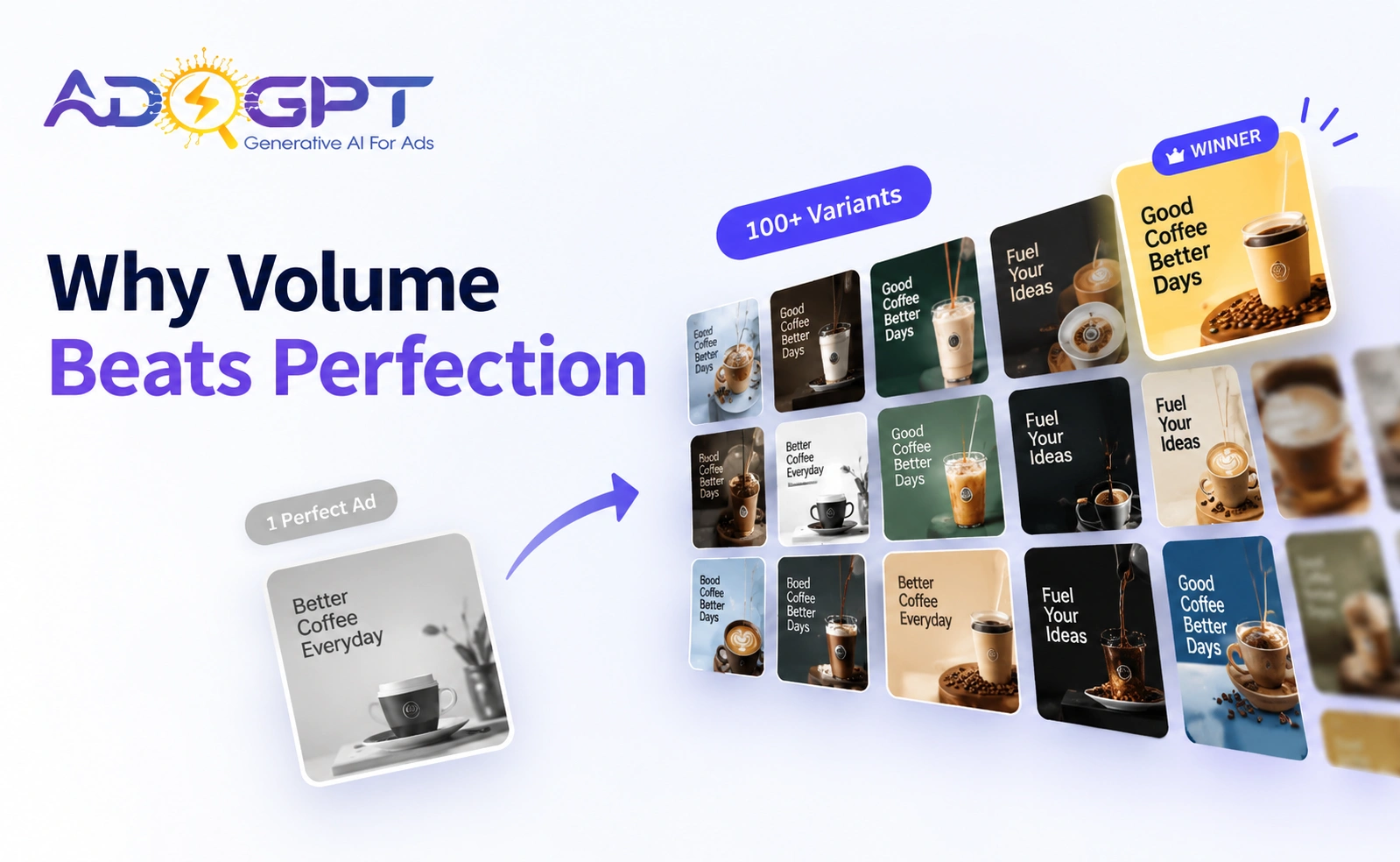
More than nine in ten of your ad variants will not scale. That is not pessimism; it is the baseline. Research consistently shows that only 6–7% of ad variants perform at scale, which means the brands finding the most winners are the ones testing the most creatives. If you are using an AI ad creative generator to produce one polished ad per week, you have misunderstood what the tool is for.
Most marketers treat AI ad generation as a quality shortcut. The actual advantage is a volume one.
The Math Nobody Runs
Before talking workflow, run this calculation. A modest multivariate test suite, five hooks, four headlines, three visuals, two CTAs, three aspect ratios, produces 360 variants before platform adaptation or localization. That is before accounting for Meta versus TikTok versus YouTube Shorts, each with different safe zones, text limits, and audience psychology.
Traditional production workflows collapse under that math. A single in-house video concept takes 6–12 hours to script, shoot, and edit. At that pace, 360 variants is a quarter’s worth of work, not a week’s.
The question stops being “how do I make a great ad?” and becomes “how do I generate enough tests that the 6–7% winners can reveal themselves before my budget runs out?”
Where Most AI Ad Workflows Break Down
The failure modes I see most often are not technical. They are strategic, and they happen before the first prompt is written.
Copying the aesthetic, not the strategy. A competitor’s ad goes viral. You notice the minimalist black background, the bold sans-serif, the quick-cut rhythm. You recreate it. It flops. The look was never the variable; the tension, the curiosity hook, the timing of the reveal were. Recreating the surface without studying the underlying structure is why so many AI-assisted ads underperform despite looking identical to proven winners.
Skipping competitor research and guessing instead. The fastest way to brief an AI generator well is to know what is already working in your category. Wasted budget from guessing, rather than using a structured competitor database, is one of the costliest and most avoidable mistakes in paid social. Skipping competitor research features is a named failure mode for a reason: pattern recognition at scale only works if you have the data to pattern-match against.
Treating the brief as an afterthought. A Nielsen 2025 Digital Advertising Benchmark Report found that the top quartile of AI-assisted creative teams shared one consistent trait: they spent more time on brief development and competitive research, not less. The AI generation layer freed time from production , and the smart teams redirected it upstream. The brief is where audience tension, psychological hook, and format rationale get encoded. A weak brief produces volume without signal, which is worse than no volume at all, because it generates false confidence.
Also Read!
The Workflow That Actually Works
Here is the sequence I recommend, built entirely around real capabilities.
Step 1: Research before you prompt
Search the competitor ad database first. AdsGPT‘s Competitor Intel database contains 500M+ ads, filterable by brand, region, and platform. You are not looking for ads to copy; you are looking for structural patterns. Which emotional hooks appear repeatedly in your category? What pain points surface in the copy? Which formats dominate: UGC-style video, product B-roll, static image?
The one-click remix feature is useful here, but use it deliberately. Remix the tension-setup-resolution arc, not the color palette.
Step 2: Write a real brief, one hypothesis per brief
Specify: the audience pain point in their own language, the single psychological trigger you are testing, the CTA, the format. “DTC skincare brand, targeting women 28–40 dealing with hormonal breakouts, hook: dermatologists won’t say this publicly, format: UGC video, CTA: shop the routine” is a brief. “Make me a skincare ad” is a prompt that wastes a batch.
One hypothesis. One brief. Run several in parallel; that is the point.
Step 3: Generate in batch, not one at a time
AdsGPT generates 60 ads in 60 seconds from a single prompt. Across a morning, four or five distinct brief hypotheses produce hundreds of variants spanning image ads, UGC videos, B-roll clips, and AI avatar ads, all from the Ad Factory in a single session.
BrandIQ, AdsGPT’s brand control system, locks colors, fonts, logo lockups, and voice rules once and applies them across every subsequent batch automatically. This is not a minor convenience. It eliminates the revision loop that kills timelines: BrandIQ-style controls cut two to three revision rounds per client, saving hours each week that compound fast across a month.
Step 4: Export sized for each platform, launch fast
AdsGPT supports 9 ad platforms with auto-adjusted aspect ratios, text limits, and safe zones per channel. Export once, deploy everywhere. For Meta specifically, you can pick a creative, add a CTA, and publish a live ad without leaving the platform. Speed matters. The longer a batch sits between generation and launch, the longer you delay the feedback signal the next brief depends on.
Step 5: Scale winners with Recreate, kill losers fast
When a variant starts pulling results, click Recreate to generate five fresh variations immediately. You are not guessing what made it work; you are preserving the structural elements that converted and varying the surface to prevent creative fatigue. For ongoing optimisation, Autopilot audits and adjusts Meta ads around the clock, with an undo log so nothing is irreversible.
Launching the test is the easy half. Systematically scaling winners and cutting losers, at speed, without second-guessing every decision, is where ROAS actually moves.
The Formats That Are Still Underused
Most shipped AI creatives through 2024 and into 2025 were still static, according to The State of Ad Creation 2026, which analyzed 24,000+ ad-served designs across 2.4 billion views. That gap matters. UGC-style video, product B-roll, and AI avatar ads are not saturated in most categories; creative fatigue is less acute, and the attention mechanics reward the format itself, not just the message.
UGC Video Ads are worth testing specifically because UGC-style content converts up to 4× better than polished brand content. The production bar is also counterintuitively lower, which means more variants per brief and faster signal.
Product B-roll Video fills a specific gap for product-focused brands. YouTube Shorts, Reels, and product pages all consume short-form video at volume. A brief that once required a full shoot day can now be batched alongside static variants in the same session.

The Volume Threshold That Changes Your Timeline
At a 6–7% hit rate, the number of variants you generate per week determines how quickly winners surface, not how confidently you picked them in advance. Run only a handful per platform each week, and you may wait months before a clear directional signal emerges. Push volume high enough, and that same signal compresses to days. The math is unforgiving in both directions.
For teams managing multiple clients, the arithmetic sharpens further. If you are handling six to twenty clients simultaneously across nine or more channels, production volume per client has to be high enough to sustain real testing , not just deliver a creative refresh each quarter.
Two practitioners who work inside this system described the shift clearly. A performance director at a mid-market ecommerce company: “We stopped guessing and started shipping waves of tests each week. Our CPA stabilized within two cycles.” A growth lead at a DTC subscription brand: “We moved from three new ads per week to 40+. Scaling budgets felt safe again.”
Neither quote is about the quality of a single ad. Both are about what happens when volume is high enough that the 6–7% can surface on a timeline that matters.
The free plan includes 35 ad credits, no credit card required. That is enough to run one proper brief-to-batch cycle and see what the volume-first approach actually produces before committing to anything.
Start your free AdsGPT trial, run your first batch of 60 ads in 60 seconds, and find out how many variants you were previously leaving untested.

MOST POPULAR