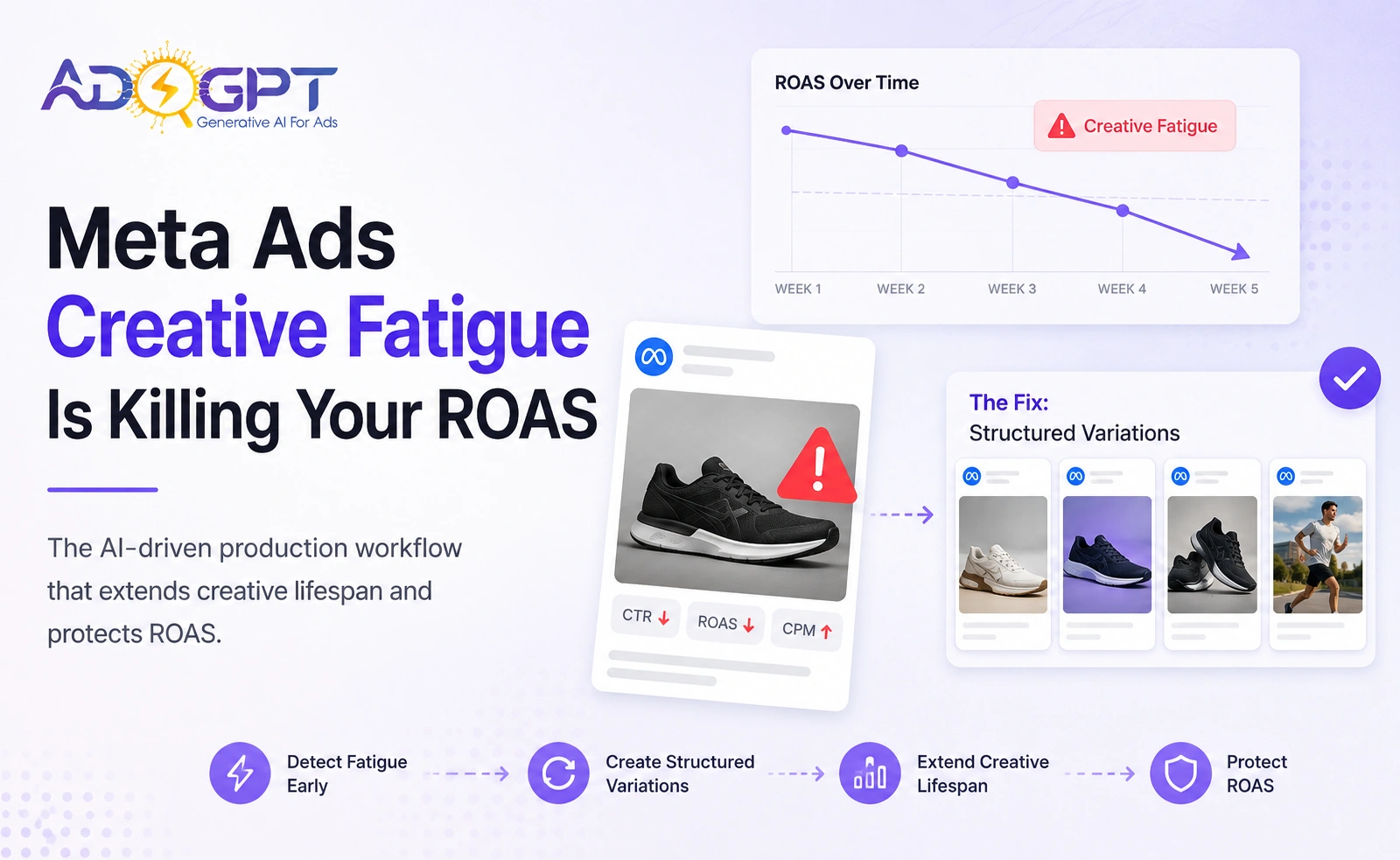
The worst thing you can do after finding a winning ad is pour budget into it. I know that sounds backwards. But after watching growth teams repeat the same mistake, the pattern is clear: the moment you scale a winner without simultaneously generating variations, you’ve started a countdown clock. On Meta in 2026, that clock runs fast.
Here’s the mechanism. Meta is rolling out three new creative metrics, Creative Fatigue, Creative Similarity, and Top Creative Themes, that will increasingly govern delivery. The algorithm isn’t neutral about repetition. It deprioritises creatives it has already served to the same audience. Scale a single winner hard, and you’re training the auction to work against you.
The Common Thread Co analysis of Meta’s Andromeda update is blunt: if your ROAS has slid since Q4 2025 and your targeting hasn’t changed, audit your creative similarity score first. A study of over one million Meta ad creatives cited in that report found creative similarity is now a primary predictor of delivery degradation. Same hook, same visual language, same format, and Meta quietly stops showing it.
The Real Cost of “Set and Scale”
Most paid media teams don’t feel the damage immediately. ROAS holds for the first week. Maybe two. Then frequency climbs, CPMs rise, and the creative that was printing money quietly starts bleeding it.
Singular’s 2025 analysis is blunt: creative fatigue is one of the biggest threats to campaign performance today. Modern ad platforms- Meta, Google, TikTok- don’t wait for your CTR to drop before deprioritising a fatigued creative. They detect the pattern earlier. By the time your dashboard shows the damage, you’ve already lost days of efficient spend.
The signs are consistent across accounts: declining CTR despite consistent targeting, rising CPA and CPC, stagnant or falling conversions, lower relevance scores. The instinct to keep scaling a winner makes sense. It just doesn’t account for the shelf-life problem. And the shelf-life problem is fundamentally a production problem, not a strategy problem.
Why Most Teams Can’t Fix This the Traditional Way
The honest solution is continuous variation testing: always have fresh creative entering the auction, rotate formats, test new hooks, keep the algorithm from seeing a stale pattern. The math required to do this properly is daunting. A modest multivariate suite, five hooks, four headlines, three visuals, two CTAs, three aspect ratios, produces 360 variants before platform adaptation. Add localisation and that doubles.
A designer-and-copywriter team producing three to five ads a week cannot fill that funnel. As our own analysis notes, traditional marketers relying on monthly reports or manual performance checks to spot fatigue are working far too slowly for real-time advertising. The production constraint isn’t talent. It’s throughput.
There’s another layer: what works on Facebook won’t work on YouTube, and your Instagram creative won’t automatically click on LinkedIn. Per-platform reformatting of text length, aspect ratios, and visual format turns a 10-ad batch into a 40-asset production job. Manually, that’s weeks of work. That’s why teams that try to solve creative fatigue by hiring more creatives usually hit the same ceiling.
The Variation Workflow That Actually Works
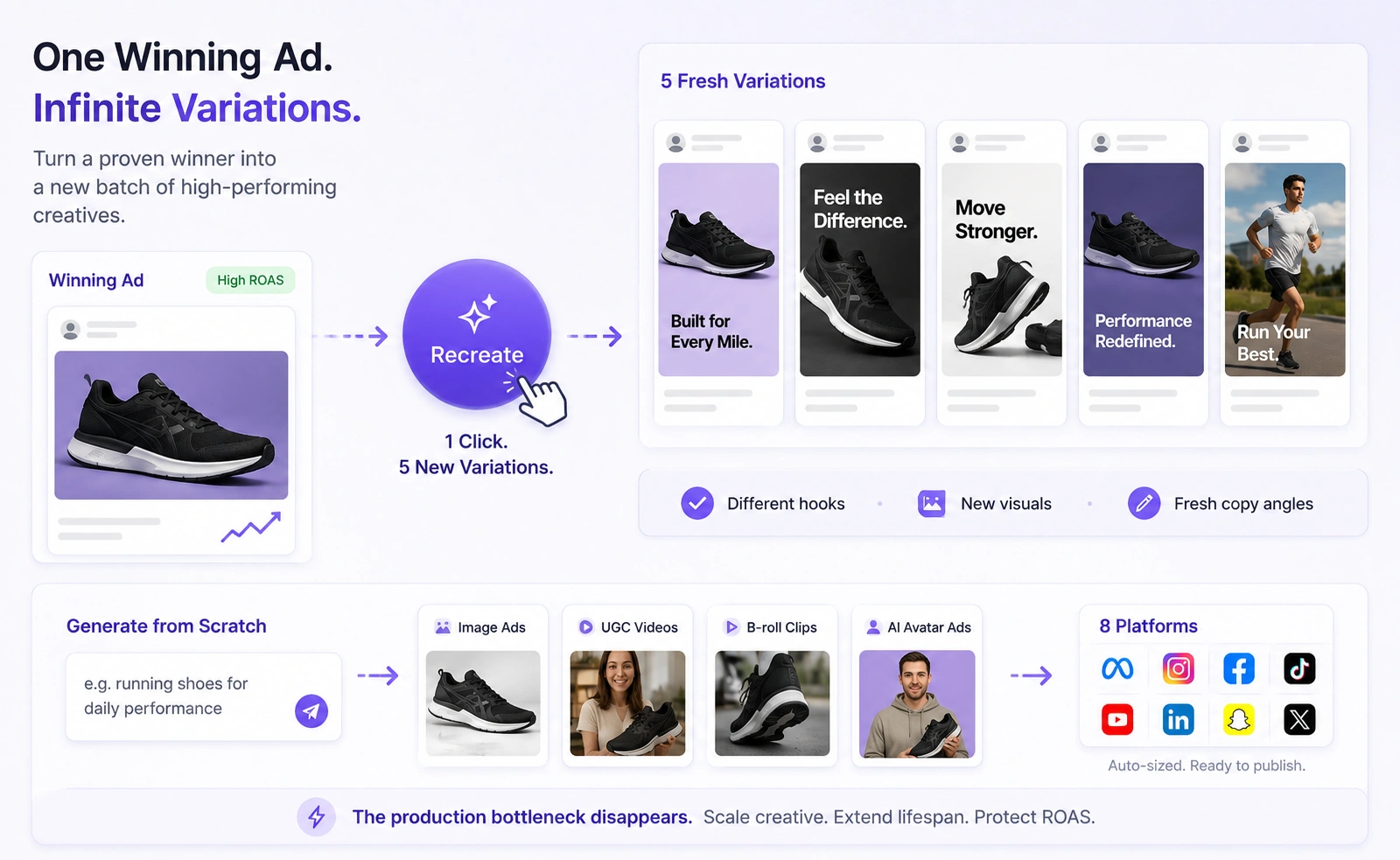
The teams that break out of this cycle do something specific. They don’t treat a winning creative as a destination. They treat it as a template for the next batch.
In AdsGPT, this is a single click. You find a creative that’s converting, whether you built it in the platform or identified it through the 500M+ competitor ad database, and you hit Recreate. The system generates five fresh variations, each with a different hook, visual treatment, or copy angle, all sized and spec’d for the platform you’re running. You’re not starting from a blank brief. You’re systematically forking a proven structure.
That distinction matters more than it sounds. Starting from a proven structure means the variations inherit what’s already working- the offer framing, the format, the audience signal- while changing the variables that drive fatigue. You’re not gambling on a new concept. You’re extending the life of an existing winner.
The same logic applies from scratch. Submit a single prompt and generate image ads, UGC videos, B-roll clips, and AI Avatar Ads simultaneously, auto-adjusted for eight platforms with correct aspect ratios and text limits. See the AI ad creative generator overview for platform-by-platform specs.
The production bottleneck that made continuous variation testing impractical disappears.
Ready to run the Recreate workflow yourself? Start free, no credit card required →
On UGC: The Format Rotation Most Teams Skip
One of the sharpest levers for extending creative lifespan is format rotation, specifically, mixing polished brand creative with UGC-style video. Most teams that run into fatigue are running one format type. The algorithm sees the same visual language repeatedly, and so does the audience.
UGC Video Ads convert up to 4× better than polished brand content, partly because they signal authenticity and partly because they look different from everything else in the feed. Adding a UGC batch to an otherwise static-heavy creative mix isn’t just a hedging strategy; it’s a pattern interrupt that buys the rest of your creative more time.
The practical challenge is that real UGC is expensive to source and slow to produce. The UGC Video Ads and AI Avatar Ads features in AdsGPT generate this format at the same pace as everything else: a prompt in, platform-ready video out, no production coordination required.

Autopilot: Solving Fatigue at the Account Level
Individual creative refresh is a tactic. Account-level creative health is a system. The difference is whether you’re reacting to fatigue after it hits or preventing it before it does.
AdsGPT’s Autopilot runs continuous audits of live Meta campaigns, identifies creatives approaching frequency thresholds or showing declining engagement, and optimises accordingly, with an undo log so nothing changes without a record. You’re not waiting for ROAS to drop before you notice a creative is dying. The system flags it first.
This matters because creative fatigue rarely announces itself cleanly. CPM creep, minor frequency upticks, a slight drop in hook rate (three-second views divided by impressions)- these appear weeks before a ROAS collapse. They’re easy to miss when you’re managing campaigns manually across multiple accounts. Meta’s own ad manager is building toward early-warning alerts for these signals, but the feedback loop inside a dedicated system runs faster.
What the Numbers Look Like When This Works
I’ll be direct about what the data shows and where it comes from.
Accounts using AdsGPT’s brief-driven workflow report 80% lower production costs versus a traditional agency workflow. Average accounts after 60 days on the platform report 4.8× higher ROAS from winning creatives. The mechanism connecting those numbers is straightforward: more variation throughput means the algorithm always has fresh creative to prefer. Creative lifespan extends. Budget stops burning on fatigued placements.
Over one million ads have been generated on the platform to date. The pattern across those accounts is consistent. Teams that build a systematic refresh cadence, recreate on every winner, rotate UGC every two to three weeks, and Autopilot watching for frequency signals stop chasing their own tail on fatigue. They start compounding on what works instead.
AI-powered multivariate testing can evaluate dozens of creative variations simultaneously in real-time, rather than waiting weeks for manual performance checks. That speed advantage is structural, not marginal; it’s the difference between catching fatigue early and discovering it in a post-mortem.
The Practical Starting Point
If you’re running Meta ads and one or two creatives are doing most of the work, the place to start is not a full creative strategy overhaul. It’s this:
- Identify your current top performer.
- Use Recreate to generate five variations, different hooks, same proven structure.
- Run all five simultaneously with enough budget for each to reach significance within seven to ten days.
- Retire the parent creative as soon as one variation matches its performance; don’t wait for fatigue to force your hand.
- Repeat. Treat the new winner the same way.
This isn’t a one-time intervention. It’s a cadence. The teams that crack creative fatigue aren’t the ones with the best single ad. They’re the ones who’ve made variation production routine enough that the algorithm always has something fresh to prefer.
The free plan provides 35 creatives with no credit card required, enough to run the first two cycles of this workflow and see whether the cadence holds before committing to a paid tier. The Creator plan, at $99/month for 1,250 Ad Credits, is where most DTC teams find the volume they actually need for sustained testing.
Scale your winners. Just never stop building what comes next.
Start your free AdsGPT trial and generate your first variation batch today →

MOST POPULAR