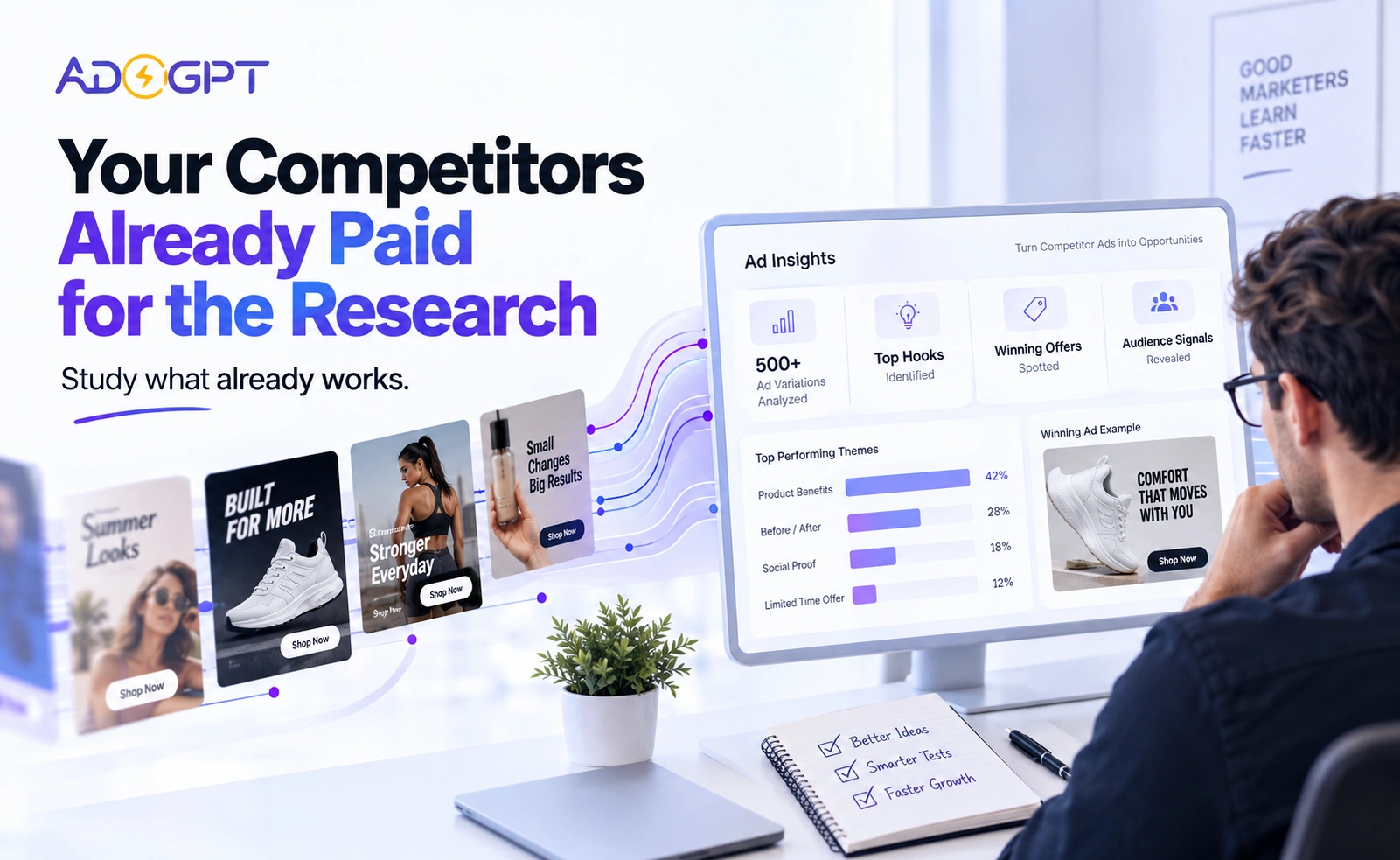
Every dollar your competitors spent testing ads was, in effect, free market research for you. They paid for the audience signal. They burned the bad hooks. They proved which offer structure converts. And most growth teams ignore every bit of it, open a blank Google Doc, and start writing from feelings.
That habit is expensive. Here’s a better one.
Listen to the blog.
Why “Original” Ad Creative Is Often Just Expensive Guessing
There’s a romantic idea in marketing that great creative must be born in-house, untouched by what competitors are doing. It doesn’t hold up. What separates a strong CTR from a weak one is almost never originality — it’s hook clarity, format fit, and offer framing. Those are learnable signals. They exist, right now, in the ads your competitors are actively spending money to run.
The reason most teams don’t act on competitor creative intelligence isn’t philosophical. It’s practical. Manually trawling Meta’s ad library, screenshotting creatives, briefing a designer, and producing a variation used to take days. By the time your version shipped, the original had already peaked in the auction. The latency killed the insight.
That time gap is exactly what AdsGPT is built to close.
The 500-Million-Ad Library Nobody Is Using Properly
AdsGPT’s Competitor Intel database indexes 500 million+ ads across platforms. You search, you find a creative that’s clearly working — evident from how long it’s been running, its format, its placement spread — and you hit one button to remix it for your brand. Not copy it. Remix it: same proven structure, your offer, your voice, your product.
That distinction matters legally and creatively. The underlying hook mechanic (say, a problem-agitate-solve open, or a bold price anchor in the first frame) isn’t ownable. The execution is. AdsGPT’s competitor ad analysis generates similar yet original variations from a selected competitor creative — you get the structural logic of a proven ad without reproducing anyone’s copy or imagery.
Most teams use this feature once, as a curiosity. The ones getting results use it as their primary brief format.
A Concrete Workflow: From Competitor Signal to Live Ad in One Session
Here’s how this actually plays out, step by step, using AdsGPT’s real toolset:
- Search with intent. Filter the 500M+ database by your category, platform, and approximate run duration. Long-running ads on Meta are almost always profitable — advertisers don’t keep spending on losers. These are your shortlist.
- One-click remix. Select the creative. AdsGPT generates fresh variations mapped to your brand positioning. You’re not starting from zero — you’re starting from a validated structure.
- Batch across formats. From that single remix brief, generate image ads, UGC-style videos, B-roll clips, and AI Avatar Ads in one pass. One competitor insight, five format variants, ready for testing across placements simultaneously.
- Size to spec and export. AdsGPT sizes creatives to the exact specs of eight platforms. No designer time spent resizing a 1:1 to a 9:16 for Reels. Export and drop directly into your ad manager.
- Scale what wins. Once a creative gets traction, click Recreate. AdsGPT generates five fresh variations of that winner — enough to keep the test-and-scale loop running without creative fatigue killing performance.
The entire chain, from competitor signal to batch creative ready for export, happens in a single working session. That’s not a marginal time save. It’s a structural shift in how often you can test.
The Format Question Most Teams Get Wrong
One thing competitor research reveals fast: winning ads on Meta look nothing like winning ads on Google. This isn’t surprising, but teams regularly ignore it when remixing. A Google ad demands clarity and precision — short headlines, hard offer statements, zero ambiguity. Meta and LinkedIn allow more expressive copy, emotional arcs, longer hooks. The same competitor insight needs to be translated differently per platform, not just resized.
AdsGPT’s platform-specific generation handles this at the output layer. When you remix a competitor creative for Google versus Meta, the copy isn’t just cropped — it’s restructured for the context in which it will be read. That’s worth noting because manually adapting copy platform-by-platform is where most production time gets lost, and where most of the subtle errors (a truncated headline, a hook that reads wrong in a discovery feed) creep in.
UGC Deserves Its Own Mention Here
If you’re studying competitor creative and ignoring their UGC-format ads, you’re missing the fastest-growing segment of what’s actually working. UGC Video Ads convert up to 4× better than polished brand content, and the gap keeps widening as audiences have grown fluent at scrolling past anything that looks like an ad.
The irony is that UGC-style creative is historically the hardest to produce at scale — you need talent, shooting setups, and editing time. AdsGPT’s UGC Video Ads feature generates that format from a prompt. When you find a UGC-style competitor ad that’s clearly running profitably and remix it through AdsGPT’s UGC pipeline, you’re compressing what used to be a multi-week production cycle into hours.
For context on how to approach ad research more broadly before you start remixing, this breakdown of researching ads via Meta’s ad library is worth reading alongside what AdsGPT’s own database surfaces.
What This Does to Your Testing Velocity, and Why That’s the Real Prize
According to IAB research cited by eMarketer, 83% of ad executives deployed AI in creative processes in 2025, up from 60% the year before. The category is moving fast. Adoption alone doesn’t win, though — velocity does. The team running twelve competitor-informed creative variants per week will beat the team running two handcrafted originals. Given enough budget and time, that’s nearly always true.
AdsGPT accounts that run this workflow report 4.8× higher ROAS within six weeks on average after 60 days. The mechanism isn’t magic — it’s iteration rate. More tests, more data, faster convergence on what actually converts for your specific audience.
The production cost side is equally significant. Traditional agency creative workflow runs expensive. AdsGPT’s batch generation approach cuts production cost by 80% compared to that model. That saving doesn’t just affect the budget line — it removes the constraint that forces teams to bet on a single creative direction instead of testing five simultaneously.
DTC brands and growth teams who want a fuller view of measurement will find this useful: this ad optimization checklist maps how click-through rates, conversion rates, cost-per-click, and ROAS track across the full creative-to-launch process.
The One Mistake That Undermines the Whole Approach
Teams who get disappointing results from competitor-informed creative usually make the same error: they remix once, don’t test enough variations, and declare the approach didn’t work. One variant of one competitor ad is not a test. It’s a sample size of one.
The workflow only compounds when you use the Recreate function after an initial winner emerges. That’s when the five fresh variations give you real signal — because now you’re testing against a known baseline, not guessing in the dark. The loop is: competitor insight → remix → batch → test → find winner → Recreate → scale. Stopping at step three skips the part that actually delivers the ROAS lift.
The other mistake is treating every competitor creative as equally worth remixing. Long run duration on a well-funded account is your filter. A creative that’s been running for eight weeks on a brand with a real media budget is almost certainly cash-flow positive. An ad that appeared once and vanished told you something too — just not what you wanted to know.

Start With What’s Already Working
The blank brief isn’t creative courage. It’s an expensive way to rediscover what the market already knows. Your competitors’ ad spend is the largest free research budget you’ll never have to justify to a CFO.
Use it.
Start your free AdsGPT trial — 35 creatives, no credit card, and the full 500M+ competitor ad database is available from day one.
MOST POPULAR