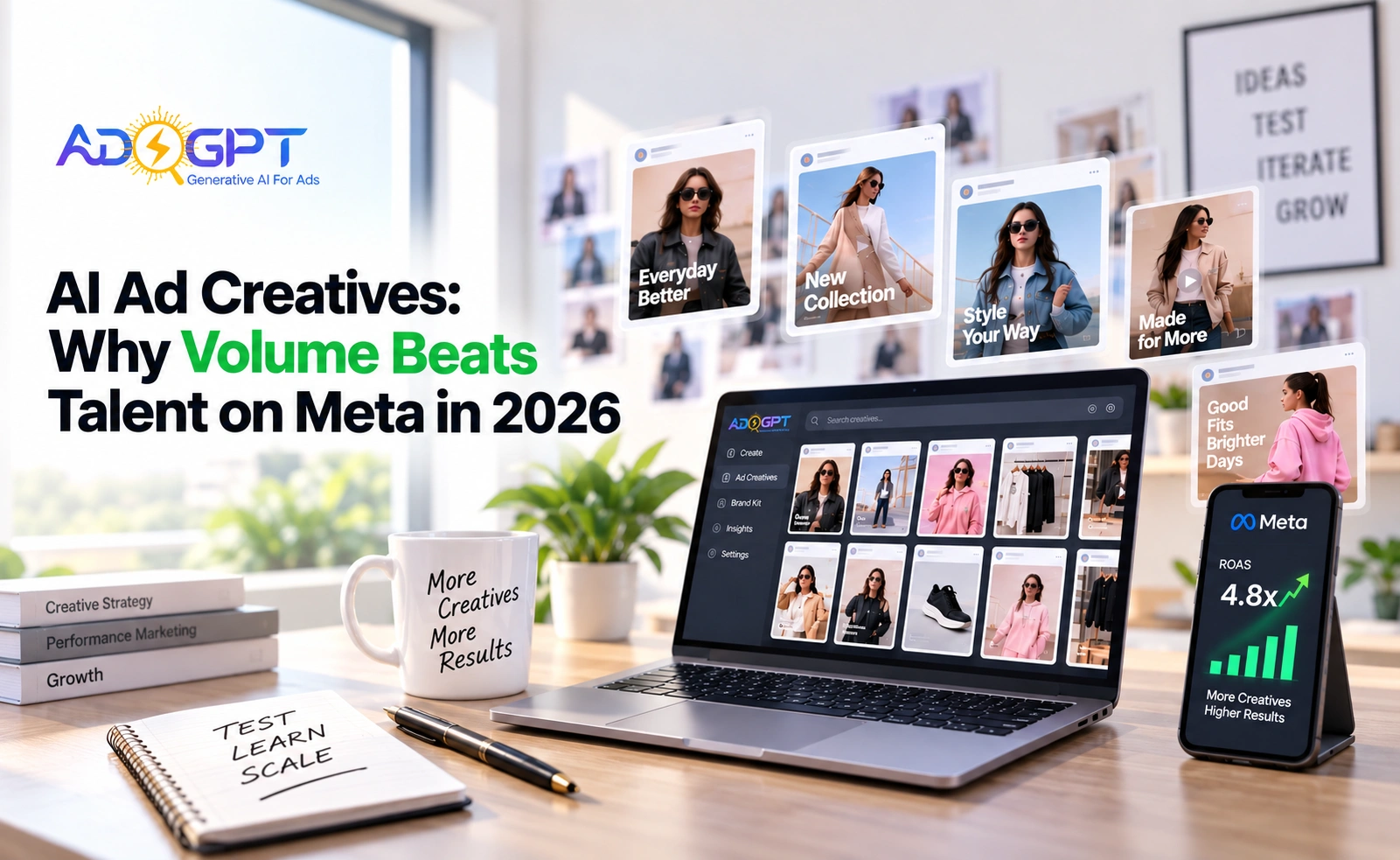
Most advertisers obsess over making one ad perfect. Meta’s algorithm in 2026 doesn’t care about perfection; it cares about signal volume, and the brand feeding it fifteen creative variants this week will outrank the brand agonizing over a single hero video.
This is the mistake I see constantly. A DTC team produces a polished brand video, launches it into Advantage+, watches it plateau well below expectations, and concludes their product isn’t a good fit for paid social. The real diagnosis is simpler and more fixable: they starved the algorithm of creative surface area.
What Actually Changed on Meta in 2026
Meta’s Advantage+ suite now handles targeting, creative production, and real-time budget optimization in ways that would have required a full media team two years ago. That sounds like good news. It is, but only if you give it enough creative surface area to work with.
Two specific shifts matter here.
First, Meta’s own platform data shows that campaigns using AI-generated imagery produce an 11% higher click-through rate and a 7.6% higher conversion rate than equivalent non-AI campaigns. The algorithmic return on feeding it varied creative types has never been higher.
Second, the old scaling pattern- find one winner, push budget- is breaking down. As practitioners documented after Meta’s mid-2026 targeting changes, the system now processes far more creative variations in parallel and actively needs that volume to optimize efficiently. Consolidated campaigns with a broad creative pool outperform tightly segmented ones with a handful of assets.
The practical upshot: if you’re running fewer than ten active creative variations per ad set, you’re under-feeding the machine.
The Production Bottleneck Is the Real Problem
Most brands know they should test more creatives. They just can’t produce them fast enough. A traditional agency workflow- brief, script, shoot, edit, resize for eight platforms- takes weeks and consumes a substantial slice of the monthly ad budget. The creative team becomes the bottleneck for the performance team.
That’s the problem AdsGPT was built to eliminate. The platform lets you generate image ads, UGC videos, B-roll clips, and AI avatar ads from a single prompt in batch, not one at a time, but in volume, sized to spec for eight platforms simultaneously. Production cost drops 80% versus a traditional agency workflow. That gap changes the decision calculus entirely: you can run multiple angle tests for what a single traditional shoot used to cost. Five tests will almost always beat one careful guess, not because any single variant is smarter, but because the algorithm has more signal to optimize against.
The Specific Workflow That Moves ROAS
This isn’t abstract. Here’s the exact sequence that accounts using AdsGPT run to build creative velocity.
Step 1: Mine Competitor Signals First
Don’t guess at angles. AdsGPT’s Competitor Intel database covers 500 million+ ads across platforms, surfacing four categories of insight per ad: messaging style, audience signals, timing patterns, and creative format. Search for what competing brands in your category have run longest; an ad live for 60-plus days in a top-spending account has likely found an angle worth studying.
Long-running ads in most categories share a structural trait: they lead with a transformation hook anchored in a specific, credible experience rather than a generic product claim. That framing is why the algorithm rewards them with broader delivery. Hit one-click remix, and AdsGPT generates similar-yet-original variations adapted to your brand. You’re anchoring your brief in confirmed market signal, the fastest way to skip the cold-start problem on a new product launch.
Timing patterns matter too. When a wave of video-heavy creatives from multiple advertisers hits the same 10-day pre-holiday window, that’s a category signal, not coincidence, and Competitor Intel surfaces it before you’ve spent a dollar.
Step 2: Generate Your First Batch with Format Diversity
Meta rewards format diversity within an ad set. A single prompt in AdsGPT can output AI Ad Creatives (static image), a UGC Video Ad, a Product B-roll Video, and an AI Avatar Ad in one session. Static ads anchor the brand, B-roll shows product in motion, UGC builds the social proof that converts skeptics.
UGC format specifically converts up to 4× better than polished brand content; any batch that omits UGC is leaving conversion rate on the table. The recommended batch size is 5–8 creatives per angle, not 50 across all angles at once. Volume without discipline is noise; striking the balance between quality and quantity is what lets AI actually accelerate optimization rather than generate chaos.
Generate your first format-diverse batch free , no credit card required , at AdsGPT.
Also Read!
Step 3: Launch, Watch, and Use Recreate, Not Replace
This is the step most teams skip. When a creative shows early signals- lower CPC, higher thumb-stop rate- the instinct is to raise the budget on it. The better move is to hit Recreate first. AdsGPT generates five fresh variations of that winning creative before you scale. Same angle, same format, different execution. You give the algorithm new fuel in the format and style it already indicated it likes. Budget increase comes after the variants are live, not before.
Teams that treat Recreate as the scaling trigger, rather than a budget increase, are the ones whose reach continues to expand rather than plateau. The platform’s learning doesn’t stall because you’re constantly feeding it variation inside a proven angle.
Step 4: Evaluate at the Ad Set Level, Not the Individual Asset Level
A “losing” creative inside a high-performing ad set might be providing the contrast that makes the winner perform. AdsGPT’s platform analysis, drawn from over 1 million ads generated and studied across DTC accounts, consistently shows the same pattern: teams that pause individual assets too early disrupt the system’s ability to allocate spend intelligently. Watch aggregate ad set KPIs, conversion rate, ROAS, and cost-per-result before touching individual creative status. That discipline, more than any single creative decision, is what separates accounts that compound from accounts that plateau.
Step 5: Turn on Autopilot for Overnight Optimization
AdsGPT’s Autopilot runs an AI audit of your Meta ads around the clock, with an undo log so no change is irreversible. You generate at volume during the day; Autopilot applies performance learnings at night. You wake up to a tighter ad set rather than a stale one.
Where This Goes Wrong
Launching too many formats before you have pixel signal. If your Conversion API setup is weak, poor event match quality degrades optimization accuracy; more creative volume won’t save you. Fix the measurement layer first. No AI ad tool compensates for bad signal infrastructure.
Prompting by product category rather than by angle. This is a named failure mode: briefing AdsGPT with a product category instead of a specific angle produces headlines like “Feel Better Every Day” and “Support Your Wellness Journey,” low-engagement copy the algorithm restricts delivery on. Prompt by angle, price, transformation, social proof, urgency, not by what the product is.
Ignoring platform-specific copy requirements. Even when your visual is the same, the copy shouldn’t be. When you export sized-to-spec creatives from AdsGPT for eight platforms, adjust the copy per platform; the visual format is handled, but headline framing still needs human intent behind it.
What the Numbers Look Like When This Works
Average AdsGPT accounts reach 4.8× ROAS within 60 days, based on AdsGPT’s analysis of account performance data across the platform. For external grounding: Meta’s own figures show AI-generated creative producing 11% higher CTR and 7.6% higher conversion rates at scale; the directional signal aligns. The 4.8× figure isn’t from a single breakthrough ad; it’s from the compounding effect of running more tests, finding signal faster, and scaling proven formats before they fatigue.
Worth reading alongside this: how creative engagement directly drives algorithmic reach. Reach is heavily influenced by engagement response, not budget alone, which is precisely why ongoing creative volume is mandatory rather than optional.
The Concrete Difference Volume Makes
Here’s the mechanism in plain terms. A campaign running three creatives gives the algorithm three learning cycles; it allocates impressions, collects response data across those variants, and converges on the least-bad option among them. A campaign running a dozen creatives across format types, hooks, and angles gives it a proportionally richer signal surface to route spend against. The gap in CPC between those two approaches isn’t magic. It’s the platform finding the efficient frontier faster because it has more to work with. 71% of DTC advertisers surveyed say they’re under pressure to produce more creative in 2026; the teams still running three or four variants per campaign are paying a premium for slower learning, and that premium compounds every week they don’t change the habit.
The free plan covers 35 creatives with no credit card required. The Creator plan, at $99/month for 1,250 Ad Credits, is what most DTC teams need to sustain weekly batch generation at scale.
Start your free AdsGPT trial and run your first competitor remix before you touch your next ad budget decision.

MOST POPULAR