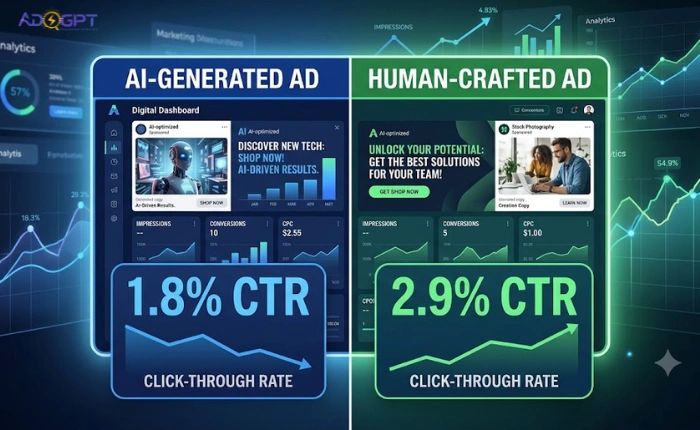
AI-generated ai ads are, on average, losing to human-crafted ones by a wide margin, Meta’s 2025 creative testing data puts average CTR at 1.8% for AI ads versus 2.9% for human-crafted ones. If you’ve been pumping out AI creatives and wondering why performance is flat, that’s your answer. The problem isn’t that AI is bad at making ai ads. The problem is the order of operations most teams use.
Prompt in. Creative out. Publish. Repeat.
That’s not a workflow. That’s guessing at scale.
The Actual Failure Mode
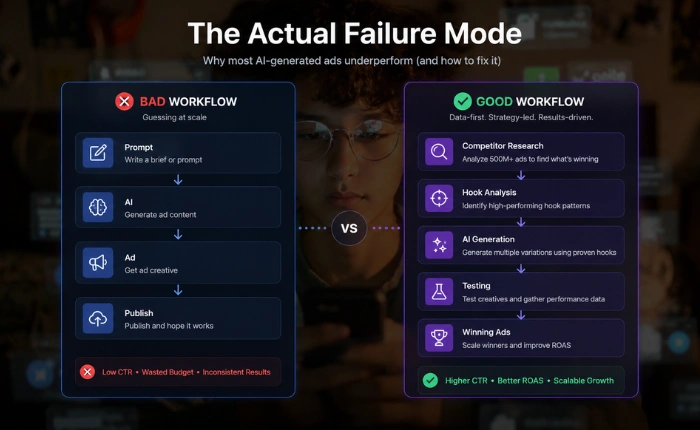
MarTech’s breakdown of why AI-driven creative fails points to execution, not technology. The tools aren’t the issue. What’s broken is what goes into the AI before it generates anything , the brief, the hook intelligence, the competitive context. Without that, you’re generating into a vacuum. The AI dutifully produces something that looks like an ad but has no structural reason to perform.
Here’s the version I see constantly: a brand switches from a design agency to an AI creative tool, slashes production cost, ships three times the volume , and ROAS drops. Volume isn’t the lever. The hook is.
What the CTR Gap Is Actually Measuring
That 1.8% versus 2.9% spread isn’t a gap between “AI-made” and “human-made.” It’s a gap between uninformed and informed creative. Human copywriters and art directors don’t start from nothing. They’ve reviewed competitors’ ai ads, absorbed weeks of performance data, and built instincts for what their specific audience responds to. The AI, when prompted without that input, starts from nothing.
That’s fixable. But you have to feed the machine the right raw material first.
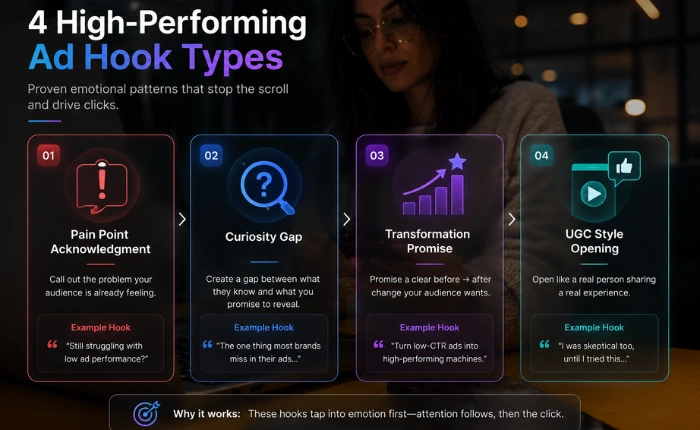
Research from AdsGPT’s own published analysis found that winning hook structures cluster around just four emotional patterns: pain-point acknowledgment, curiosity gaps, transformation promises, and direct UGC-style openings. Four. The reason most AI ads miss is they aren’t built around any of them , they’re built around whatever the brand brief says, which is usually about product features.
The Competitor-First Workflow That Changes the Math
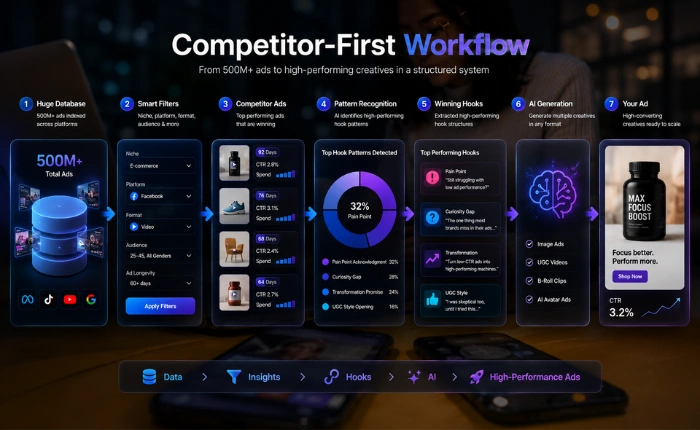
Before you open AdsGPT and start generating, you need to know what’s already winning in your category. Not what you think is winning. What’s actually running and sustaining spend.
The old way of gathering this intelligence was genuinely broken. Teams manually browsing the Meta Ad Library could realistically review only 10–15 competitor ads per week, a sample too small to identify real patterns. Screenshots went into shared folders with no tagging, no searchability, no way to connect an old ad to a trend emerging today. Institutional knowledge just sat there, unused.
Even worse: the Meta Ad Library contains millions of active creatives at any given moment. Reviewing 15 of them isn’t research. It’s a coin flip with extra steps.
The fix is to search at a scale that actually reveals signal. AdsGPT’s competitor ad database holds over 500 million ads, searchable by niche, platform, format, and audience. An ad that has run for 60–90 days is treated as a performance-confirmed signal; no brand sustains spend on a non-performing creative that long. Filter by longevity, and you’re not looking at what’s new. You’re looking at what’s working.
The Four-Step Process
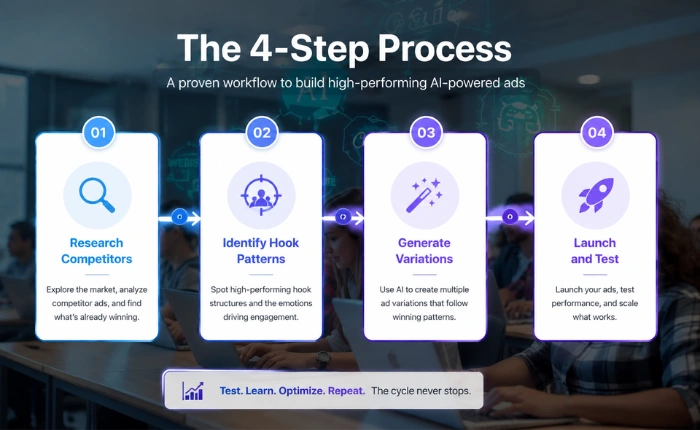
This is the sequence that closes the CTR gap:
- Filter by category and sort by longevity. Use AdsGPT’s 500M+ ad database to surface competitor creatives that have been running for 60+ days in your niche. These are statistically more likely to be performance-confirmed than ai ads that launched last week.
- Identify the hook structure in the first three seconds. Watch the opening of each video or scan the first line of each static. Map it to one of the four patterns: pain acknowledgment, curiosity gap, transformation promise, or UGC-style opener. You’re not copying the creative , you’re extracting the structure.
- Generate multiple variations built around that framework. Now prompt the AI. Feed it the hook pattern, your brand voice, and your offer. The AI generates into a structure that already has a track record, not into empty space. Use Ad Factory to produce image ai ads, UGC videos, B-roll clips, and AI avatar ai ads in batch from a single prompt.
- Produce UGC-style ai ads without a shoot. UGC Video Ads convert up to 4× better than polished brand content, and a single UGC shoot could run thousands of dollars with additional design approval backlogs. AI Avatar ai Ads replace the shoot entirely , creator-style video with no coordination, no editing delays.
AdsGPT’s own data suggests a marketer can go from zero context to a clear picture of dominant hook patterns in under 30 minutes, and from there to a week’s worth of test creatives in under an hour. That’s not a marginal efficiency gain. That changes how many ideas you can test per week, which is ultimately what drives performance improvement.
Also read –
The Competitor-Remix Method for Faster Winning Ads
Ad Creative Fatigue Is a Production Problem
Why Volume Without Structure Still Fails
This is what I’d push back on with most growth teams. The reflex is to ship more. Ten creatives a week becomes fifty. Then a hundred. But if none of them are built on a validated hook structure, you’re just generating more evidence that AI ads underperform. The platform algorithm doesn’t distinguish between thoughtfully generated creative and rushed output; only the audience does, in the first three seconds.
Five creatives built on proven hook patterns will outperform fifty prompts written at 11 pm with no competitive context. Every time.
What Scaling Actually Looks Like
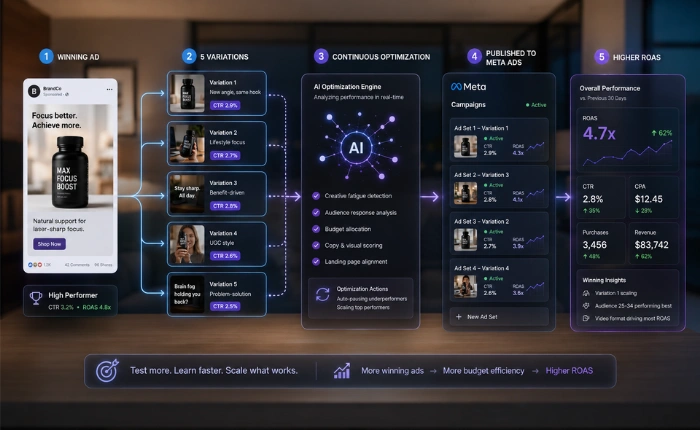
Once you have a winning creative, something with early positive signals, the move isn’t to pause testing and run it until it dies. It’s to use AdsGPT’s Click Recreate function to generate five fresh variations on the winner while it’s still performing. You maintain the hook structure, the emotional register, and the format that’s working. You change the surface: different opening line, different visual angle, different avatar voice.
This is also where the 50% reduction in prototype-to-launch time that teams using AdsGPT have reported becomes meaningful. Faster iteration isn’t just cheaper; it means your winning creative isn’t exhausted before your next test is ready to replace it.
For teams running Meta ai ads directly, AdsGPT’s Autopilot feature audits and optimizes live Meta campaigns continuously, with an undo log , so you’re not flying blind between check-ins. Combined with the ability to publish directly to Meta without leaving the platform, the gap between “creative is ready” and “creative is live” collapses.
Check this for more
The Input Problem Is Solvable
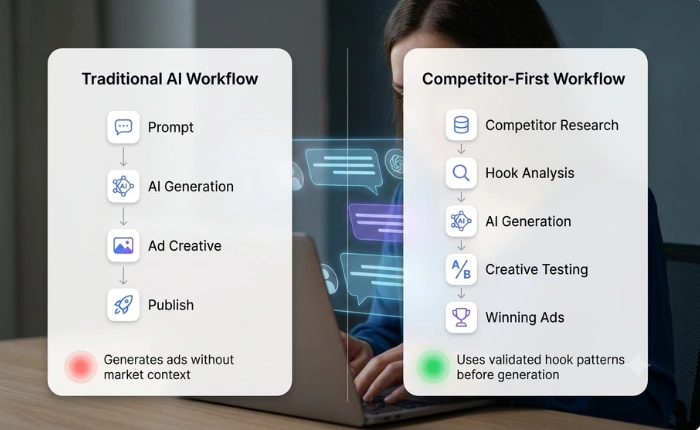
That CTR gap is real. But it isn’t a verdict on AI creative; it’s a verdict on AI creative generated without competitive intelligence, without hook structure, without the inputs any experienced human creative would bring to the brief. The 1.8% versus 2.9% split measures what happens when you skip that foundation, not what AI is capable of when you don’t.
Fix the inputs, and the output changes.
Start with what’s winning in your category. Extract the hook pattern. Generate into a proven structure. Test UGC-style formats that your audience already responds to. Scale what works before it exhausts. That’s the workflow that makes the gap close, not a better prompt, and not fifty more creatives per week.
If you want to understand how AI-powered competitor ad insights feed into a full creative strategy, that’s a good next read. And if you’re evaluating tools, the breakdown of how AdsGPT compares to other AI ad generation tools covers the key differences in workflow and output depth.
The free plan includes 35 creatives with no credit card required, enough to run the four-step process above and see whether your hook research actually changes the numbers before you commit to anything. Start your first competitor research session on AdsGPT and find out what’s actually winning in your category.
MOST POPULAR