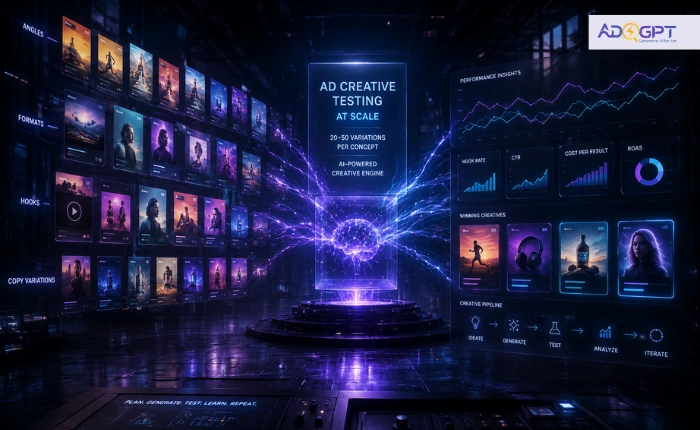
Ad creative testing is the single most powerful lever in paid media, yet most teams test three headlines, pick a winner, and move on. That’s why their CPA plateaus. This playbook shows you how to run structured creative tests at volume 20 to 50 variations per concept without blowing your budget or your weekend, and where a tool like AdsGPT, the AI ad-creative generator built around brief-in, tested-copy-out, removes the production grind entirely.
Why small creative tests quietly cap your results
Meta’s ad delivery now runs through Andromeda at the retrieval stage, and GEM in the auction, and both systems evaluate creative by an internal quality signal that rewards variation. When you feed the algorithm four near-identical ads, it has nothing to differentiate across audience segments. It averages out. You stall at an average CPA.
Accounts that compound their growth on Meta consistently name creative volume and creative-to-account-structure fit as the two non-negotiable levers. Not mysterious. But the execution bottleneck is real, and it starts with the brief.
The reason teams don’t scale ad creative testing is obvious: writing, designing, and trafficking 30 variations by hand takes days. The workflow, not the ambition, is the constraint.
The 4-layer Ad creative testing framework
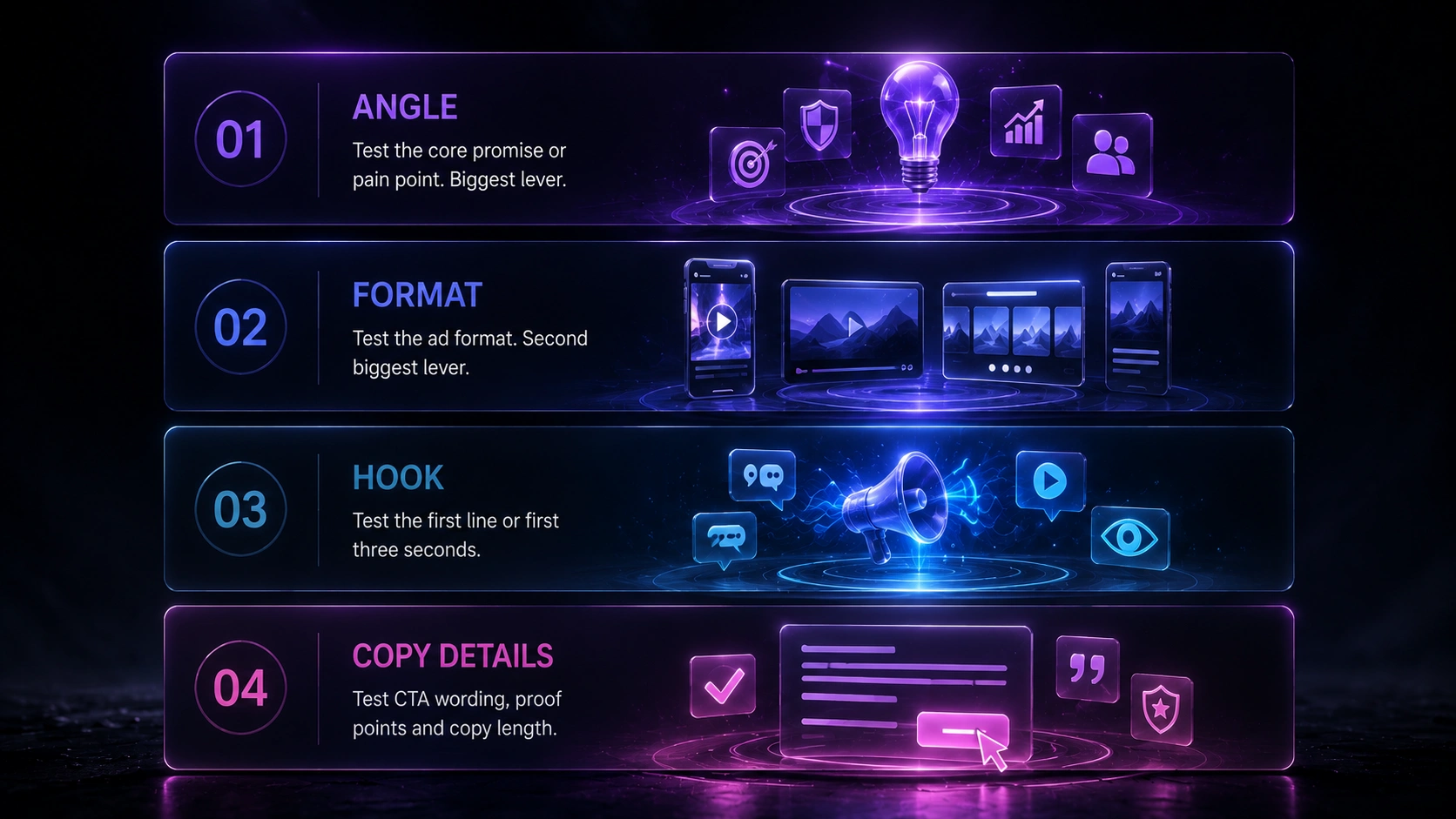
Effective ad creative testing starts with one principle: don’t test “ads.” Test one variable at a time, in order of impact. Changing the headline and the image, and the offer simultaneously tells you nothing about which one moved the needle. Work through these four layers from biggest to smallest:
- Angle the core promise or pain point (“save time” vs “cut cost” vs “avoid risk”). This is your biggest lever by a wide margin, and the one most teams skip straight past.
- Format tatic vs video vs carousel vs UGC-style. Second biggest lever, and increasingly shaped by where generative AI is heading: nearly 90% of advertisers plan to use generative AI to build video ads, per the IAB’s 2025 Video Ad Spend & Strategy report.
- Hook the first line or the first three seconds that stop the scroll.
- Copy details CTA wording, proof points, and length. The smallest lever is where most people wrongly start.
A clean test plan: pick 5 angles, write 3 hooks per angle, and you have 15 creative directions before you touch a single word of body copy. That’s your test batch. For a deeper look at how those elements come together visually, see our guide to what makes ad creative actually work.
How to size a test so results are real.
Every ad creative testing experiment needs enough data to be trusted. Wait for enough conversions that the result is statistically meaningful for your funnel’s conversion rate and for enough impressions that frequency effects aren’t distorting early numbers. Underpowered tests are worse than no tests. They hand you false winners you’ll scale into losses. If your daily budget can’t feed 15 variations to significance in 7–10 days, test fewer at a time, not sloppier. Our A/B testing checklist has a budget-sizing table worth bookmarking for this step.
Where the time actually goes and how AI collapses it
Map a manual creative sprint, and the hours pile up fast in production, not strategy. Writing 15 hook + headline + primary-text combos. Adapting each to platform character limits and specs. Second-guessing, rewriting, getting sign-off. That’s a full day before anything goes live, and it scales linearly with every additional variation you want to test.
This is the exact slice AI-powered ad creative generation is built to remove. In AdsGPT, you fill in the brief fields: your product or service, the audience you’re targeting, the specific angle you’re testing, and the tone for your ad creative testing. AdsGPT returns platform-ready ad copy headlines, primary text, and CTAs already fitted to the channel specs you’ve selected, whether that’s Meta, Google, or LinkedIn. Need video formats? The UGC Video Ads and AI Avatar Ads features generate talking-head and spokesperson creatives from the same brief, so a format test doesn’t mean a separate production workflow. Users running this way report 80% lower production costs versus a traditional agency workflow, which is the difference between running one creative test per month and running one per week.
The discipline of naming one angle per brief is what forces the creative to be testable. A brief, scoped tightly to one promise,e produces copy variations that genuinely differ from each other in the argument they make, not just in surface wording. That’s what separates output that converts from generic copy that reads as if a committee wrote it. Vague brief in, vague ads out. The brief is the work.
For a practical breakdown of how AI creative tools compare in real workflow terms, the AI ad creative generator guide is worth reading alongside this playbook.
A step-by-step weekly Ad creative testing loop

Here’s a cadence that compounds. Run it every week, and your account improves systematically:
- Monday plan. Pick one layer to test (start with the angle). Choose 5 directions. If you want to ground those angles in what’s already working in the market, AdsGPT’s competitor research pulls from a 500M+ ad database, so you’re not guessing at angles, you’re remixing proven ones.
- Monday generate. Brief AdsGPT once per angle; pull 3 variations each. Fifteen ads, in minutes. This is the step where the workflow stops being theoretical.
- Tuesday afternoon. Load all 15 into one campaign, even budget, let the platform distribute. Don’t hand-pick favorites; your intuition is the thing you’re trying to replace.
- Through the week, leave it alone. Resist the urge to kill ads on day two. Early numbers lie.
- Following Monday, read and rotate. Pause the underperformers. Take the top 2–3 angles into a new hook or format test. Winners become next week’s control.
Each week’s winner defines the next week’s baseline, so you’re always testing against your current best, not starting from zero. The teams building this habit now will have a real head start. Research from the California Management Review (UC Berkeley, 2025), examining a leading media advertising agency’s shift to generative AI for digital ad creation, finds that the integration restructures creative workflows at the team level, not just individual output speed. The loop above is that restructuring made concrete.
Metrics that tell you what to keep
Judge creative on the right layer of the funnel:
- Hook rate (3-sec views ÷ impressions) tells you if the opening works. According to the Motion Creative Benchmarks 2026 report, advertising functions as a science of prediction, isolating variables like the opening frame, which lets you pinpoint what’s failing before you rewrite anything else. Fix the first frame before touching a single headline.
- CTR tells you if the promise is compelling enough to act on.
- Cost per result is the only verdict that pays the bills. Accounts running structured creative tests with AdsGPT have documented 4.8× higher ROAS from their winning creatives within six weeks which is what happens when the Ad creative testing loop is tight enough to actually surface winners rather than just burn spend.
A high-CTR ad with a bad CPA is a scroll-stopper that attracts the wrong people. Cut it. A modest-CTR ad with a strong CPA is a quiet winner. Scale it. The combination of hook rate + CPA is what separates a real creative signal from platform noise. Use both together before making any kill decision.
Three mistakes that waste test budget
Testing too many variables at once. You can’t attribute the result. One layer per test, always.
Calling winners too early. Day-one CTR is noise. Wait for the volume before you touch anything.
Never retiring winners. Even great creative fatigue as frequency climbs. Creative fatigue is described as the single biggest silent killer of paid media performance in 2026 by Darkroom Agency’s performance Ad creative testing research, and by the time it shows up in your CPA, you’ve already wasted spend defending an ad that’s done. Keep the pipeline full,l so the next challenger is ready before fatigue surfaces in the data.
Turn Ad creative testing from a chore into a system
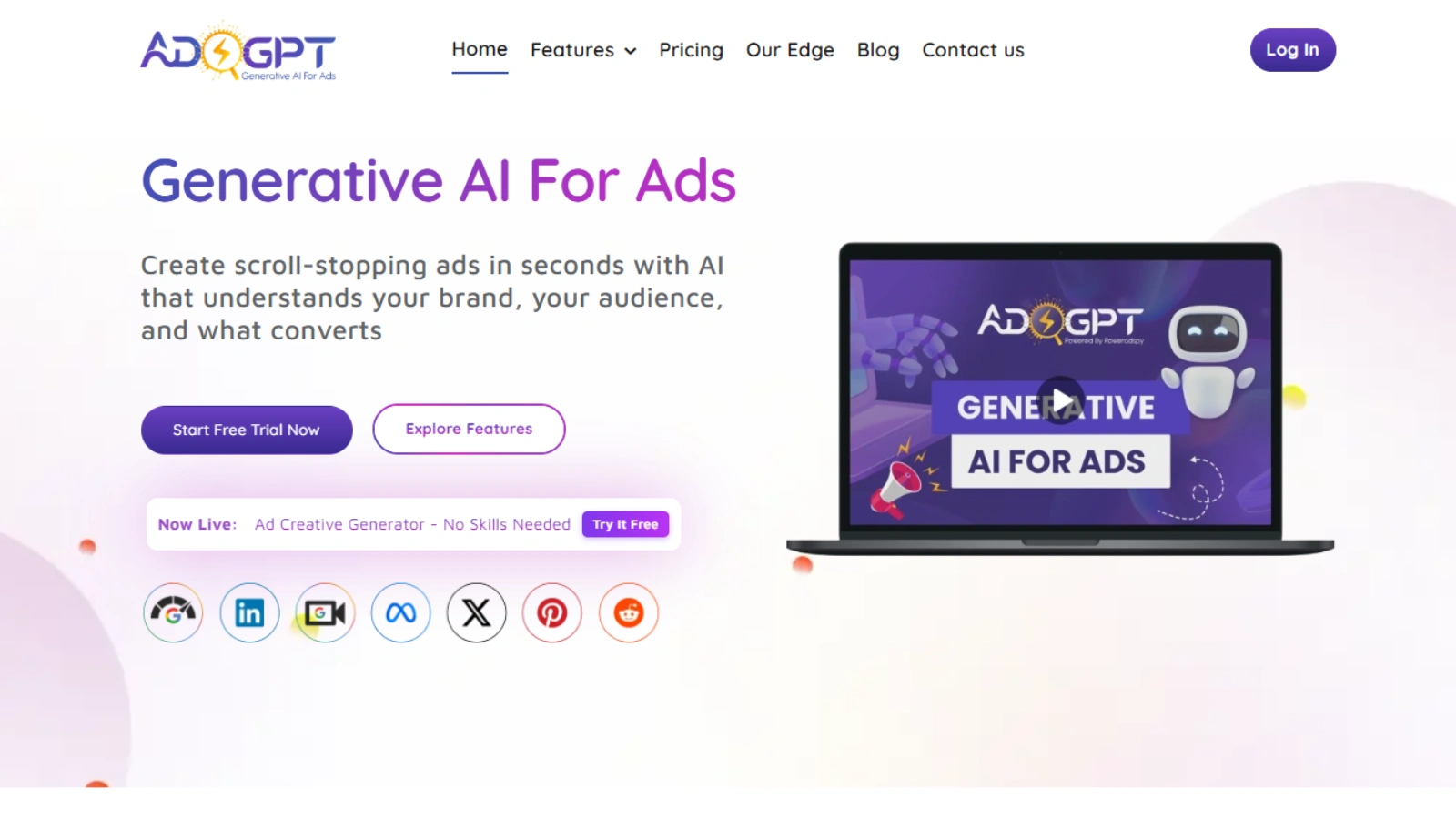
The teams that win aren’t the ones with the cleverest single ad. They’re the ones with the fastest Ad creative testing loop. When producing 15 fresh, on-brief variations takes minutes instead of a day, Ad creative testing at volume stops being aspirational and becomes your default operating rhythm.
That’s the actual job AdsGPT does. Feed it a brief per angle, get platform-ready copy back across static, video, UGC, and avatar formats, and run the weekly loop above without drowning in production. Over 10,000 marketers have now generated more than a million ads on the platform, doing exactly this. The bottleneck stops being volume and starts being your read on what the data is telling you, which is where your attention should have been all along.
Start your free AdsGPT trial and run your first 15-variation creative test this week.

MOST POPULAR