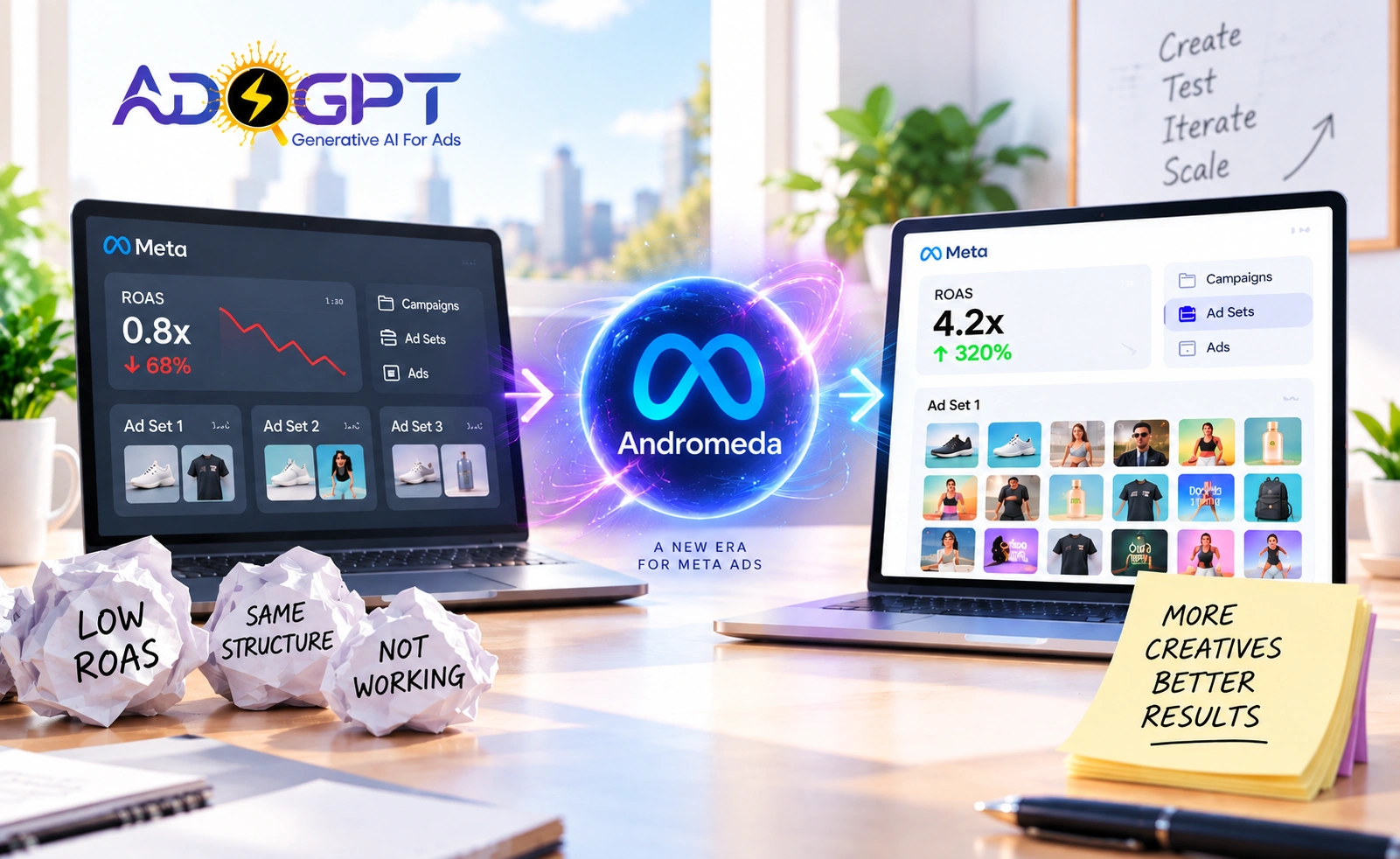
Mid-2025, thousands of Meta advertisers watched their ROAS collapse without touching a single setting. The campaigns hadn’t changed. The budgets hadn’t changed. Something else had.
That something was Andromeda, Meta’s sweeping AI overhaul of how its delivery system reads, ranks, and allocates spend across creatives. As one media buyer put it in a now-viral post: ads that were working just weren’t working anymore. If you’re still running the account structure you built in 2023 or 2024- multiple tightly-defined ad sets, each holding two or three creatives- you are actively fighting the algorithm instead of feeding it.
Here’s the counterintuitive truth most brands haven’t accepted yet: you need fewer ad sets and dramatically more creatives per ad set. And that changes everything about how fast you need to produce creative.
Why Your Old Structure Is Starving the Algorithm
The pre-Andromeda playbook made sense at the time. Separate audiences into separate ad sets. Keep creative volume low so you could read results cleanly. Let the winning audience scale.
Andromeda flipped that logic. Research aggregated from advertisers who adopted Andromeda best practices puts the optimal creative load at 15–20 creatives per ad set, with a learning phase of 7–10 days. When you split budget across five to ten ad sets, each ad set gets too few conversion events to optimize. The signal the algorithm needs to learn- which creative, which audience segment, which placement- stays fragmented across too many containers, and the system never builds enough momentum to exit the learning phase cleanly.
The result looks like underperformance. You assume the creative is bad and swap it out. Nothing improves. What’s actually broken is the structure.
The Creative Volume Problem Nobody Talks About
Consolidating into one broad ad set sounds simple. It isn’t; the moment you do it, you’ve committed to maintaining 15+ creatives in rotation and cycling them actively, not just refreshing once a quarter.
This is where most DTC brands hit a wall. Most ads fatigue within 7–14 days. The algorithm allocates the majority of spend to a top creative; frequency climbs, engagement falls, cost per result rises. With small audiences, burnout arrives even faster. Here’s the math you have to accept: one broad ad set, minimum 15 creatives, fatigue cycle of 7–14 days. You need new assets every week.
Format mix matters too. Static images, B-roll clips, and UGC-style video each fatigue at different rates; rotating across formats is a meaningfully different lever than swapping one static for another. At a traditional agency cadence, that volume is either prohibitively expensive or physically impossible. Which is exactly why brands are rebuilding their production stack around AI.
What an Andromeda-Ready Creative Workflow Actually Looks Like
AdsGPT was built for exactly this problem, not the one-off creative request, but the ongoing, high-cadence production demand that modern Meta campaigns require. The workflow that fits the Andromeda structure best involves three repeating steps.
Step 1: Source from What’s Already Winning
Don’t start from a blank brief. Use the Competitor Intel database, which covers 500 million+ ads across platforms, to find what’s already converting in your category. Search by niche, filter by platform, identify patterns in format and hook type. Then use the one-click remix feature to pull a competitor’s structure and rework it for your brand in seconds. You’re not copying; you’re starting from a proven signal instead of a guess. Our post on how a DTC brand reverse-engineered competitor hooks shows exactly what that diagnostic looks like in practice.
Step 2: Generate Across Formats in Batch, Not One at a Time
A single prompt in Ad Factory can produce image ads, UGC Video Ads, B-roll clips, and AI Avatar Ads simultaneously. This matters because Andromeda rewards creative diversity within an ad set. Feeding it five static variations of the same visual concept is not the same as feeding it a static, a UGC-style video, and a B-roll clip. The algorithm has genuinely different signals to work with.
On UGC specifically: the efficiency gap is stark. One documented case from 2025 Meta advertisers showed an iPhone-shot testimonial driving an $8.34 CPA against a $31.20 CPA from a polished professional ad. AdsGPT’s own platform data puts UGC Video Ads at up to 4× better conversion than polished brand content. The format most brands historically underproduced because it was expensive to source can now be generated in the same batch workflow as static images.
The structural shift this enables is real. The same media buyer community reporting the Andromeda disruption also documented a client moving from 1.8 ROAS to 4.2 ROAS in 21 days after abandoning segmented ad sets in favour of broad targeting with creative volume. Accounts that fully adopted these practices saw an average +31% ROAS improvement and -24% reduction in CPA. The algorithm needs options, and it needs them across formats.
Also Read!
Marketing Benchmark 2026: We Tested 13 AI Models To Find The Best One For Your Campaigns
Step 3: Scale What’s Working, Fast
Once Andromeda identifies a winner, which it will faster because your ad set now has enough signal volume, you need to move quickly. The Click Recreate function generates five fresh variations from a single winning creative in one click. Different hooks, different formats, same underlying concept the algorithm already validated. That’s how you scale a winner without starting from scratch.
Sized-to-spec exports for eight platforms mean no manual resizing before pushing live. For Meta specifically, you can pick a creative, attach a CTA, and publish a live Meta ad without leaving the platform. See our breakdown of Meta ad formats and sizing requirements if you’re still reconciling legacy dimensions.
The Autopilot Problem: You Can’t Watch 15 Creatives Manually
Nobody mentions this in the “run more creatives” advice: monitoring 15+ creatives across a live campaign manually is genuinely hard. Most growth marketers catch creative fatigue during a weekly review, by which point the algorithm has already allocated the majority of spend to the fatigued creative and costs have climbed.
AdsGPT’s Autopilot runs continuous audits on live Meta ads and flags performance shifts in real time. The undo log matters here. Automated optimization is only trustworthy if you can reverse a bad call without rebuilding the ad set from scratch; that’s the difference between a system you trust and one you’re afraid to turn on.
The Mistake That Cancels Out All of This
One warning before you go wide on creative volume: quantity without concept discipline is actively harmful. Flooding an account with loosely related variants dilutes the learning signal, reduces audience recognition, and produces ten mediocre creatives competing against each other instead of one winning concept scaled intelligently.
The Andromeda-era playbook isn’t “produce as many creatives as possible.” It’s “produce enough high-quality, format-diverse creatives from a strong concept that the algorithm has real options to work with.” That distinction separates accounts that recovered after Andromeda from accounts still troubleshooting.
The economics have shifted enough to make this sustainable. AdsGPT platform data shows 80% lower production cost versus a traditional agency workflow, a figure that reflects the removal of per-asset design, copywriting, and video editing fees. Weekly creative refreshes are no longer a budget reserved for eight-figure advertisers. If you want to see how creative fatigue compounds costs over time, the numbers make the case for building this infrastructure now rather than when performance has already eroded.

What to Do This Week
If your Meta campaigns haven’t recovered since mid-2025, the diagnostic is straightforward. Check whether your conversion volume per ad set is high enough for the algorithm to exit the learning phase. Count your active creatives per ad set. If you’re running seven ad sets with three creatives each, you’re splitting the signal the algorithm needs to consolidate.
Consolidate to one or two broad ad sets. Build your creative library to 15+ assets across at least three formats: static, video, and UGC-style. Use Competitor Intel to source your angles, generate in batch via Ad Factory, and let Autopilot flag fatigue before your weekly review catches it.
Accounts running this structure are seeing an average 4.8× ROAS within 60 days, per AdsGPT platform data. They’re not running smarter targeting. They’re running more creative, faster, with a structure that feeds the algorithm what it actually needs.
The free plan covers 35 creatives with no credit card required, enough to restructure your first broad ad set and run your first proper Andromeda-aligned test before the week is out.
Start your free AdsGPT trial and build your Andromeda-ready creative library today.
MOST POPULAR