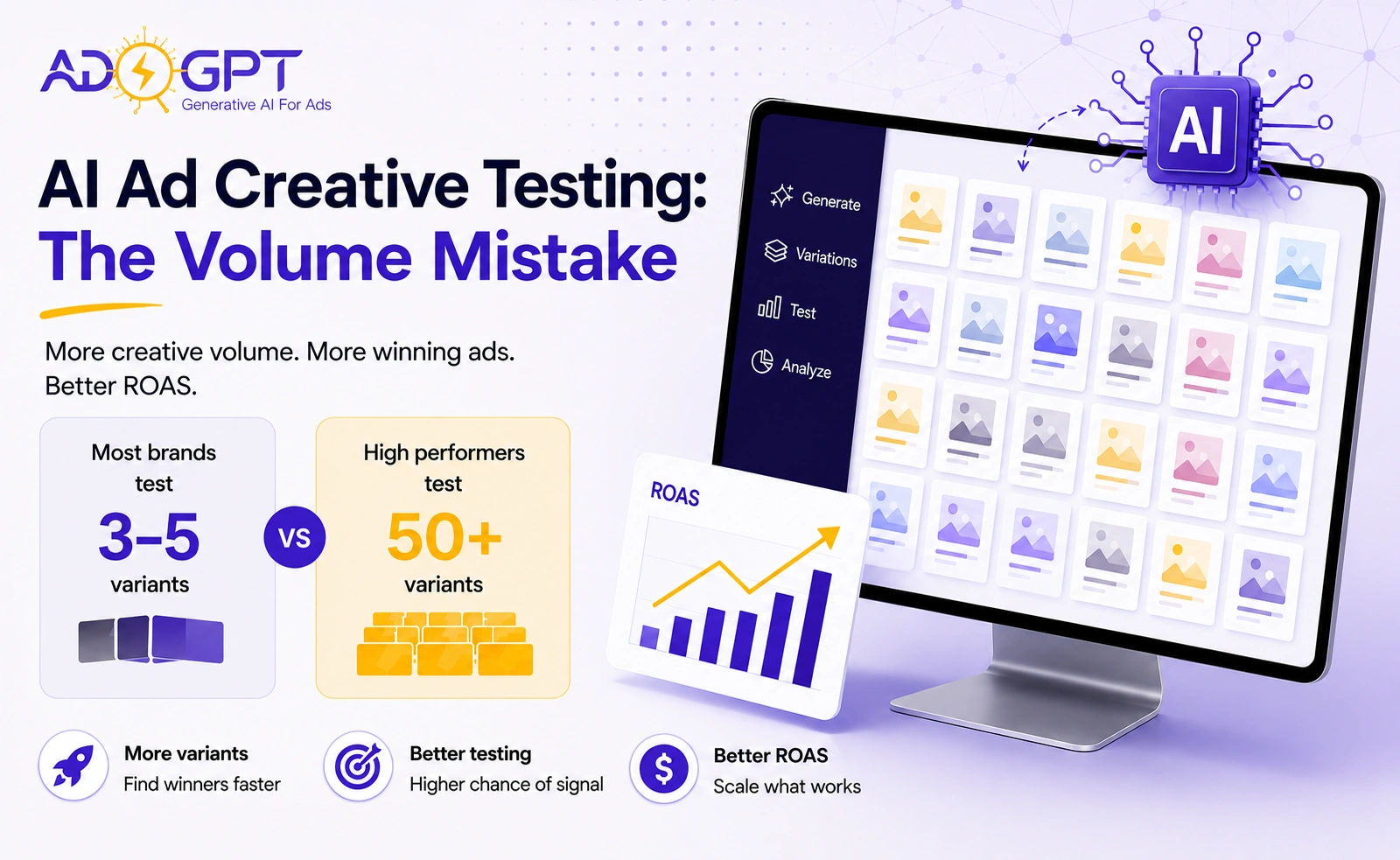
AI-generated ads don’t outperform human-made ads because the AI is more creative. They win because a team using AI Ad Creative ships ten versions in the time a traditional workflow ships two. Volume is the mechanism, and the platforms reward whoever finds signal fastest.
Most marketers haven’t internalised that. They’ve swapped their designer for an AdsGPT subscription, generated three banner variants, and called it “AI-powered testing.” That’s not a testing program. That’s cheaper production with a worse feedback loop.
If you’re generating fewer than fifty variants per campaign cycle, you’re not testing. You’re guessing with extra steps.
In a hurry? Listen to the blog instead!
Why Volume Is the Actual Variable
The math on creative testing is merciless. A modest multivariate grid, 5 hooks × 4 headlines × 3 visuals × 2 CTAs × 3 aspect ratios, produces 360 variants before you’ve touched a single localization. Add one language, and you’re near 720. That is the real competitive surface area for a campaign that earns meaningful signal.
Nobody runs 720 variants manually. The production bottleneck compresses the test to whatever the team can turn around in a week; a single in-house video concept can run six to twelve hours to script, shoot, and edit. You end up with five AI Ad Creative, ship them, call the winner, and scale it into fatigue within three weeks.
Teams running genuine volume-first programs operate in a different category entirely. Enterprise-scale platforms have logged 494,000 ads launched across 71,950 batches in a single month, saving teams roughly 37,087 hours of manual work. That’s not a marginal efficiency gain; it’s a structurally different way of finding winners. And creative fatigue accelerates the moment you do find a winner, which makes the next round of testing an immediate priority, not an optional follow-up.
What the ROAS Data Actually Tells You
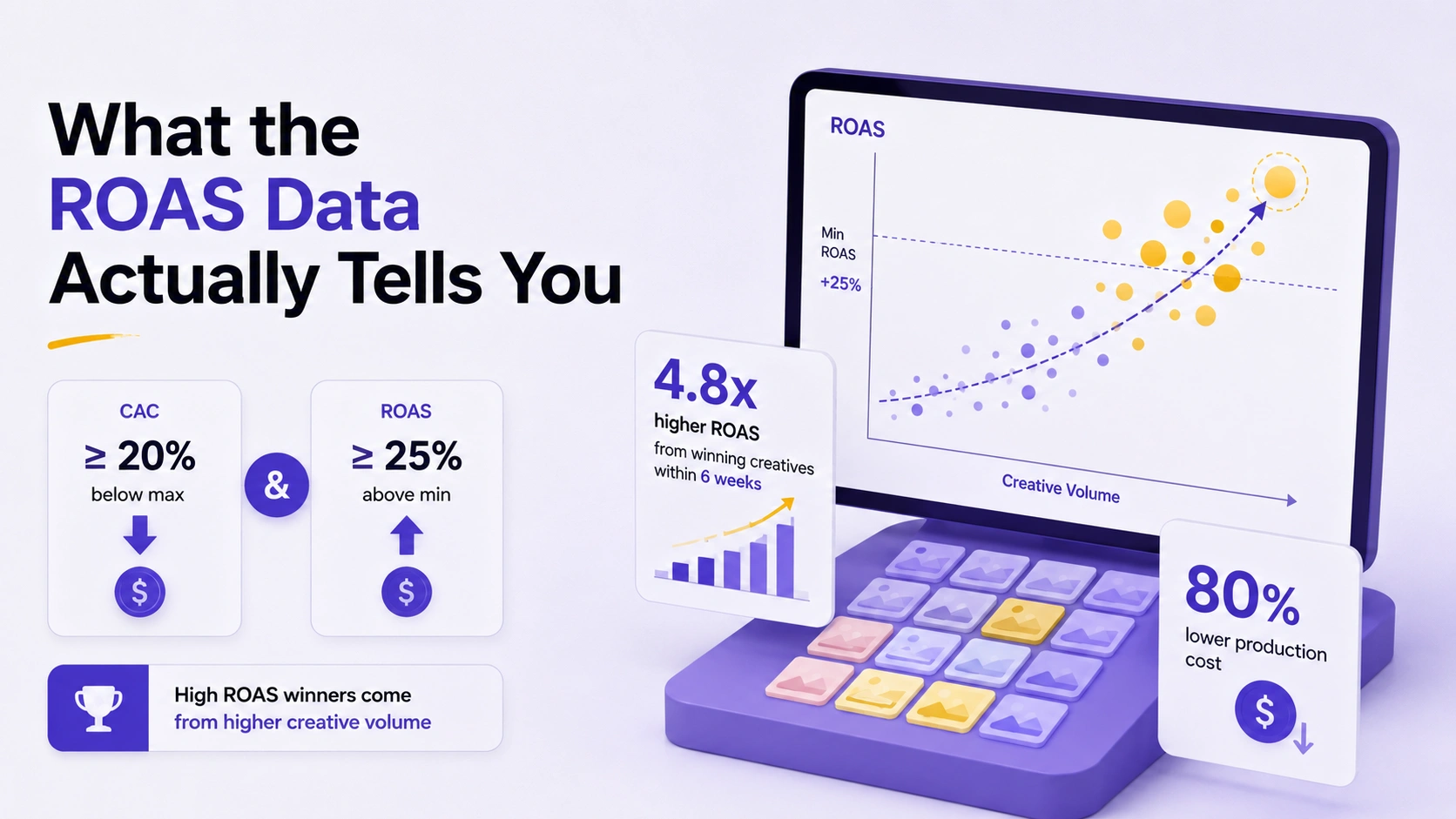
Two numbers define whether a creative is worth scaling: CAC at least 20% below your maximum allowable and ROAS at least 25% above your minimum threshold before you commit budget. Everything else is noise. The problem is that finding creatives that clear both bars requires generating enough variants actually to encounter them, and most five-variant tests never do.
AdsGPT’s platform data shows 4.8× higher ROAS from winning creatives within six weeks, averaged across accounts after 60 days. That trajectory makes sense when you understand the mechanism: more variants per cycle means higher probability of encountering a creative that clears both kill criteria. Six weeks is roughly three creative cycles. Three cycles of genuine volume testing surfaces signal that a three-variant test never finds.
The cost efficiency compounds. At 80% lower production cost versus a traditional agency workflow, the cost-per-winner metric shifts fundamentally. Cost-per-winner, total testing spend plus total production costs divided by the number of winning creatives found, is the number that shows whether a testing program is actually working. Lower production cost per variant means more variants for the same budget, which finds more winners, which brings cost-per-winner down further. That’s the compounding effect volume creates.
Also Read!
The Framework: Volume-First Creative Testing
Here’s the workflow, built around what AdsGPT actually does rather than how most people use it.
Step 1: Start With Competitor Signal, Not a Blank Brief
Don’t open a prompt and start inventing angles. Pull from the 500M+ competitor ad database, filterable by brand, region, and platform. Search for your category. Find what’s already running long enough to have survived budget scrutiny. One-click remix the strongest performers for your brand.
This isn’t copying. It’s pattern-matching on proven structural elements, hook formats, visual treatments, offer framing , before you invest in generating volume. You’re starting the test at a higher floor. For more on reading competitor creative effectively, this breakdown of competitor ad creative strategy is worth twenty minutes before you run your first search.
Step 2: Generate in Batch, Not One at a Time
This is where most teams leave performance on the table. AdsGPT generates ads in bulk from a single prompt; that output volume should restructure your weekly creative rhythm entirely. Instead of briefing one concept and waiting for revisions, you feed a well-structured brief and immediately have a testable pool.
Ad Factory handles this across formats simultaneously: image ads, UGC-style videos, Product B-roll Video with motion cues, and AI Avatar Ads, from one input. That matters because UGC Video Ads convert up to 4× better than polished brand content, yet they’re the format most teams produce least often because production friction is high. Batch generation removes that excuse.
Before you generate, get your inputs right. AdsGPT’s generation flow asks for four things: product or service name, a short description, key features or benefits, and target audience. Sloppy inputs produce sloppy batches. Spend ten minutes on the brief; it compounds across every variant you generate.
Step 3: Export Sized-to-Spec, Launch Fast
The friction between “generated” and “live” is where creative velocity dies. AdsGPT exports creatives sized-to-spec for eight platforms- Facebook, Instagram, LinkedIn, YouTube, Google, TikTok, and more- with auto-adjusted aspect ratios, text limits, and safe zones. Export the full batch, drop into your ad manager, push.
For Meta specifically, the loop is tighter: pick a creative, add a CTA, and publish a live Meta ad without leaving AdsGPT. That direct-launch integration removes the export-import-upload cycle entirely. Small in isolation. Significant when you’re pushing a hundred variants.
Format discipline matters here. Instagram Stories, LinkedIn banners, YouTube pre-rolls, TikTok clips- each format carries different creative rules, and spec mismatches kill otherwise strong ads invisibly until the ad is live and bleeding budget. Sized-to-spec export eliminates that category of failure.
Step 4: Feed Winners Back Into the System
This is the step that separates a testing program from a testing experiment. When a creative wins, don’t just scale the budget. Click Recreate and generate five fresh variations from that winning structure. The winning creative tells you something specific about what your audience responds to: a hook format, a visual angle, an offer frame. Generate variations that preserve that signal while rotating the elements that fatigue fastest.
Run Autopilot to have the AI audit and optimise your Meta ads continuously, with an undo log so nothing irreversible happens without visibility. Volume testing combined with continuous optimisation is what produces stable CPAs across cycles, not a single lucky creative.

What Volume-First Testing Won’t Fix
Worth saying clearly: generating 360 variants of the wrong strategy doesn’t help. AI handles the production step, resizing, reformatting, and batch asset creation. It doesn’t replace the strategy step: deciding which angle to test, which offer to surface to which audience, which format pattern to challenge in your category.
Volume-first testing assumes you’ve already done the thinking about what variables matter. If your five-variant tests are underperforming because the offer is wrong, shipping 360 variants of the wrong offer generates expensive noise. Start with the competitor research. Form a hypothesis about why a format or angle is working in your category. Then generate at volume to find the best expression of that hypothesis.
The platform is the accelerant. The strategy is still yours.
Getting Started Without Burning Budget on Setup
If you’re new to volume-first testing, the free plan includes 35 ad credits with no credit card required. That’s enough to run a real batch and see what the output looks like against your brand. The Creator plan at $99/month for 1,250 Ad Credits is where sustained testing programs typically live for solo operators and small teams. Agencies and growth teams running daily creative cycles tend to need the Growth or Scale plans.
The test worth running in week one: take your current best-performing AI Ad Creative, use it as the reference for a competitor search, pull the structural elements, and generate a full batch. Compare those variants to your current five-ad test. The CTR spread will tell you more about what’s actually driving performance in your creative than three months of incremental single-variant testing.
If you’re evaluating which AI Ad Creative tool fits your stack before committing, this guide on choosing the right AI ad creative generator in 2026 walks through the evaluation criteria without the vendor spin. And if you’re building the case internally for a volume-first approach, the full creative testing methodology breakdown covers the decision frameworks in more depth.
The teams winning on paid social right now aren’t the ones with better creative instincts. They’re the ones generating enough variants to find signal before their competitors do. Volume is the advantage. The tools to close that gap exist.
Start your free AdsGPT trial and generate your first batch today, no credit card required.

MOST POPULAR