Running ads as a solo founder is deceptively hard. On paper, it looks simple: write a headline, choose a visual with an AI image ad maker, target an audience, and launch. In practice, the real bottleneck is creative production.
New angles are needed constantly. Visuals go stale. Campaigns lose momentum. And when you’re handling product, support, sales, and growth on your own, waiting days for a designer or freelancer slows everything down.
That was the problem this founder was facing. He had a good grasp of targeting and copy, but he was only testing a few creatives at a time. By the time revisions came back, the campaign had already lost momentum. He knew the real advantage in paid social came from volume and iteration, but producing that volume manually was too slow.
Listen To The Podcast Now!
Why the Old Way Wasn’t Working
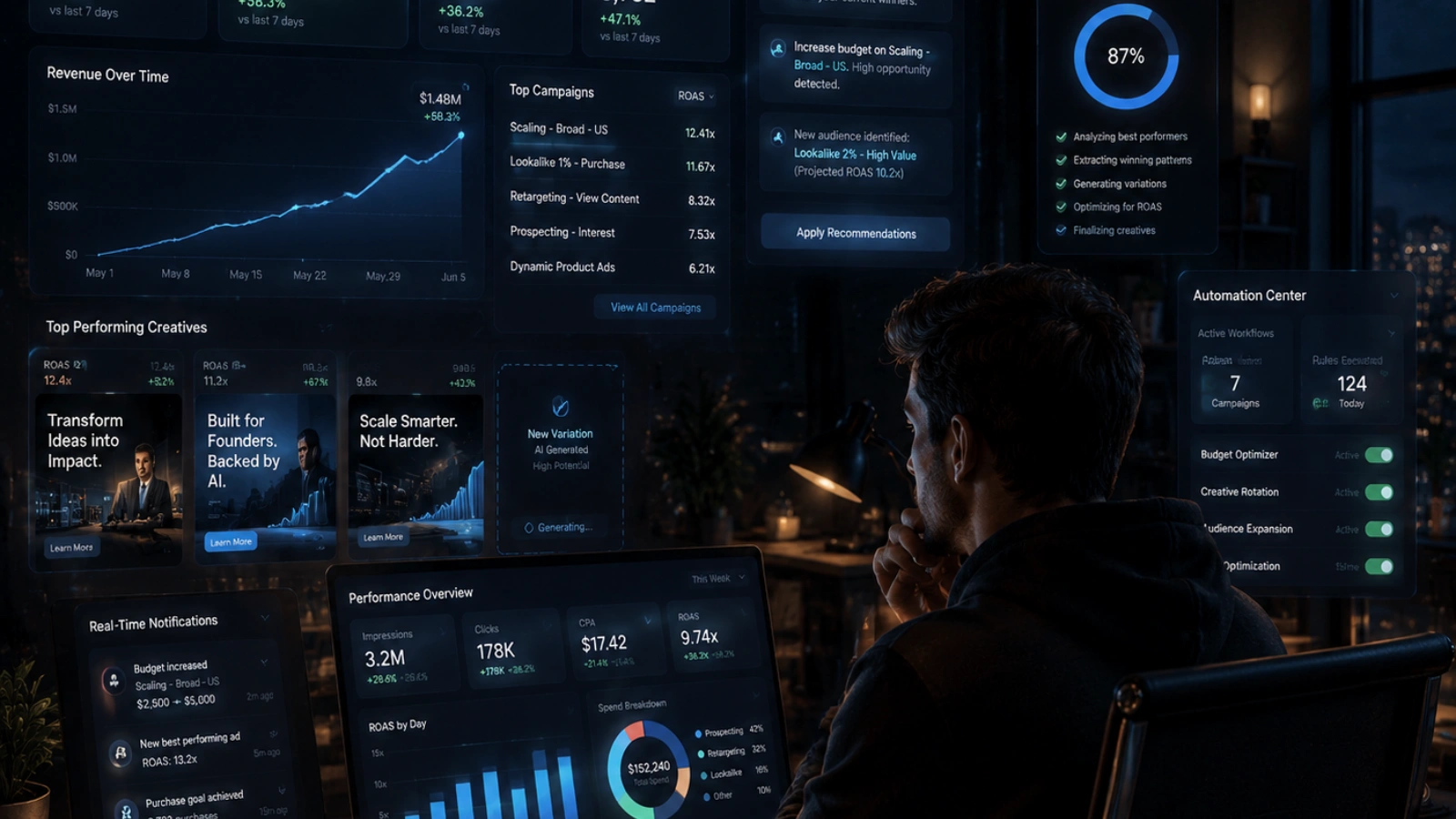
Before he found a better workflow, the founder tried the obvious fixes. He hired a freelance designer. He bought Canva templates. He tried batching his creative sessions into one big “production day” every two weeks.
None of it solved the real problem.
- Freelance workflow delays
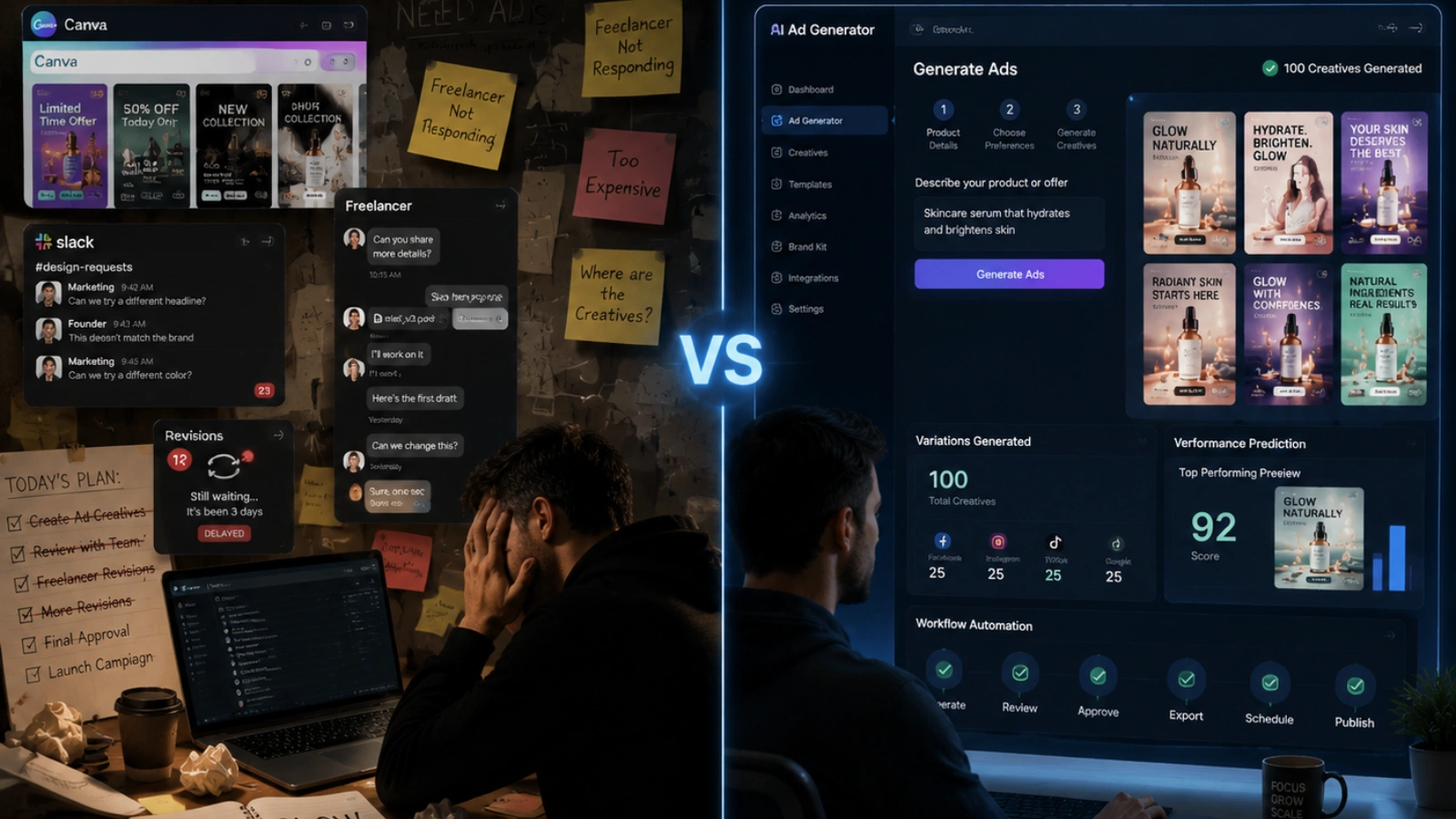
The founder hired a freelance designer and tried outsourcing creative work, but revisions took 2–3 days each time. Even small changes had to go back into a queue, causing ideas to lose relevance before launch. Without a fast image ad maker in his corner, every iteration felt painfully slow.
- Template limitations
Canva templates improved speed slightly but made ads look repetitive. Hooks became predictable, visuals lacked variety, and real creative experimentation was reduced. He wasn’t using an AI advertisement generator; he was manually assembling the same layouts over and over.
- Lack of a rapid testing system
The tools he used were not built for fast iteration. They worked like standard design software with minor AI features, making it difficult to generate multiple variations quickly for proper testing and learning. An image ad maker built for volume was nowhere in his workflow.
- High cost of experimentation
Many strong ideas were never tested because production took too much time, money, and effort. As a result, ad fatigue increased not due to a lack of ideas, but because slow execution couldn’t keep up. He needed an image ad maker that could match the pace of his thinking.
The Experiment: 100 Ads in 7 Days
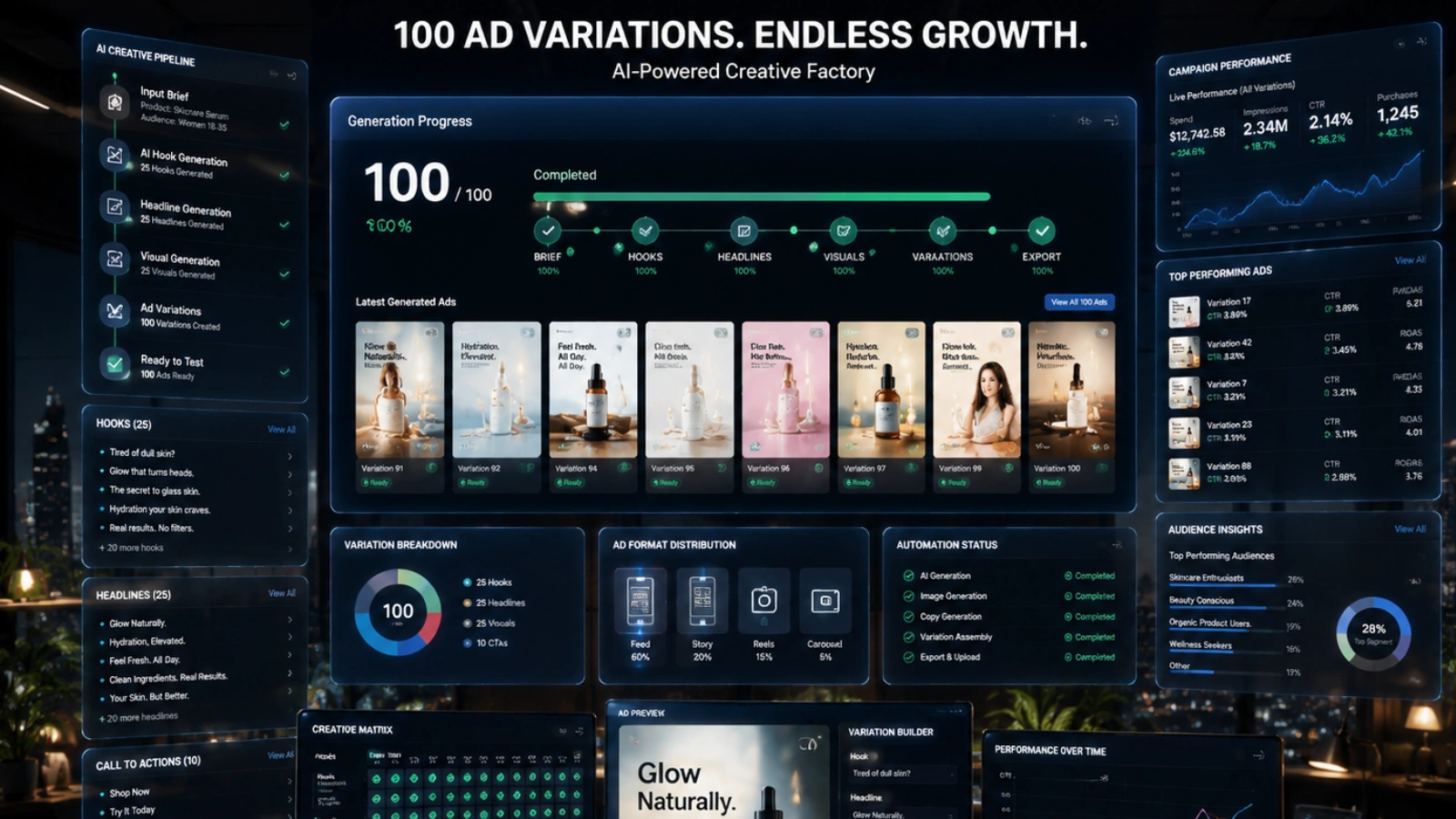
He decided to try a different approach. Over seven days, he set out to test 100 ad variations using AdsGPT as the creative engine.
He mapped out the variables he wanted to test: different hooks, headlines, visuals, and calls to action. Some versions leaned into curiosity. Others focused on a problem-first angle or social proof. The goal was not to make each ad perfect. The goal was to create enough meaningful variation to learn what resonated.
Instead of waiting days for each revision, he was able to generate and launch new creatives the same day. That faster loop changed the way he tested. He could compare multiple directions at once, spot early signals, and move quickly on the ideas that showed promise.
What Makes AdsGPT Different: Key Features
AdsGPT was used as a creative generation tool to speed up ad production and increase testing volume, rather than a performance optimization system.
Its role was to help convert a single idea into multiple testable ad variations quickly, enabling faster iteration during the campaign.
Key capabilities used in this workflow:
- High-volume generation of ad creatives from a single brief or input
- Multiple variations of hooks, headlines, CTAs, and messaging angles
- Platform-ready formats for Meta, Instagram, and other ad placements
- Fast iteration cycles, reducing creative production time from days to hours
- Support for multiple ad formats such as static image ads and video-style creatives
- Ability to quickly produce structured ad sets for A/B testing
Instead of replacing strategy, AdsGPT mainly acted as a speed layer for creative production, making it easier to test more ideas in less time.
The Turning Point
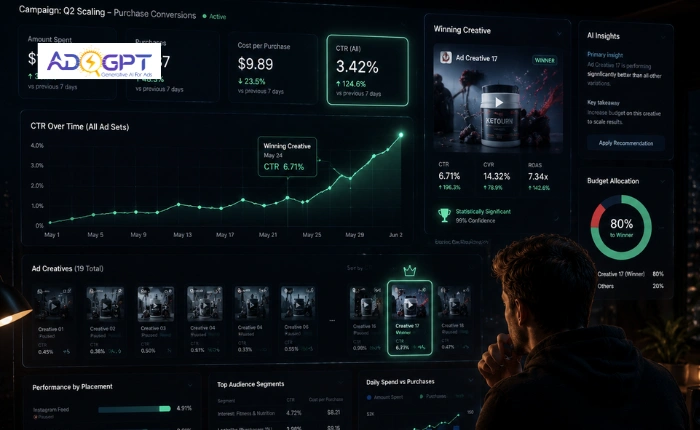
By day five, one variation began outperforming the others. The difference was clear enough to matter, even at an early stage.
What won was not the polished version he had expected. It was a simpler, more direct ad that spoke to a specific frustration in the audience’s own language. The visual was plain, the headline was straightforward, and the CTA was unremarkable. But it felt familiar to the people seeing it, and that made the difference.
That was the key lesson: creative testing often rewards clarity over cleverness. What looks refined to the founder is not always what feels most relevant to the audience.
Redrafted results section
After seven days, the experiment delivered three clear outcomes.
- He tested 100 creative variants across multiple hooks, visuals, headlines, and CTAs.
- He identified a winning ad with stronger engagement than previous campaigns.
- He reduced creative turnaround from days to hours, making future testing much easier.
Just as important, he ended the week with a repeatable process instead of a one-off win. The biggest value was not the single ad that performed best. It was the workflow that made the next test faster and smarter.
What the Data Taught Him
Looking back at the week, the founder pulled out the key patterns:
Specificity beats polish. The ads that named a real, concrete problem outperformed the aesthetically cleaner ads with vaguer value props. Audiences responded to recognition that’s exactly my problem more than to beautiful design. No image ad maker can replace this insight, but one can help you find it faster.
Volume created learning. He’d tested more creative angles in seven days than in the previous quarter. That volume wasn’t just about finding one winner; it changed how he thought about ad development entirely. Creative isn’t a single decision; it’s a process of discovery.
Speed reduced emotional attachment. When you’ve spent three days working with a freelancer on a single creative, you’re emotionally invested. You want it to work. When you can generate a variation in minutes using an image ad maker, you hold it more loosely, which makes it easier to kill what isn’t working and move on.
Patterns repeat. Once he understood why the winning ad worked, he could apply that logic across future campaigns. The seven-day experiment didn’t just find a good ad. It built a repeatable framework.
The shift wasn’t just about automation. It was about using ad creatives AI to test ideas at a scale that was simply impossible to do manually and letting the data surface insights that no amount of planning or intuition could have predicted.
The Results, Plainly Stated
After seven days:
- 100 creative variants tested across different hooks, visuals, headlines, and CTAs
- A clear winning creative identified — with measurable CTR lift over previous campaigns
- Faster campaign launches — production time dropped from days to hours.
- Stronger creative consistency — less dependence on a single freelancer’s availability
- A replicable testing framework — not just one good ad, but a system for finding the next one
None of this required a design team. None of it required an agency retainer. It required a structured approach to testing and the right image ad maker to remove the production bottleneck.
Also Read:
How to Use an AI Ad Maker to craft Personalized Ad Campaigns 5x Faster
How an EdTech Brand Replaced 3 Freelancers With an AI Ad Maker
The Real Competitive Advantage
The most valuable outcome from this experiment wasn’t the winning ad itself.
It was speed.
Not speed for its own sake, but speed as a mechanism for learning. When you can test faster, you fail faster, learn faster, and improve faster. The founders and marketers who win at paid social aren’t necessarily the most creative people in the room. They’re the ones who can iterate quickly enough to find what works before their budget runs out and before their competitors stumble onto the same insight.
For solo founders especially, that matters enormously. You can’t out-resource a company with a full creative team. But you can out-iterate them if you have the right workflow.
AdsGPT was a meaningful part of that workflow, not a magic solution, but a real multiplier. As an AI advertisement generator built specifically for testing at scale, it removed the creative production bottleneck that had been quietly limiting its ability to test, learn, and scale. Using ad creatives AI in this way gave him leverage that no freelancer arrangement or template library ever could. For founders who are serious about paid acquisition but don’t have the budget or bandwidth for a design team, having a dedicated image ad maker like AdsGPT is worth paying close attention to.
Seven days. One hundred variations. One winning pattern.
The ads didn’t get better because they got more polished. They got better because there were enough of them to find the truth.
Conclusion
The real advantage here was not automation for its own sake. It was speed as a learning tool.
When creative production gets faster, testing becomes broader, and learning compounds. For solo founders, that matters because they usually cannot outspend bigger teams, but they can out-iterate them. The founder did not need a design department to find a winning ad. He needed a workflow that let him test enough ideas to surface the right one.
Seven days. One hundred variations. One clear lesson: the best ads are rarely the most polished ones. They are the ones that reach the audience fastest and most truthfully.
FAQ
- What is an AI advertisement generator, and how does it work?
An AI advertisement generator is a tool that creates ad creatives using artificial intelligence. It generates variations of headlines, visuals, and messaging based on input prompts, helping marketers quickly produce multiple testable ads without manual design work. - How is an image ad maker useful for solo founders?
An image ad maker helps solo founders create ad visuals quickly without relying on designers or agencies. It enables rapid production of multiple ad variations, making it easier to test different hooks and visuals and identify winning creatives faster. - What are ad creatives’ AI tools used for in performance marketing?
Ad creatives AI tools are used to generate, test, and optimize multiple advertising variations at scale. They help marketers experiment with different hooks, layouts, and messaging styles, improving campaign performance through faster iteration and data-driven decisions. - Can AI-generated ad creatives perform better than traditional designed ads?
AI-generated ad creatives can perform better when the focus is on testing volume and speed rather than perfection. By producing multiple variations quickly, marketers can identify high-performing angles faster than traditional design-heavy workflows that limit experimentation. - Why is testing multiple ad creatives important in paid advertising?
Testing multiple ad creatives is essential because audience response is unpredictable. Running variations through tools like an AI advertisement generator allows marketers to discover winning combinations of copy, visuals, and hooks that drive higher engagement and conversions.
MOST POPULAR