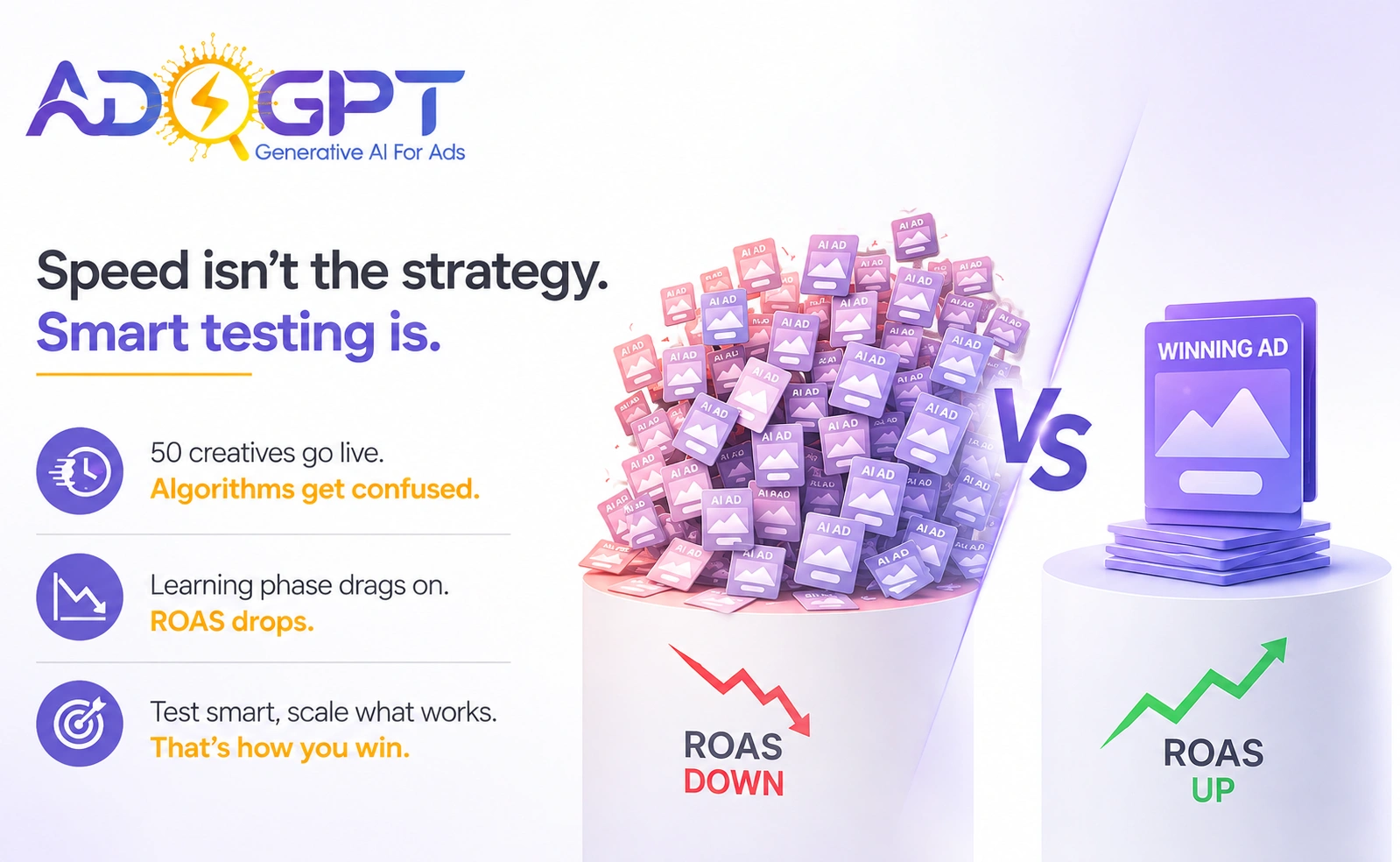
Most marketers who switch to AI ad generation make the same mistake on day one: they treat the output speed as the strategy. Brief goes in, fifty creatives come out, all fifty go live. ROAS drops. They blame the tool.
The tool isn’t the problem. The approach is.
There’s a real mechanism behind the failure. Research into AI-generated ad performance has found that flooding ad accounts with ungated volume forces native advertising algorithms into prolonged learning phases, the exact opposite of what a performance marketer wants. Instead of the platform quickly routing budget toward winning creative, it spreads thin across dozens of signals it hasn’t mapped yet. Everything underperforms. The marketer sees bad numbers, and either pulls everything or adds more ads. Neither fixes the root problem.
In a hurry? Listen to the blog instead!
The CTR Gap Is Real, But Misread
Meta’s 2025 creative testing data shows average CTR sitting at 1.8% for AI ads versus 2.9% for human-crafted ones. That gap is cited constantly as evidence AI creative doesn’t work. That reading is wrong.
The gap exists because most AI ad deployments treat generation as a substitute for strategy. Volume without structure isn’t testing; it’s noise. And the algorithm penalizes noise.
Meta’s ad delivery runs through Andromeda at the retrieval stage and GEM at auction, both evaluating creative by an internal quality signal that rewards variation, not volume. Variation means distinct angles, distinct hooks, distinct visual frames. Fifty ads that are minor permutations of the same concept read as one weak signal repeated fifty times. The platform doesn’t reward that. It learns slowly from it, if at all.
What Structured Volume Actually Looks Like
The fix isn’t fewer ads. It’s fewer ad directions tested more rigorously per cycle.
The minimum viable test batch before touching body copy or budgets: 5 angles × 3 hooks = 15 creative directions. That’s the floor. Below it, you don’t have enough signal to distinguish a bad angle from a bad hook. Above it, you start diluting budget per creative below the threshold where the platform can learn anything meaningful in a reasonable window.
And that window matters enormously. The recommended test window is 7–10 days. Killing ads on day two produces false winners. Those winners get scaled, CPA spikes, and the team concludes AI creative doesn’t perform at scale. What they actually scaled was a premature read.
A workable weekly loop looks like this: Monday, pick one angle with five directions and write a brief per direction. Generate three variations per brief, 15 ads total. Tuesday afternoon, load all 15 into a single campaign with an even budget split and leave it alone. The following Monday, read results and rotate the top two or three angles into the next test cycle. This workflow compounds. Each cycle feeds the next. Within a few rotations, you know which creative angles your specific audience actually responds to.

Where the Production Math Gets Painful
Here’s where the scale problem becomes real, even with this structured approach.
A modest multivariate test suite- 5 hooks, 4 headlines, 3 visuals, 2 CTAs, 3 aspect ratios- requires 360 variants before platform adaptation or localization. Add a second market, and that number doubles. A single in-house video concept takes 6–12 hours to script, shoot, and edit. No team running weekly test cycles can absorb that production load manually and stay nimble.
This is the actual use case for AdsGPT: not replacing creative strategy, but eliminating the production bottleneck that makes structured testing operationally impossible for most teams.
From a single prompt, AdsGPT’s Ad Factory generates image ads, UGC videos, B-roll clips, and AI avatar ads in batch. Creatives export sized-to-spec for nine platforms with auto-adjusted aspect ratios, text limits, and safe zones, no manual resizing per platform. The 15-ad weekly cycle that used to require days of production time collapses to an afternoon.
The Competitor Intel Layer Most Teams Skip
Structured testing still requires good angle hypotheses. You can generate 15 creative directions from instinct, but you’ll burn test cycles on angles that a competitor already proved don’t work in your category.
AdsGPT’s Competitor Intel database contains 500 million+ ads searchable by brand, region, and platform. The practical workflow: search for top-performing ads in your category, identify which hooks and angles are already getting traction, then one-click remix them for your brand. You’re not copying; you’re skipping the hypothesis-generation phase and starting your test cycle with angles that have demonstrated signal elsewhere.
When a creative wins, the Click Recreate function generates five fresh variations for scaling. This is where disciplined creative testing stops being theoretical; you have a winner and five derivatives ready before creative fatigue sets in.
The UGC Exception Worth Understanding
One format breaks the general pattern: UGC-style video. UGC Video Ads convert up to 4× better than polished brand content, and the reason is structural. Polished brand content signals “advertisement” immediately. UGC-style content doesn’t trigger the same avoidance reflex.
This is where AI Avatar Ads become genuinely useful rather than gimmicky. You get the UGC visual register, direct-to-camera, conversational, unpolished-feeling, without sourcing real creators or managing usage rights. The format performs because it reads as peer recommendation, not broadcast advertising. That distinction matters more than most brand teams acknowledge.
Business leaders have been told AI makes marketing faster and cheaper, and in production, that’s true. But emotional resonance is a separate variable. The most-cited AI ad failures share a common thread: they replaced human warmth with technical efficiency, and viewers noticed immediately. UGC-style formats sidestep this by design; the format’s appeal was never about polish.
Autopilot as a Safety Rail, Not a Replacement
For teams running live Meta campaigns, AdsGPT’s Autopilot audits and optimizes ads around the clock with an undo log. The undo log is the part most people underestimate. Automated optimization without a rollback mechanism is a liability; a single bad optimization decision at 2 am can spend significant budget before anyone notices. The undo log converts Autopilot from a risk into a tool a performance team can actually trust.
The broader account data bears this out: average accounts see 4.8× higher ROAS from winning creatives within six weeks, and 80% lower production costs versus traditional agency workflows. Those numbers require both the production capability and the testing discipline working together. Neither alone gets there.
The Actual Takeaway
AI ad generation tools are production infrastructure. They don’t automatically produce better creative outcomes; they remove the constraint that prevented most teams from running disciplined testing cadences in the first place.
The teams winning with AI aren’t the ones generating the most ads. They’re the ones who identified a structured test protocol and finally have the production speed to execute it consistently. Choosing an AI ad creative generator as a performance marketer is a different skill than choosing one as a designer. The former cares about test throughput and signal quality. The latter cares about output aesthetics.
If you’re running weekly creative cycles and production is the binding constraint, the math is direct. AdsGPT’s Creator plan runs $99/month for 1,250 Ad Credits. A traditional agency retainer for comparable output typically runs $3,000/month or more. The free plan gives you 35 credits with no credit card required, enough to run one full test cycle and see whether the workflow fits before committing.
Start your free AdsGPT trial and run your first structured 15-ad test cycle this week. The platform is trusted by 10,000+ marketers and has generated over one million ads.

MOST POPULAR