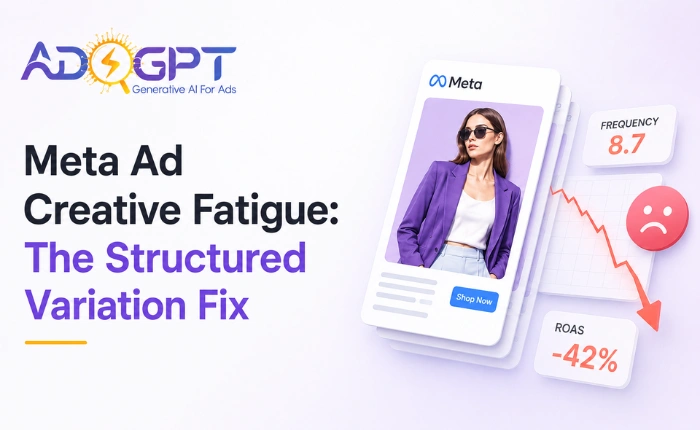
Your best-performing Meta creative from last month is probably already dead. Not underperforming, dead. Meta’s own data shows most ads fatigue within 7–14 days, and with small audiences, the burnout arrives even faster. The better the ad performs early, the quicker it saturates; the algorithm allocates the majority of spend to your top creative, driving up frequency until costs climb and engagement falls.
Most growth marketers respond to this by producing more ads. That instinct is wrong, and it’s expensive.
More Variations ≠ More Signal
Here’s the counterintuitive part: flooding your account with loosely related variants accelerates fatigue rather than beating it. Too many variations dilute the learning signal, reduce audience recognition, and make individual ads easier to tune out. You end up with ten mediocre creatives competing against each other instead of one winning concept scaled intelligently.
The fix is not volume. It’s structured variation, generating fresh executions from a proven concept, not spinning random new ideas hoping one sticks.
This is the specific problem AdsGPT is built to solve. Try AdsGPT’s Click Recreate free →
What “Structured Variation” Actually Means in Practice
When a creative wins, you have one piece of evidence: this concept, this hook, this format resonated with this audience right now. The mistake is discarding that evidence and starting from scratch when performance dips. The smarter move is to preserve the winning concept and vary the execution.
AdsGPT’s Click Recreate workflow operationalizes exactly this. You pick a winning creative, click Recreate, and get five fresh variations generated from that same source. Not remixes of a brief, derivatives of a proven asset. The conceptual core stays intact; the visual treatment, copy angle, or format shifts enough to reset the fatigue clock without abandoning what was working.
That distinction matters more than it sounds. Creative fatigue isn’t just about repetition; it’s about the algorithm continuing to serve a creative after the audience has mentally filtered it out. An ad that feels genuinely different while carrying the same strategic DNA can re-engage the same audience. One that merely swaps a headline cannot.
The Production Math Has Changed
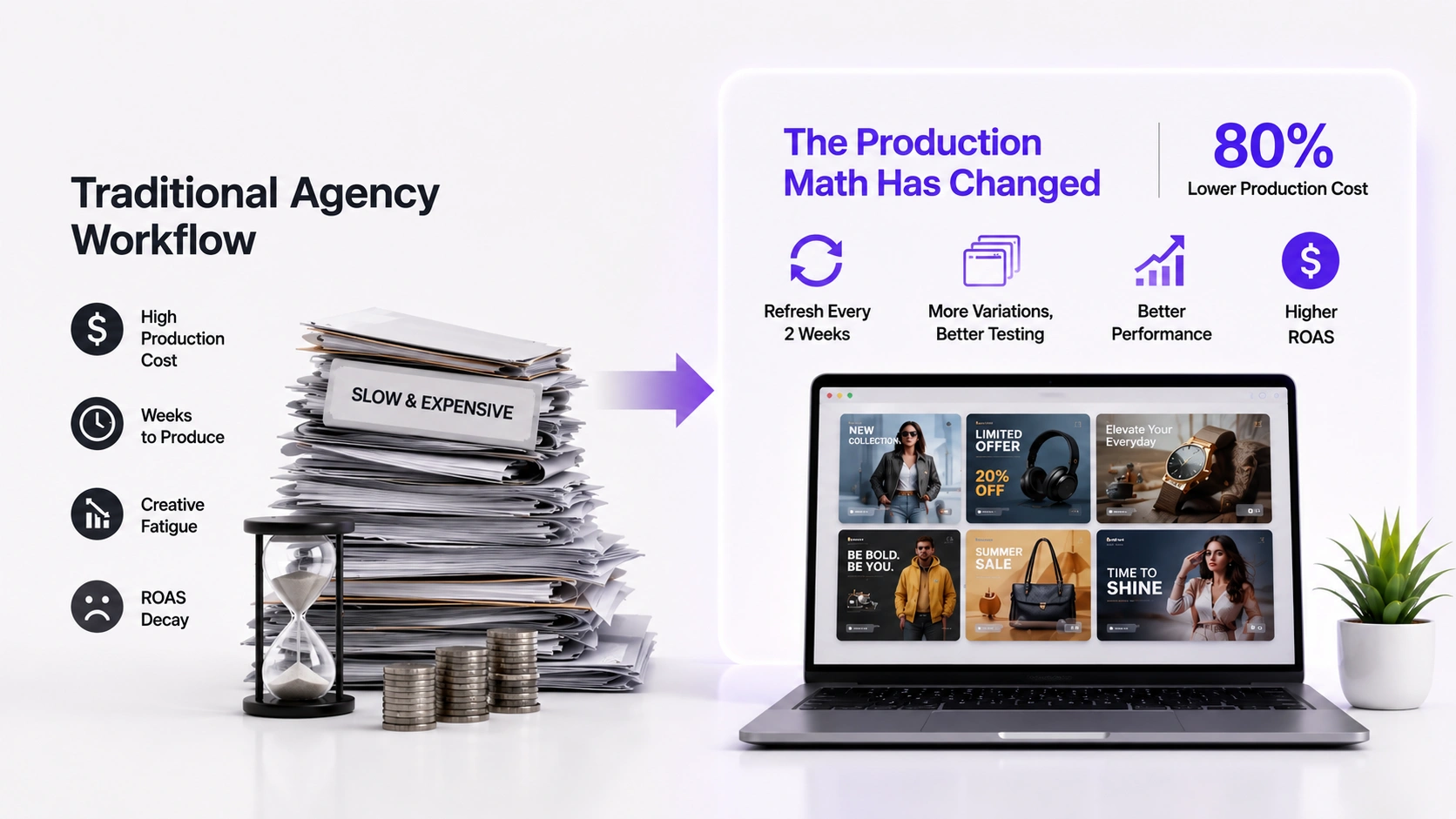
Traditional creative testing assumed a certain cost per asset. At agency rates, that cost made aggressive variation testing prohibitive; you couldn’t afford to refresh five creatives every two weeks across three campaigns. So teams held onto tired assets longer than they should have, watched ROAS decay, and blamed the platform.
The production economics have shifted. AdsGPT reports 80% lower production cost versus a traditional agency workflow. At that cost structure, refreshing creatives every two weeks is no longer a luxury; it’s just the operating cadence for staying competitive on Meta. The bottleneck that used to be production time is gone. The bottleneck now is creative strategy: knowing what to generate, not how fast you can generate it.
That shift in constraint changes how you should be spending your time.
Instead of testing entire ads every time, focus on the part that grabs attention first: Stop Testing Whole Ads, Test Hooks Instead
The Format Rotation Most Teams Skip
Even teams that refresh copy and visuals regularly tend to stay in one format. Static images fatigue differently than video. B-roll clips fatigue differently than UGC-style content. Rotating across formats, not just executions within a format, is one of the most effective ways to maintain reach into a saturated audience.
This is where having AI Avatar Ads, UGC Video Ads, Product B-roll Video, and AI Ad Creatives all inside one tool matters operationally. You can take a concept that worked as a static image ad and reformat it as a UGC-style video or a B-roll clip without briefing a new team or waiting days for production.
UGC Video Ads specifically convert up to 4× better than polished brand content, a figure worth testing against your best static performers whenever you notice frequency metrics climbing. Nearly 90% of advertisers plan to use generative AI to build video ads, per IAB’s 2025 Video Ad Spend report. Format diversity is becoming table stakes, not a differentiator. If you’re still running only static creative, you’re not just leaving performance on the table; you’re running the format with the shortest fatigue window.
AdsGPT’s ad-creative generator supports platform-specific sizing and styling across Meta, Google, LinkedIn, Pinterest, and TikTok, with named style options, realistic, 3D, and anime, and aspect ratios including 1:1 and 16:9. You generate once, export sized-to-spec for eight platforms, and drop directly into ad manager. One creative sprint covers the full distribution surface.
The Competitor Angle Nobody Uses Correctly
There’s a second lever for beating fatigue that most accounts ignore: watching what’s working for competitors in your category and using it as creative intelligence rather than creative inspiration.
AdsGPT’s Competitor Intel database covers 500 million+ ads across platforms. The workflow is not to copy; it’s to spot hooks, formats, and angles generating engagement in your vertical right now, then remix them with your brand voice. You input a competitor’s ad URL or creative; the tool outputs unique creatives matched to your own brand voice. You’re not starting from a blank brief. You’re starting from a proven creative signal and filtering it through your product.
This changes the creative brief entirely. Instead of asking “what should we say?”, you’re asking “what is already working in this space, and how do we execute it better?” That’s a faster path to finding fatigue-resistant concepts than internal brainstorming alone. It also means your creative refresh cadence can be intelligence-driven, not just schedule-driven.
Brand consistency across all of this is handled by Smart Brand Memory: logos, brand descriptions, and brand tone saved once, applied automatically across every subsequent creative. You can move fast without drifting off-brand.
Autopilot as a Fatigue Early-Warning System
Catching fatigue early is worth more than recovering from it late. By the time CPMs spike and ROAS craters, you’ve wasted budget on a dead creative for days. Meta’s own platform surfaces a creative fatigue diagnostics alert inside what AdsGPT calls an AI ad manager view, an early warning before performance drops. AdsGPT’s Autopilot runs continuous audits on your live Meta ads and flags performance shifts in real time, doing the monitoring work that most growth marketers only do during their weekly review.
The undo log is worth noting here. Automated optimization that can’t be reversed is a risk most accounts aren’t willing to take. Autopilot includes a full undo log, which means you can let it act without giving up control of what it did.
The four signals to watch for: declining CTR, rising CPA or CPC, stagnant or falling conversions, and lower relevance scores or ad quality rankings. Any one of these trending the wrong direction is a cue to stage replacements, not to wait for a full collapse.
Not getting the results you expected from AI ads? The real issue may be deeper than creative quality: AI Ads Are Underperforming: Here’s The Real Fix
A Repeatable Refresh Cadence
Given the 7–14 day shelf life, here’s the cadence that makes sense with current tools:
- Days 1–7: New creative launches. Monitor frequency and CTR daily, not weekly. When frequency climbs steadily for a cold audience, saturation is already beginning; don’t wait for ROAS to confirm it.
- Days 7–10: When frequency rises or CTR trends visibly downward, trigger Recreate on the top performer. Five fresh variations go into testing without pulling the original.
- Days 10–14: Let the variations compete. The original is still running; you’re not abandoning it, you’re staging a replacement.
- Ongoing: Use Competitor Intel to scan for new format or hook patterns in your category every two weeks. One remix per sprint is enough to keep the creative pipeline from going stale.
Stop checking ROAS first. Check frequency. ROAS decay follows frequency increase, usually by several days. If you’re waiting for the ROAS signal to refresh creatives, you’re already behind. Frequency plus CTR trend together give you a window to stage a replacement before performance collapses, but only if you have variations ready to drop in.
That’s always been the real constraint. Not the decision to refresh. Production time. With the right creative format and a structured refresh workflow, that constraint is gone.
Creative fatigue is not a Meta problem you can escalate. It’s a production discipline problem you can solve. The shelf life is 7–14 days. Build your workflow around that reality, not the one from two years ago.
If you want to go deeper on how the underlying mechanics of ad creative affect campaign performance, this breakdown of ad creative fundamentals covers what actually drives quality scores and delivery.
MOST POPULAR