
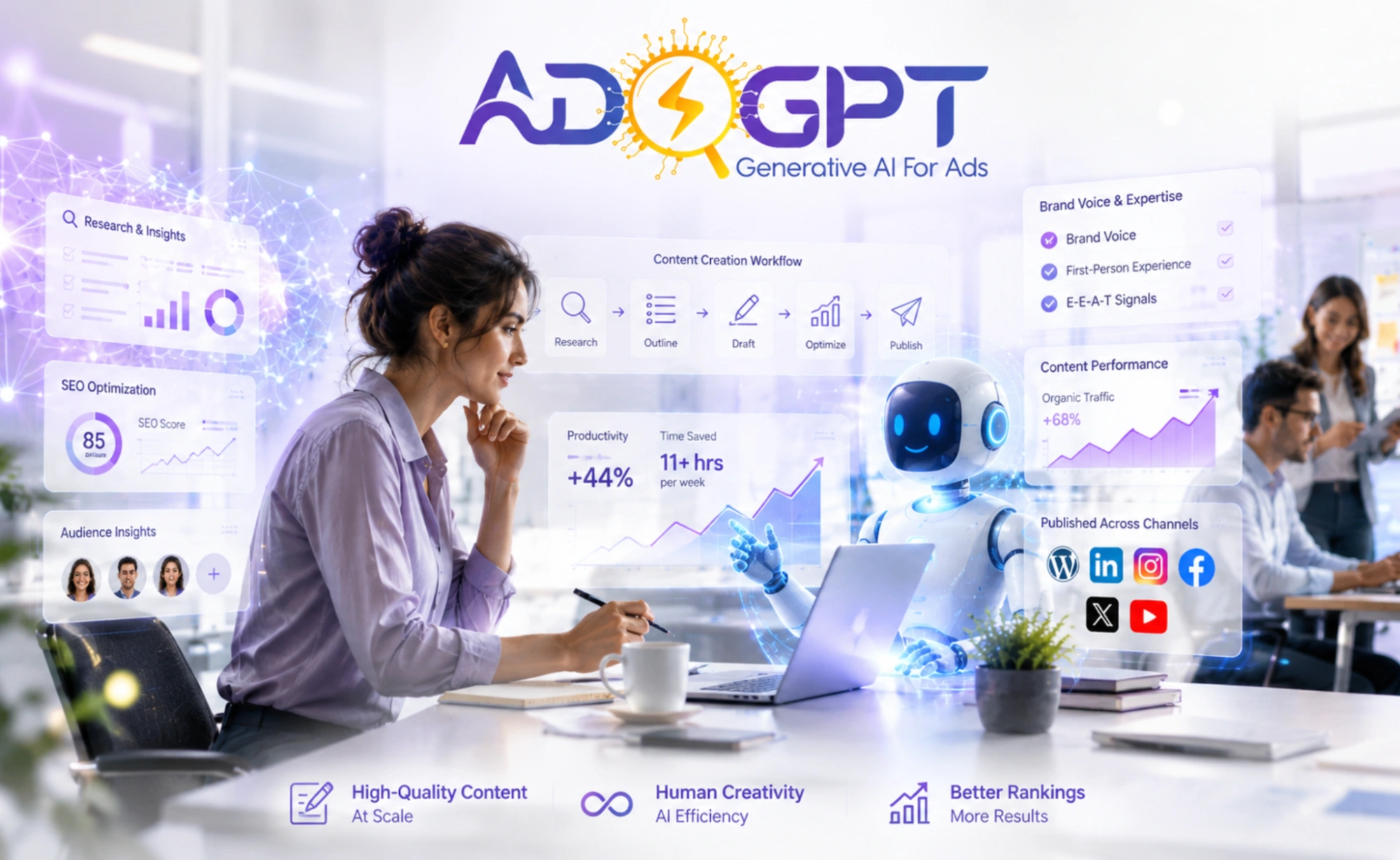
How to use AI for content creation the right way means combining large-language models with human editorial judgment, a hybrid model where AI accelerates research, outlining, and drafting, while your team layers in brand storytelling voice, first-party data, and E-E-A-T signals. The result: high-quality content at scale, without sacrificing authenticity or search performance.
The question marketers are asking is no longer whether AI belongs in their content workflow; it is how fast they need to move to avoid being left behind. As of 2025, 85% of marketers use AI tools for content creation, and those who do are 25% more likely to report measurable success than peers who do not. Marketing teams powered by AI report being 44% more productive on average, saving more than 11 hours per professional per week. The AI writing tools market alone is valued at $3.53 billion in 2025 and is on track to more than double to $7.9 billion by 2033.
But productivity numbers only tell part of the story. The deeper shift is architectural. Generative AI for content creation is not automating existing tasks; it is redesigning the relationship between strategy, creativity, and execution. Teams that understand this distinction operate differently from those still treating AI as a faster search engine or a fancier autocomplete.
Shifting From Automation To A Content Co-Pilot Architecture
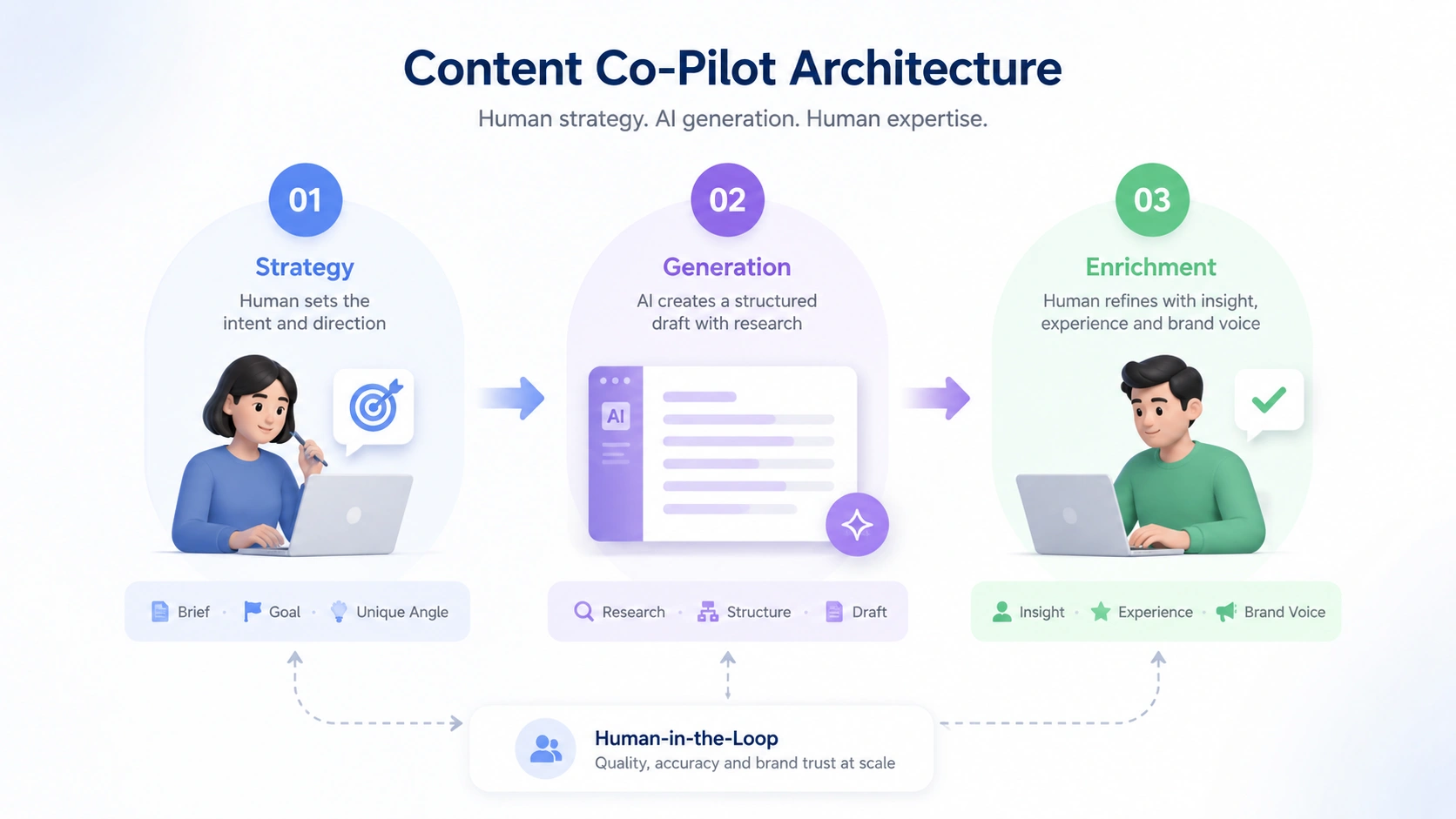
Early content automation was transactional: fill a template, insert a keyword, publish, repeat. Generative AI breaks that model entirely. Modern large language models act as co-pilots, engaging in iterative dialogue about audience intent, narrative structure, and competitive differentiation.
High-performing teams structure this co-pilot relationship in three layers. First, a human sets the strategic intent: the brief, the goal, the unique angle. Second, AI produces a structured draft informed by research synthesis. Third, a human editor enriches the draft with proprietary insight, lived experience, and brand specificity. This three-layer loop, strategy, generation, enrichment, is the human-in-the-loop architecture that is becoming the standard for content organizations serious about quality at scale.
Generic AI might write content, but it won’t capture your brand voice without human guidance. It might generate campaigns, but it won’t understand your compliance requirements or regional nuances without human oversight.”, Knak, 2025
The Truth About Google’s Search Policy on AI-Generated Content
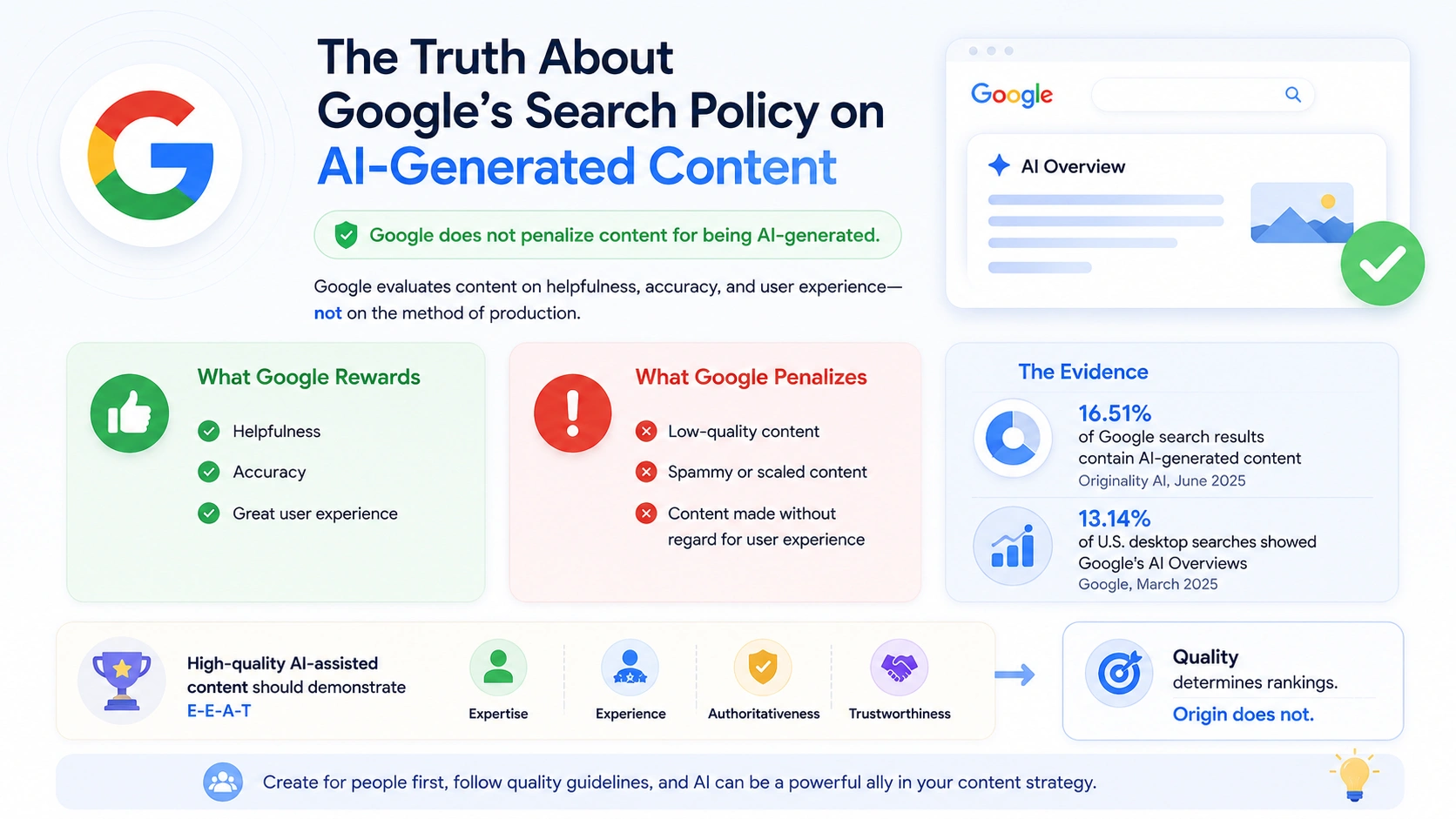
Significant confusion surrounds Google’s stance on AI content. The reality is straightforward: Google does not penalize content for being AI-generated. Google’s official guidance states that the search engine evaluates content on helpfulness, accuracy, and user experience, not on the method of commercial production. What Google penalizes is low-quality, spammy, or scaled content produced without regard for user experience, whether human-written or machine-generated.
The evidence supports responsible AI use. Originality AI’s June 2025 research confirmed that 16.51% of Google search results already contain AI-generated content. Google’s own AI Overviews feature appeared in 13.14% of all U.S. desktop searches in March 2025. High-quality AI-assisted content that demonstrates Expertise, Experience, Authoritativeness, and Trustworthiness (E-E-A-T) ranks as effectively as purely human-written content. Quality determines rankings. Origin does not
Choosing the Best AI Tools for Content Creation
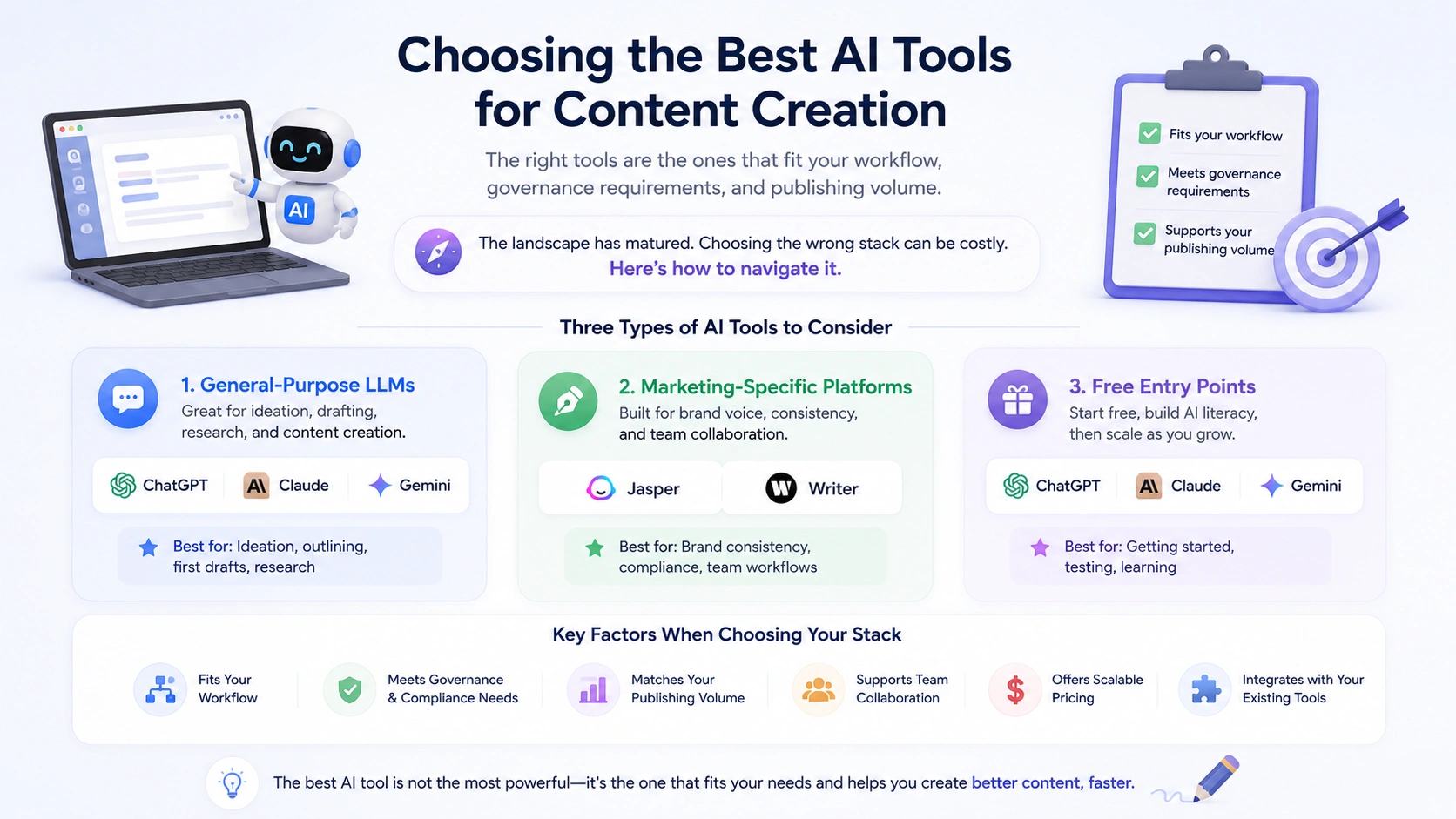
The best AI tools for content creation are not the most powerful tools available; they are the tools that fit your workflow, governance requirements, and publishing volume. The landscape has matured considerably, and selecting the wrong stack is now a genuinely costly mistake. Here is how to navigate it.
Core Text Models: Writing with ChatGPT, Claude, and Specialized Copywriting Software
Three tiers of text-generation tools dominate the 2025 content stack:
General-Purpose LLMs: ChatGPT remains the most widely adopted AI tool globally, with 88% of AI-using marketers listing it as their primary platform. At $20/month for ChatGPT Plus, it excels at ideation, outlining, and first-draft generation. Claude (Anthropic) has earned a reputation for superior prose quality and factual precision, making it the preferred choice for research-heavy articles and nuanced long-form writing. Google Gemini rounds out the big three, particularly for multimodal research tasks that blend text with visual analysis.
Marketing-Specific Platforms: Jasper AI leads the field for brand-consistency-critical teams, allowing organizations to encode voice, tone, and style rules directly into the platform. Writer.com has become the enterprise standard where compliance and editorial control are non-negotiable, the preferred choice for professional services, legal, and financial content teams.
Free Entry Points: ChatGPT, Claude, and Google Gemini all offer free tiers with usage limits, making them ideal for teams building AI literacy before committing to paid subscriptions.
Also Read!
Every Ad Format Explained: Which One Should You Actually Run?
Marketing Benchmark 2026: We Tested 13 AI Models To Find The Best One For Your Campaigns
Beyond Text: Generative AI for Video, Visuals, and Audio Production
Purely text-focused stacks are increasingly insufficient. Video now commands the closest attention across every digital channel, and 68% of CMOs report deploying or planning to deploy AI for video generation, the single highest-priority AI application for 2025–2026 according to BCG. AI-generated video is projected to account for 40% of all video ads by 2026.
- Video: Pictory and Descript convert long-form articles or recordings into polished video assets in minutes.
- Visuals: Visme AI, Canva AI, and Adobe Firefly lead for AI-powered graphic and image generation.
- Audio: Murf.ai and ElevenLabs offer text-to-speech and voice cloning for podcast, voiceover, and multilingual audio at scale.
How to Build Your First Integrated AI Marketing Stack
Rather than selecting tools in isolation, architect your AI tools for content creation around the full content lifecycle:
| Content Stage | Recommended Tool(s) | Primary Purpose |
|---|---|---|
| Research & Ideation | ChatGPT, Perplexity AI, Claude | Topic discovery, competitor gap analysis |
| Outlining & Briefing | Jasper AI, Claude | SEO-informed outlines, brand-aligned briefs |
| Long-Form Drafting | Claude, Writer.com, Jasper AI | Blog posts, whitepapers, email sequences |
| Visual Content | Canva AI, Visme AI, Adobe Firefly | Infographics, social assets, slide decks |
| Video Production | Pictory, Descript, HeyGen | Short-form video, video blogs, ad creative |
| Editing & QA | Grammarly, Hemingway Editor | Tone, readability, AI-phrase removal |
| SEO Optimization | Semrush ContentShake, Clearscope | Keyword density, on-page scoring |
Step-By-Step: How To Use AI For Content Creation Without Losing Your Brand Voice
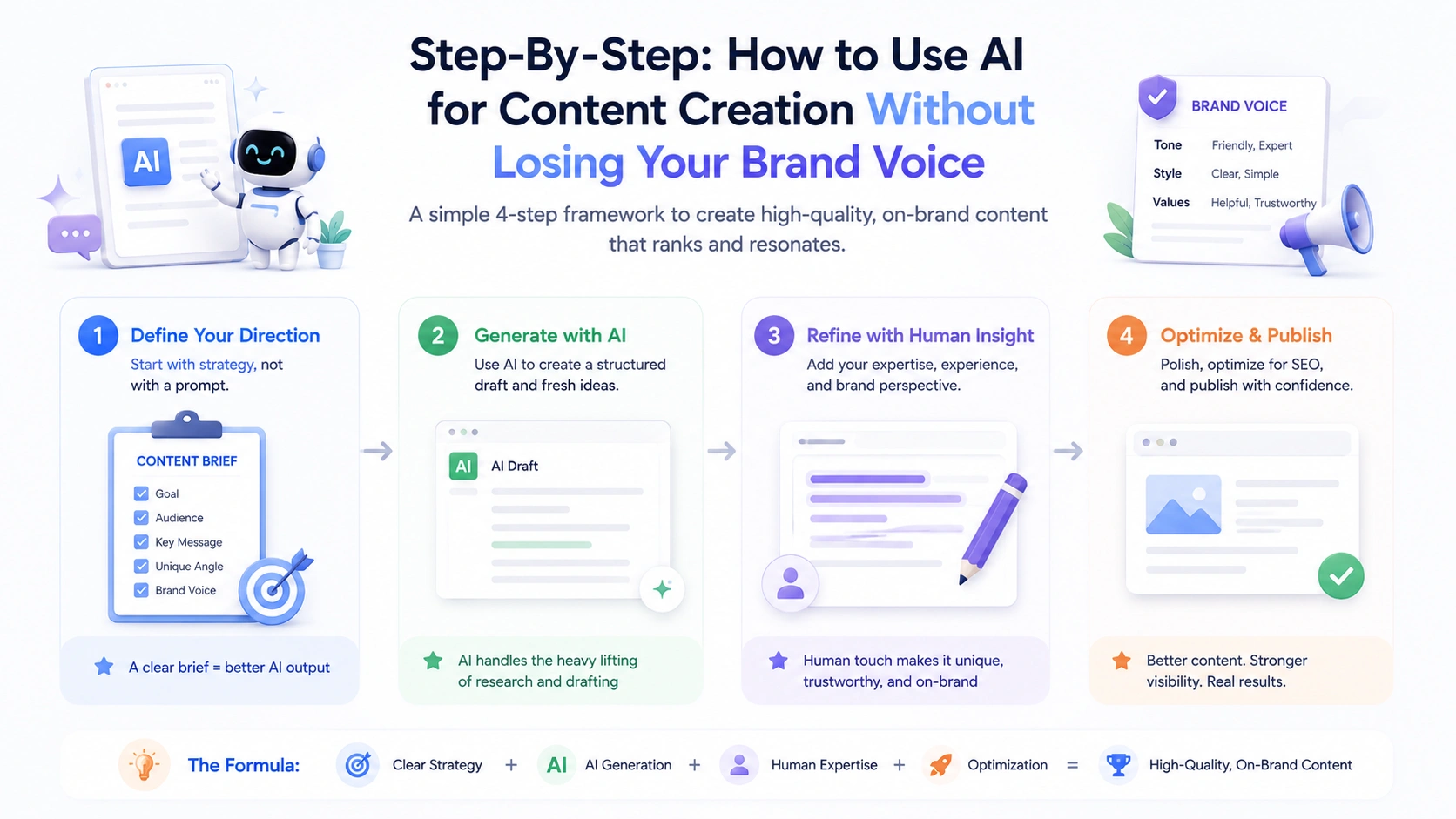
Understanding how to use AI for content creation effectively requires a structured process, not ad-hoc prompting. The four-step framework below separates teams that produce high-ranking, on-brand content from those that publish generic AI drafts and wonder why organic performance stagnates.
Step 1: Training the Model on Your Unique Brand Guidelines and Data
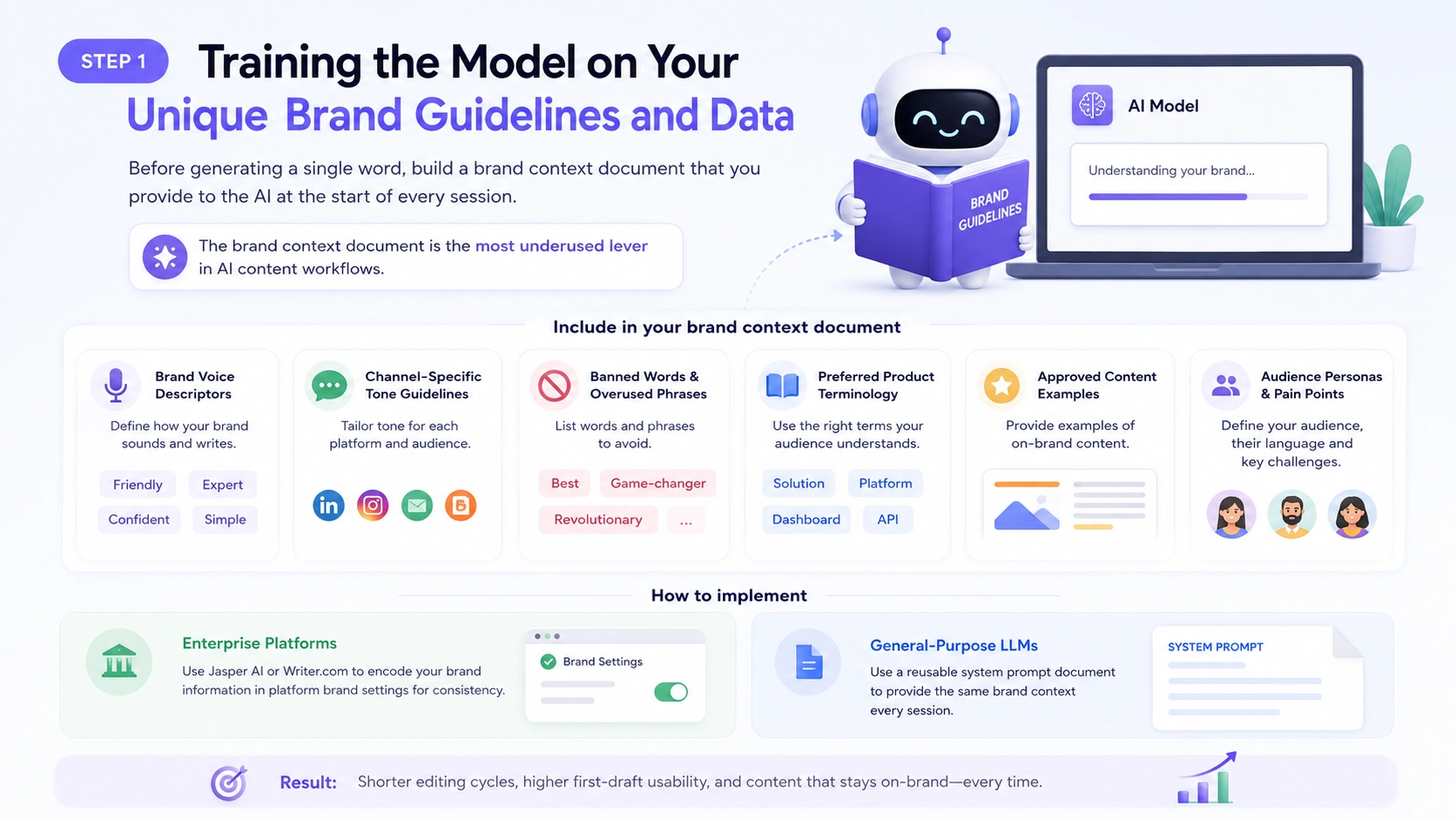
Before generating a single word, build a brand context document that you provide to the AI at the start of every session. This document should include your brand voice descriptors, channel-specific tone guidelines, a list of banned words and overused phrases, preferred product terminology, approved content examples, and target audience personas with their vocabulary and pain points.
For enterprise platforms like Jasper AI or Writer.com, this information can be encoded persistently into the platform’s brand settings. For general-purpose LLMs, a reusable system prompt document achieves the same consistency. Teams that invest in this upfront step report dramatically shorter editing cycles and significantly higher first-draft usability. The brand context document is the most underused lever in AI content workflows.
Step 2: Prompt Engineering Frameworks for High-Converting Outlines
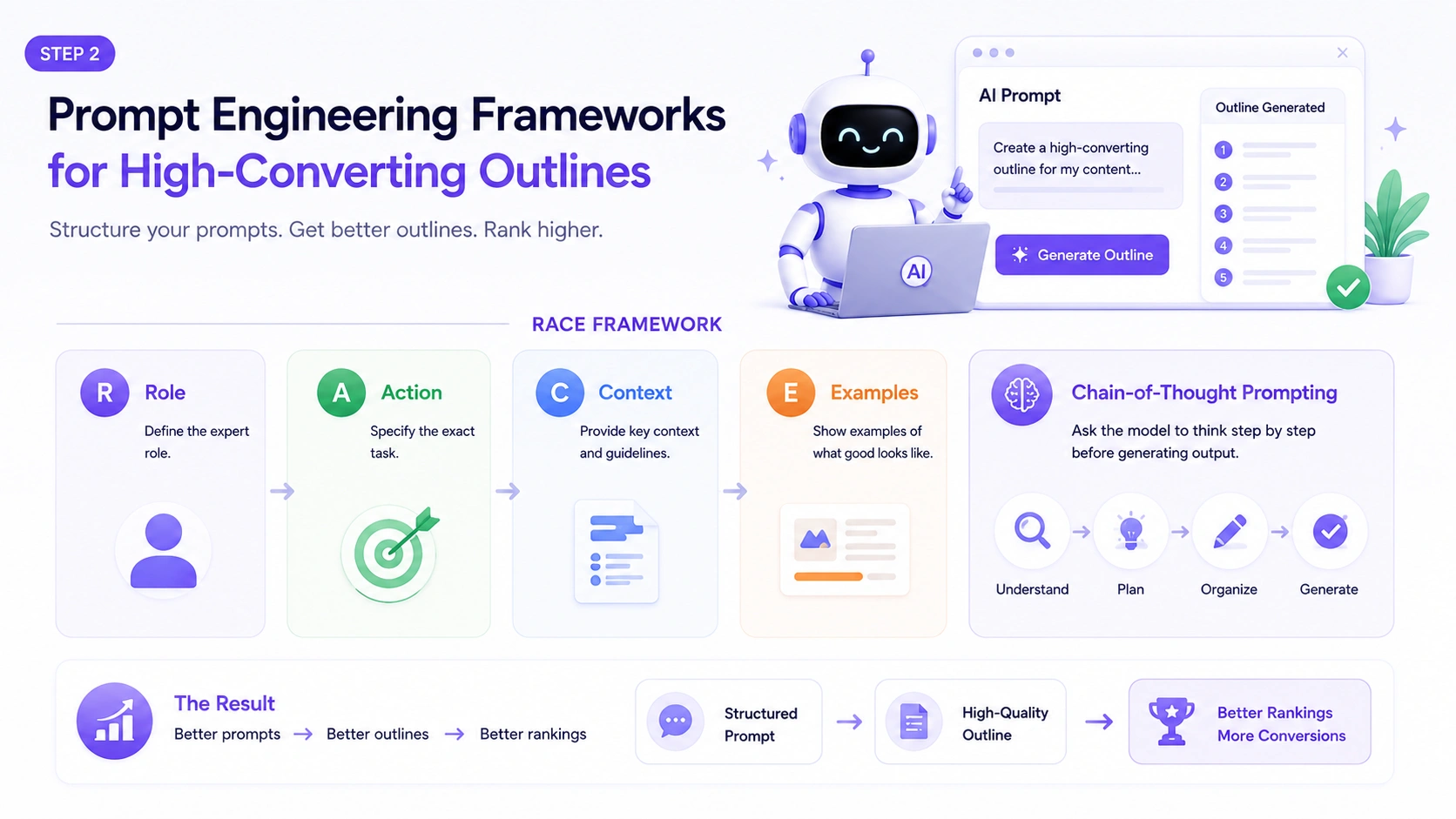
Prompt engineering is the discipline of structuring AI instructions to reliably produce purposeful, high-quality output. The global prompt engineering market reached $107.76 billion in 2024 and is projected to hit $143.22 billion in 2025, a figure that reflects how much economic value structured AI instructions now represent.
For content creation, the most effective framework for outline generation follows the RACE structure:
Role: Assign an expert identity (“Act as a senior B2B content strategist specializing in SaaS marketing”).
Action: Define the precise task (“Create a comprehensive, SEO-optimized outline for a 2,500-word pillar page targeting [keyword]”).
Context: Provide the target audience, primary keyword, funnel stage, competing URLs, and brand voice notes.
Examples: Include two to three samples of approved headings or content sections you want the AI to emulate.
Chain-of-thought prompting, asking the model to reason through the task step by step before producing output, consistently improves structural quality and logical coherence in long-form content.
Step 3: Generating the First Draft via Multi-Tier Content Chains
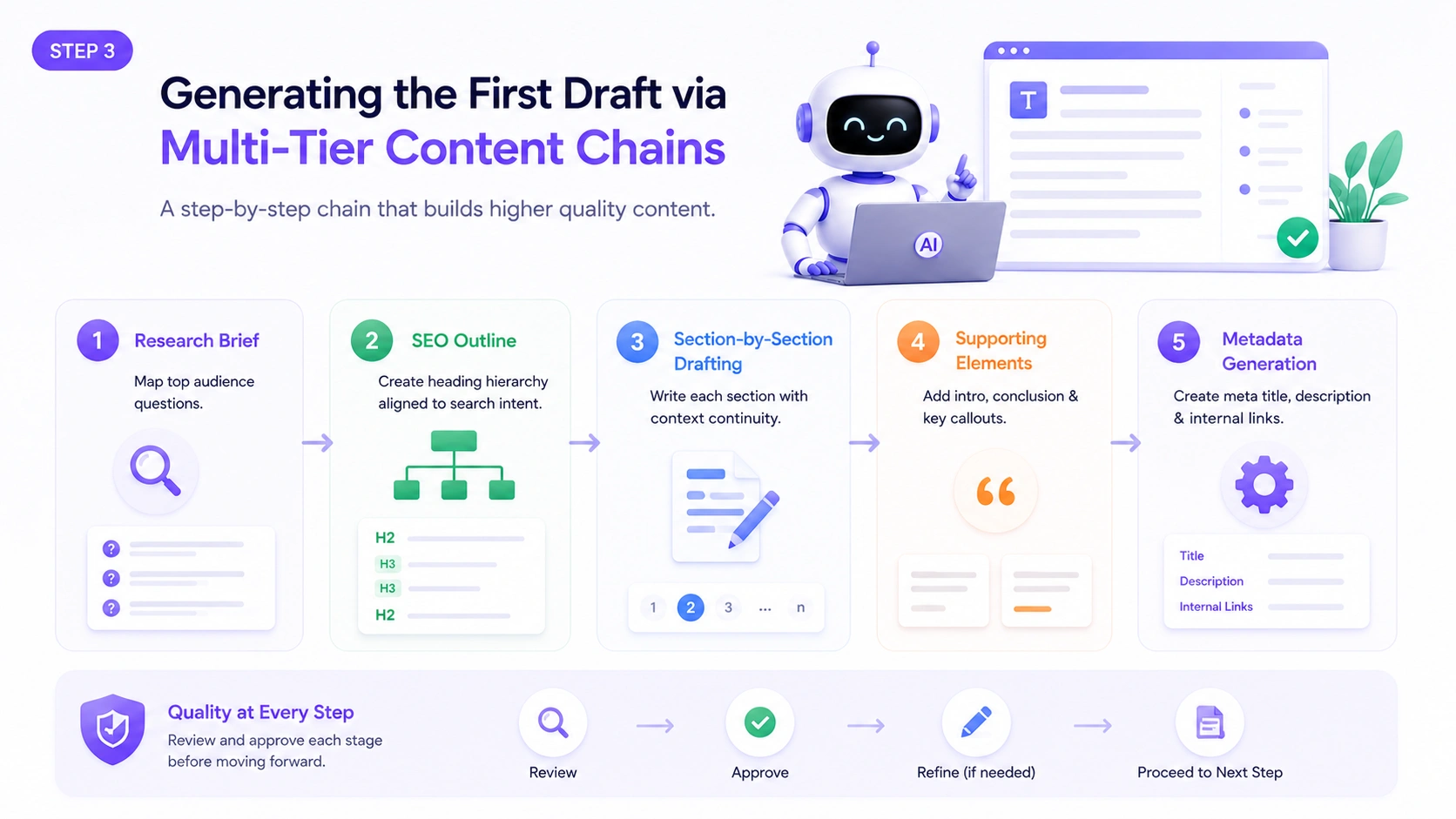
Attempting to generate a complete 2,500-word article in a single prompt produces generic, structurally inconsistent output. The superior approach is a multi-tier content chain, a sequential process where each stage builds on the last:
Research brief: Ask the AI to map the top five audience questions on the topic, pulling from common search patterns and content gaps.
SEO outline: Using the brief as context, generate a heading hierarchy with H2s and H3s each mapped to a specific search intent.
Section-by-section drafting: Generate each major section independently, providing the previous section as context to maintain narrative continuity.
Supporting elements: Draft the introduction, conclusion, and callout quotes as separate prompts once the body sections are approved.
Metadata generation: After the full draft is approved, prompt for a meta title, meta description, and internal linking suggestions.
This chained approach lets human editors review and approve each stage before proceeding, maintaining quality control throughout rather than inheriting a monolithic draft that requires wholesale restructuring.
Step 4: Eliminating the ‘Similarity Penalty’ with Human Insights
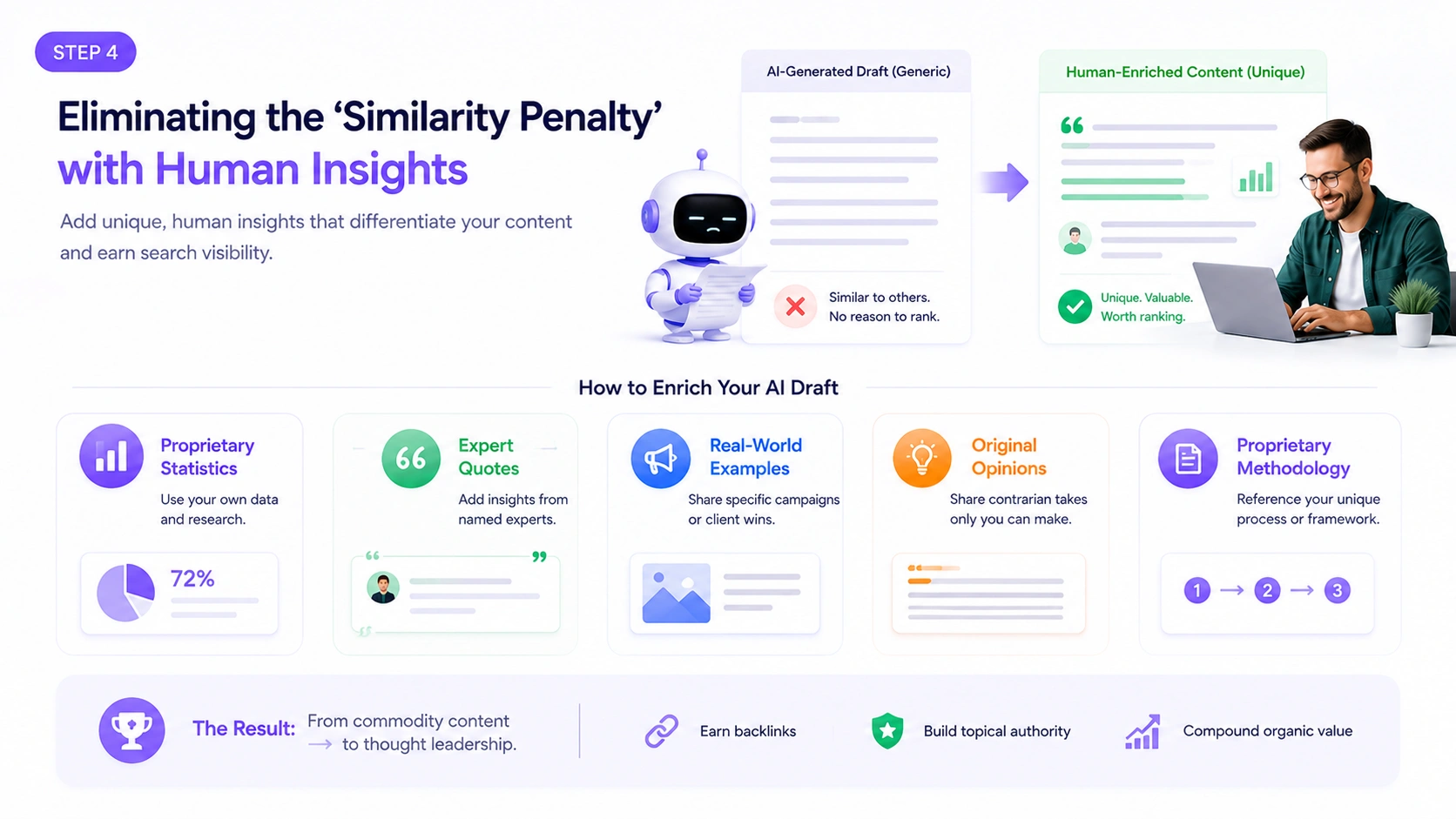
AI drafts produced without differentiation signals cluster around the same information and phrasing as every other AI-generated piece on the topic. Search researchers call this the similarity penalty; technically correct content that gives search engines no reason to surface it over existing results.
The remedy is systematic human enrichment. Specifically, replace generic AI language with: proprietary statistics from your organization’s own research, direct quotes from named internal subject-matter experts, real-world examples from specific campaigns or client situations, original opinions or contrarian predictions that only a credible expert could make, and methodology references proprietary to your team. This enrichment is what transforms an AI-assisted draft from commodity content into genuine thought leadership, content that earns backlinks, builds topical authority, and compounds organic value over time.
Advanced Workflows: Scaling Output Across Multiple Marketing Channels
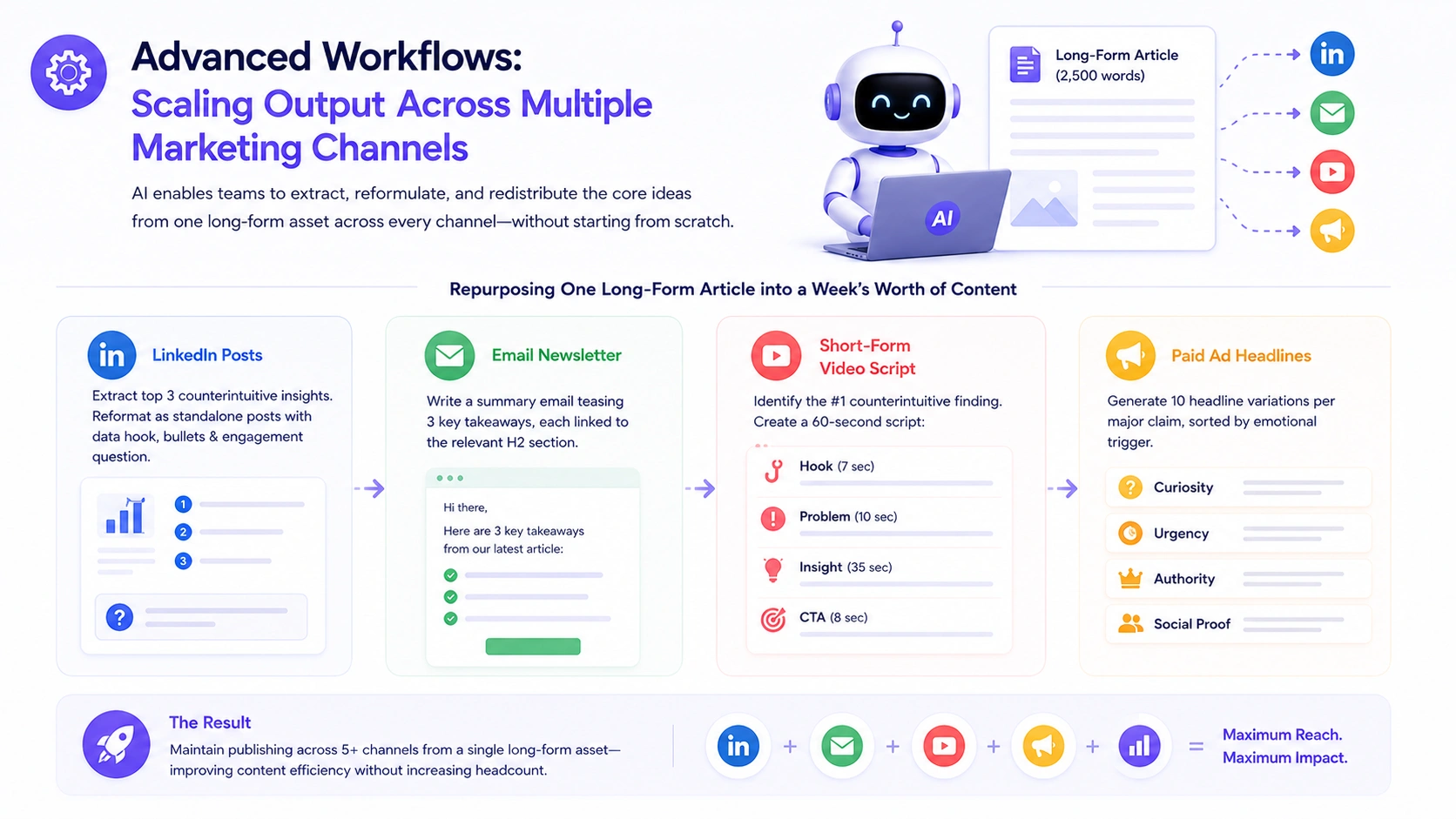
Once a reliable single-article workflow is established, the highest-leverage move is multi-channel content distribution. AI enables teams to extract, reformulate, and redistribute the core ideas from one long-form asset across every channel, without starting from scratch each time.
Repurposing One Long-Form Article into a Week’s Worth of Social Media Ads
A well-researched 2,500-word pillar page contains enough material to fuel an entire week of social, email, and paid creative. The repurposing workflow:
LinkedIn posts: Extract the three most counterintuitive insights. Prompt the AI to reformat each as a standalone post with a data-forward hook, a three-to-five bullet breakdown, and an engagement question.
Email newsletter: Prompt the AI to write a summary email teasing three key takeaways, each hyperlinked to the relevant H2 section of the original article.
Short-form video script: Identify the single most counterintuitive finding. Prompt for a 60-second script structured as hook (7 sec), problem (10 sec), insight (35 sec), CTA (8 sec).
Paid ad headlines: Prompt for 10 headline variations per major claim, sorted by emotional trigger: curiosity, urgency, authority, and social proof.
Teams that systematize this repurposing workflow consistently maintain publishing across five or more channels from a single long-form asset, dramatically improving content efficiency without increasing editorial headcount.
Utilizing AI Tools for Rapid Competitor Blog Analysis and Content Gap Identification
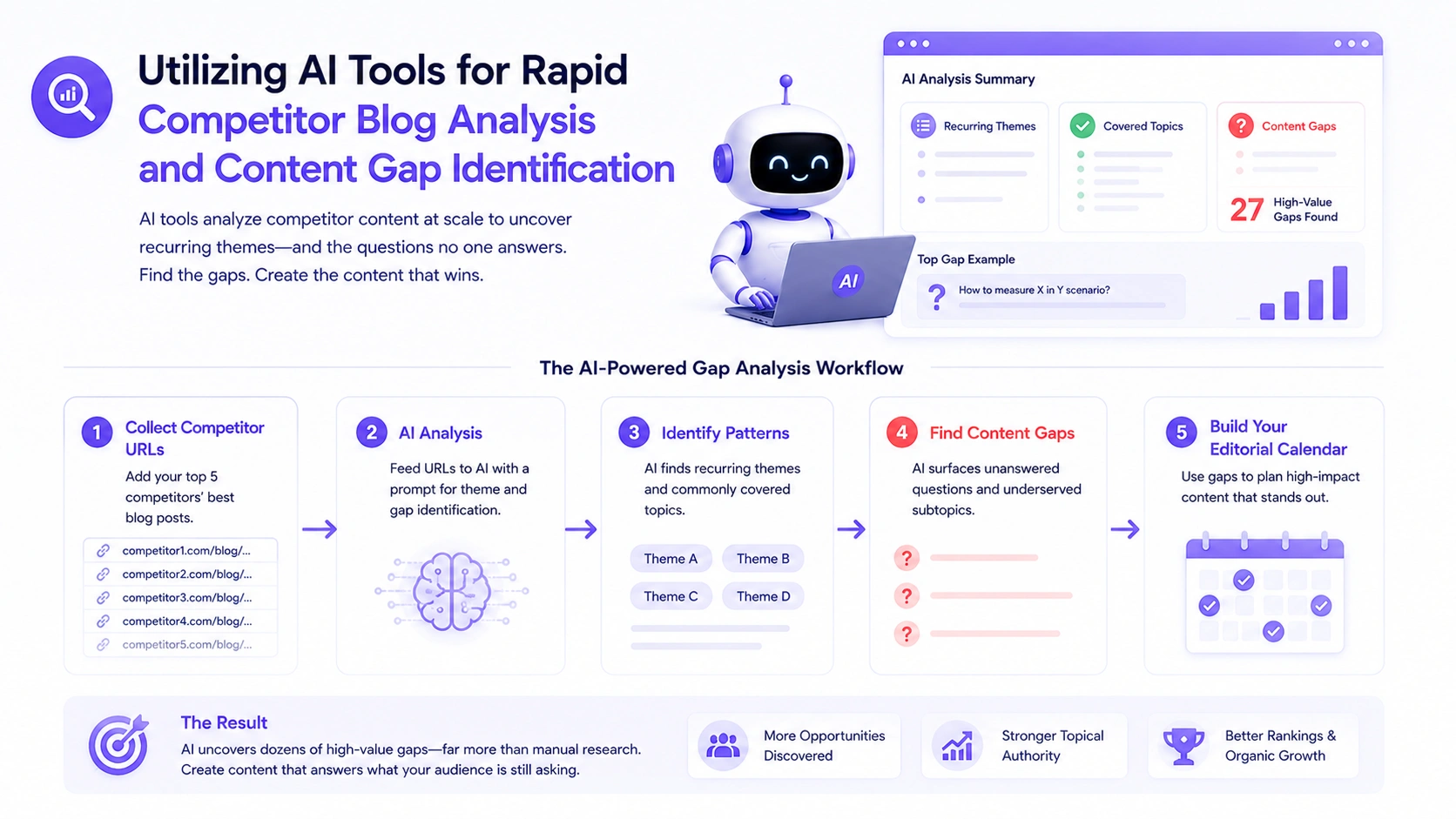
AI tools for content creation are equally powerful as analytical instruments. Compile the URLs of your top five competitors’ best-performing blog posts. Feed these to an AI model with a prompt asking it to identify recurring themes, topics addressed across multiple competitors, and, most importantly, questions none of the competitors answer satisfactorily. This gap analysis is where AI delivers disproportionate value: a human analyst might identify three to five gaps from the same material; a well-prompted AI model can surface dozens of underserved angles, subtopics, and audience questions that directly inform your editorial calendar.
Automating Localized Variations for Global Target Audiences
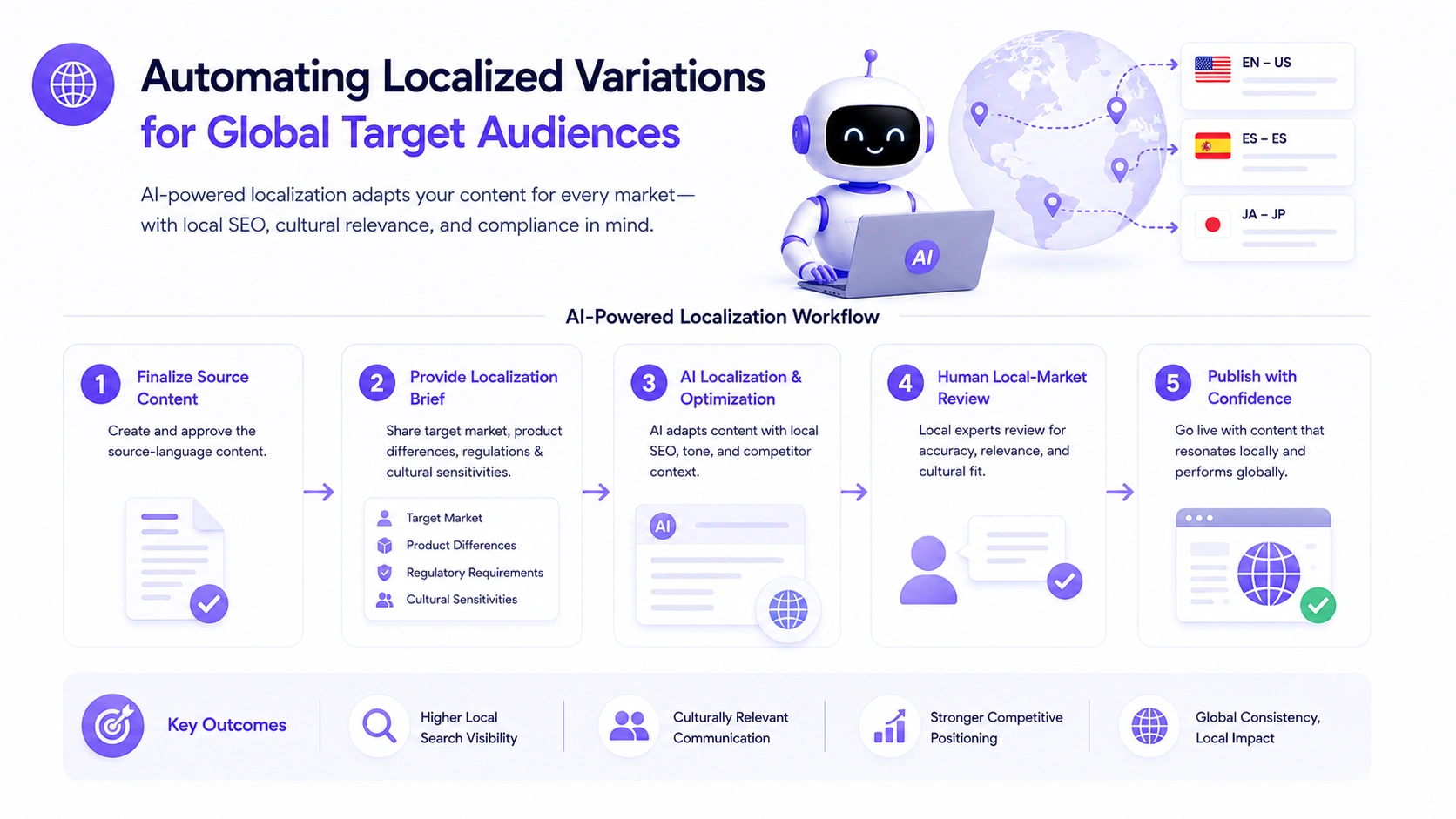
For organizations operating across multiple geographies, AI-powered localization is one of the most transformative workflow applications available. Modern localization platforms go beyond literal translation, incorporating region-specific SEO signals, cultural communication norms, and local competitor positioning. The recommended workflow: finalize source-language content first, then provide the AI with a localization brief specifying the target market, regional product differences, local regulatory requirements, and cultural sensitivities to avoid. Always include a human local-market review step before publication, particularly for product pages, legal content, or crisis communications.

The Human-In-The-Loop Checklist: Polishing AI Content For E-E-A-T
The human-in-the-loop model is not a best practice; it is a prerequisite for content that aspires to rank competitively. Google’s E-E-A-T framework evaluates signals that AI cannot independently generate: experiential credibility, institutional authority, and demonstrated trustworthiness. And from a reader perspective, 73% of consumers report they can spot and reject AI-generated vibe marketing, making the human polish layer simultaneously an SEO and an audience-retention imperative.
72% of the most successful content marketers explicitly use a human-led process to ensure quality and brand voice. AI provides the speed. The human provides the soul.
The AI Phrase Hit-List: Culling Robotic Transitions and Overused Buzzwords
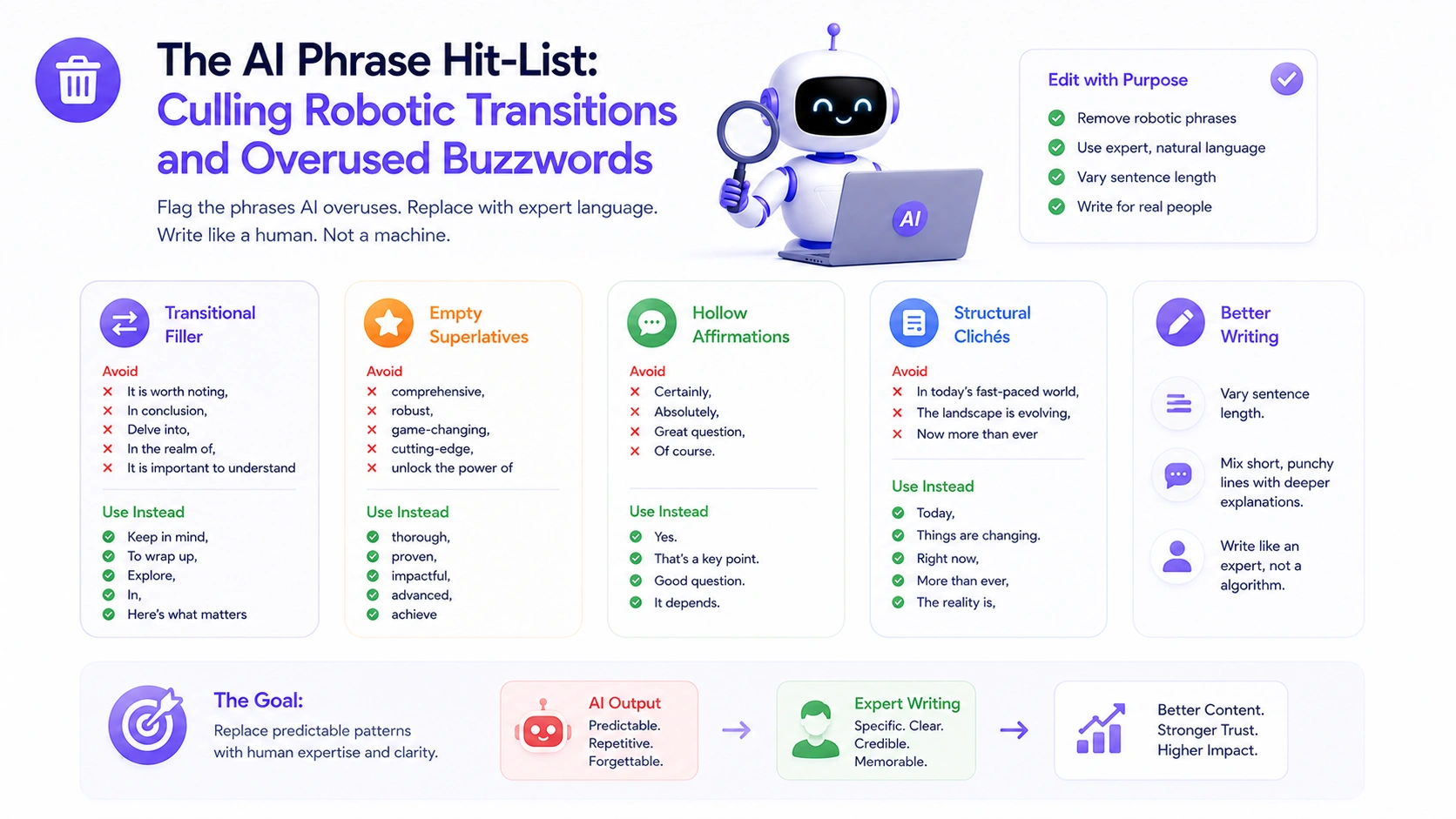
Certain phrases appear so frequently in AI output that they have become reliable markers of machine authorship. Every editing pass should flag and eliminate:
Transitional filler: “It is worth noting,” “In conclusion,” “Delve into,” “In the realm of,” “It is important to understand”
Empty superlatives: “comprehensive,” “robust,” “game-changing,” “cutting-edge,” “unlock the power of”
Hollow affirmations: “Certainly,” “Absolutely,” “Great question,” “Of course”
Structural clichés: “In today’s fast-paced world,” “The landscape is evolving,” “Now more than ever”
Replace each flagged phrase with language a recognized subject-matter expert would actually use. Then vary sentence length deliberately, AI output tends toward rhythmic uniformity that experienced readers register, even if they cannot articulate it. Short, punchy sentences after complex ones. Structural variation is introduced with a purpose.
Injecting First-Party Data, Proprietary Metrics, and Real-World Experience
The single most powerful differentiator between AI-generated content and expert-authored content is proprietary data and lived experience. No AI model can access your customers’ actual feedback, your internal product metrics, or the specific challenges your team encountered on the last project. Every published piece should include at minimum three of the following:
- A statistic sourced from your organization’s own research or platform data
- A direct quote from an internal subject-matter expert, identified by name and role
- A real-world example referencing a specific situation, outcome, or decision your team made
- An original opinion or prediction that takes a clear position on a debated industry question
- A proprietary methodology or framework that your team developed
How AdsGPT Helps Marketers Scale Content Faster
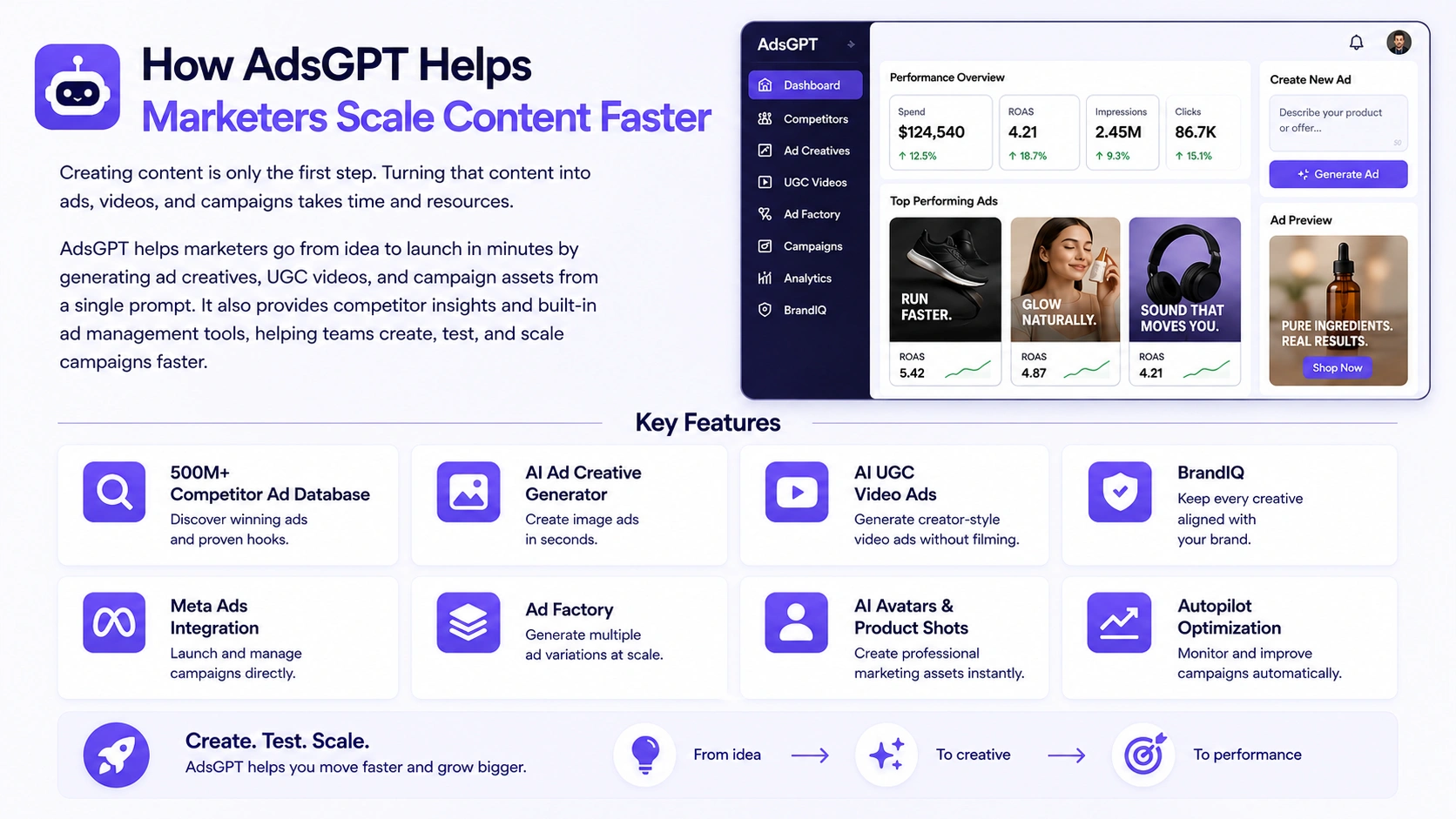
Creating content is only the first step. Turning that content into ads, videos, and campaigns takes time and resources.
AdsGPT helps marketers go from idea to launch in minutes by generating ad creatives, UGC videos, and campaign assets from a single prompt. It also provides competitor insights and built-in ad management tools, helping teams create, test, and scale campaigns faster.
Key Features
- 500M+ Competitor Ad Database – Discover winning ads and proven hooks.
- AI Ad Creative Generator – Create image ads in seconds.
- AI UGC Video Ads – Generate creator-style video ads without filming.
- BrandIQ – Keep every creative aligned with your brand.
- Meta Ads Integration – Launch and manage campaigns directly.
- Ad Factory – Generate multiple ad variations at scale.
- AI Avatars & Product Shots – Create professional marketing assets instantly.
- Autopilot Optimization – Monitor and improve campaigns automatically.
Frequently Asked Questions About AI for Content Creation
Will using AI tools for content creation hurt my site’s organic SEO rankings?
No, provided the content meets Google’s quality standards. Google does not penalize AI-generated content by default. It penalizes thin, repetitive, or manipulative content regardless of origin. AI-assisted content that incorporates original insight, accurate information, and strong E-E-A-T signals performs as well as purely human-written content in search results. Research from Originality AI confirms that 86.5% of top-ranking pages already contain some AI-generated content.
What are the best free AI tools for content creation beginners?
Three platforms offer genuine free-tier value for beginners: ChatGPT (free tier via OpenAI) for ideation and short-form drafting; Claude (free tier via Anthropic) for research-heavy writing and nuanced long-form content; and Google Gemini (free) for research-assisted writing with natural integration into Google Docs. Free tiers are ideal for building prompt engineering skills and evaluating workflows before committing to paid subscriptions.
How can I make AI-written content look and feel 100% human-written?
The most reliable method is not post-hoc detection and removal; it is building a process that prevents robotic output from the start, then enriching the draft with signals only a human can provide. Practically: begin every session by feeding the AI your brand voice guidelines and approved writing samples. Draft section by section rather than all at once. Apply the AI phrase hit-list edit described above. Then add at minimum one expert quote, one piece of proprietary data, and one specific real-world example that no model could generate without access to your internal knowledge.


MOST POPULAR