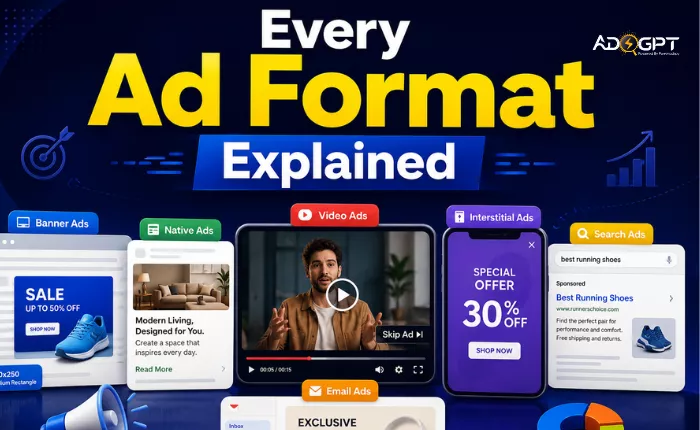
Most marketers waste their first three months running the wrong ad format for the right audience. They pick what looks familiar, or what the platform defaults to, rather than what their campaign goal actually requires. Understanding ad format is not a technical exercise. It is a strategic one. The ad format you choose determines how your creative is delivered, how your audience experiences it, what you pay per impression or click, and whether the whole campaign lives or dies before the landing page ever loads.
This guide breaks down every major ad format, what each one is genuinely good for, and how AdsGPT helps you produce platform-ready creative across all of them without a production bottleneck slowing you down.
Listen To The Podcast!
What Is an Ad Format, and Why Does It Matter?
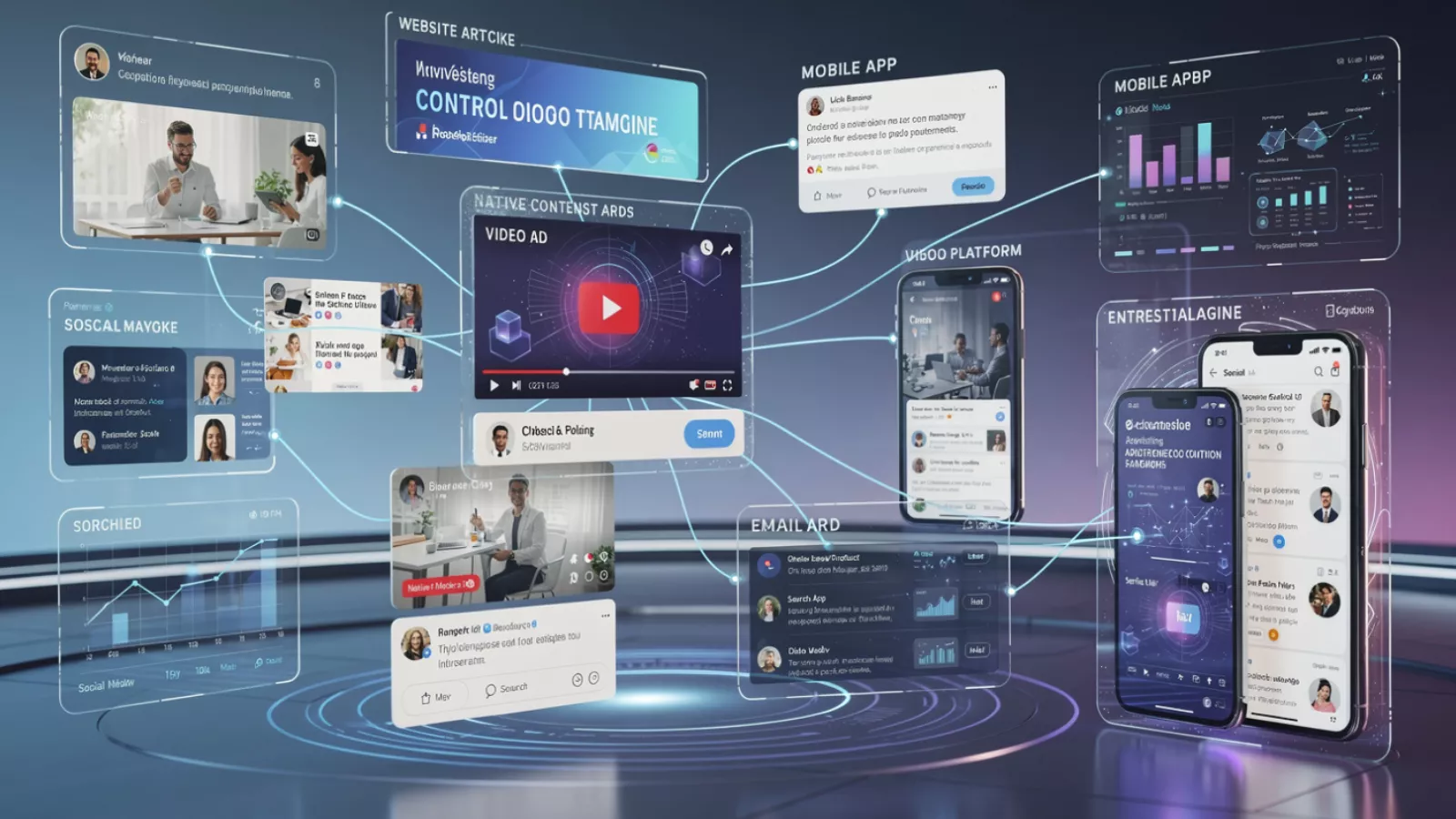 An ad format is the standardized unit that defines how an ad looks, behaves, and gets delivered. It covers the creative type, the technical specifications, the placement behavior, and how the audience interacts with it.
Ad format and ad placement are related but different. The ad format is the creative unit itself: a banner, a video, a native card. The placement is where that unit appears: in-feed, pre-roll, sticky footer, or between game levels. The same ad format can perform three to ten times differently depending on where it lands. Getting both decisions right is what separates campaigns that compound from campaigns that drain budget.
The Interactive Advertising Bureau classifies the core digital ad formats as banner ads, interstitial ads, rich media ads, native ads, and video ads. Outside of display, you also have search ads, social ads, and email ads. Each works differently, costs differently, and suits a different point in the customer journey.
Banner Ads
Banner ads are the original ad format. They are graphical ads placed in designated slots on web pages and apps, available in standard IAB sizes like the 300×250 medium rectangle, the 728×90 leaderboard, and the 160×600 wide skyscraper.
The common belief is that banners are purely static. That is not accurate. HTML5 banners can include looped animations, image carousels, text swaps, and parallax effects. Even a simple animation can lift CTR by up to 267 percent over a fully static version.
What banner ads are best for: Top-of-funnel brand exposure and retargeting at scale. Banner CPMs typically run between $2 and $10, making them one of the most cost-effective ad formats for broad reach campaigns.
The honest limitation: Global average CTR on banner ads sits around 0.06 percent. Banner blindness is real. A user who has been online for more than a decade has trained their brain to filter these out. Banners earn their place in a media mix through volume and frequency, not engagement depth.
When to use this ad format: Brand awareness campaigns, retargeting sequences, and any scenario where you need a wide reach at a low CPM. Pair with strong visual creativity and precise audience targeting for the best results.
Native Ads
Native ads are the chameleon of the ad format world. They are designed to match the look, feel, and function of the platform content surrounding them. In a news feed, a native ad looks like an article. In a product grid, it looks like a listing.
The non-disruptive quality of native is its core advantage. Users engage with native ads at significantly higher rates than banner ads because the format does not interrupt the content experience. Native accounted for 15 to 20 percent of marketers’ budgets in 2025, a figure that has been climbing steadily.
What native ads are best for: Mid-funnel goals like content engagement, lead nurturing, and soft conversions. They perform particularly well for storytelling, long-form content promotion, and audiences who are research-oriented rather than impulse-driven.
Pricing range: CPC $0.10 to $1.00, CPM $5 to $15. Premium custom native can exceed $25 CPM.
When to use this ad format: When you want to build trust rather than demand immediate action. Native is one of the best types of advertising for brands that lead with content, education, or a longer consideration cycle.
Video Ads
Video ads are the highest-engagement ad format available in digital advertising today. They deliver 27 times higher CTR than static banners and can boost purchasing intent by up to 90 percent. The tradeoff is production cost and creative effort.
Video ads are split into two main categories.
In-stream ads require a video player and interrupt existing content. Pre-roll (before the video), mid-roll (during), and post-roll (after) are the standard placements. They autoplay with sound and command full attention at the moment they appear.
Outstream ads run outside a video player, appearing within article text or social feeds. They are muted by default, which means the visual hook carries more weight in the first three seconds.
Video ads run across YouTube, TikTok, Meta, Connected TV (CTV), and OTT platforms. CTV alone is one of the fastest-growing channels in video, with CPMs exceeding $40 in premium inventory.
Pricing range: CPM $10 to $30 for standard placements. YouTube TrueView averages around $0.10 per view. CTV runs considerably higher.
When to use this ad format: Brand storytelling, product demonstrations, awareness campaigns targeting Gen Z or mobile-first audiences, and retargeting sequences where you want to deepen engagement before asking for a conversion.
For short-form video specifically: Reels, Shorts, and TikTok placements require a completely different creative approach from traditional video ads. Vertical 9:16 format, native-feeling UGC style, fast hooks in the first two seconds, and captions for silent autoplay. This is not the same creative brief as a YouTube pre-roll.
Interstitial Ads
Interstitial ads are full-screen ad units that appear during natural transition points, between game levels, between article pages, or at app open. They take over the entire screen and cannot be passively ignored.
This ad format achieves 100 percent viewability by definition. CTR benchmarks run between 2 and 5 percent, which is five to ten times higher than banner ads. For mobile app advertisers, interstitials drive 20 percent more installs compared to other ad formats.
The risk: Full-screen formats that appear at the wrong moment create friction and frustration. Poorly timed interstitials increase bounce rates and, in apps, can trigger uninstalls.
Pricing range: CPM $5 to $15, CPC $0.50 to $2.
When to use this ad format: App publishers and mobile-first marketers. The rule is simple: only place interstitials at genuine transition points where a pause is natural. Never interrupt mid-task.
Rich Media Ads
Rich media is the ad format that lives between a standard banner and a full video. It uses HTML5 to incorporate interactive elements like expandable panels, in-banner video, forms, 3D elements, and overlays.
The defining feature is interactivity. A rich media ad can expand when hovered, play a video within the banner frame, let a user submit an email without leaving the page, or display a product from multiple angles. Interaction rates on well-executed rich media can exceed 20 percent, and post-click site visits run three times longer than those from static banners.
Pricing range: CPM $10 to $25. Premium expandable units can exceed $30 CPM.
When to use this ad format: Mid-to-bottom funnel campaigns where you need to demo a product, capture data, or create a memorable brand moment within the ad unit itself. Rich media works best on premium publisher placements in tech, retail, and entertainment categories.
Also Read
How To Use Meta Ad Formats For Maximum Results In 2025?
How To Master AI Video Ads for Better Marketing?
Push and Pop-Under Ads
These two ad format types sit outside traditional display classifications but are widely used in performance and affiliate marketing.
Push ads deliver short real-time messages directly to a user’s browser or device, similar in appearance to system notifications. They achieve CTRs between 2 and 8 percent and are extremely cost-effective, with CPCs as low as $0.01 to $0.10. They work well for flash sales, retargeting, and app re-engagement.
Pop-under ads open a new tab or window behind the active browser session, loading directly to a landing page. They bypass most ad blockers and offer high volume at low cost, with CPMs ranging from $0.50 in Tier 3 markets to $1 to $4 in Tier 1. The tradeoff is lower intent and a higher risk of being perceived as intrusive.
When to use these ad formats: Performance-driven campaigns, affiliate marketing, sweepstakes, and e-commerce with impulse purchase triggers. Neither format suits brand-building objectives.
Search Ads
Search ads are text-based placements triggered by keyword queries on Google, Bing, and other search engines. They target declared intent, which makes them the highest-converting ad format for bottom-funnel campaigns.
A user searching “best CRM for small business” is already in decision mode. The ad format that reaches them in that moment converts at a fundamentally different rate than an ad served to someone passively scrolling a social feed.
Pricing: CPC averages $5.26 across industries, with significant variation by category. Legal, finance, and SaaS keywords frequently exceed $10 per click.
CTR benchmark: 3 to 5 percent, with conversion rates of 5 to 10 percent on well-optimized landing pages.
When to use this ad format: High-intent demand capture. If someone is already searching for what you sell, search ads are the most direct path to conversion.
Social Ads
Social ads are platform-specific placements across Meta, TikTok, LinkedIn, Pinterest, and similar networks. Each platform defines its own ad format variants: carousel, single image, video, Stories, Reels, InMail, Promoted Pins, and more. Meta ad formats (carousel, single image, video, Stories, Reels, Collection ads), as well as TikTok, LinkedIn, and Pinterest formats such as InMail, Promoted Pins, and more.
Social ad formats work across all funnel stages because the targeting precision lets you match the creative and format to the audience’s readiness to act. Top-of-funnel awareness on TikTok looks completely different from a LinkedIn retargeting campaign targeting mid-funnel B2B prospects.
Pricing: CPM $5 to $15, CPC $0.50 to $2 as general benchmarks, though LinkedIn runs considerably higher.
CTR benchmark: 1 to 2 percent average, with conversion rates of 5 to 10 percent depending on the offer and landing page.
How AdsGPT Produces Creative Across Every Ad Format
Choosing the right ad campaign format is one decision. Producing platform-ready creative for each format is a separate problem, and for most brands, it is the bigger one.
Every ad format has different size requirements, different visual conventions, different audience expectations, and a different definition of what a strong first impression looks like. A static banner brief is not a video brief. A Reels creative is not a LinkedIn sponsored content brief. Running campaigns across three or four formats simultaneously means four distinct production workflows, four briefing cycles, and four rounds of revisions before anything goes live.
AdsGPT was built to collapse that production overhead.
Platform-specific creative for every format
AdsGPT generates platform-ready creatives for Meta, Google, LinkedIn, Pinterest, and more, each optimized for the placement and format conventions of that channel. You are not manually reformatting a single asset across six placements.
Multiple aspect ratios in one session
Select 1:1 for feed placements, 3:4 for Stories, 9:16 for Reels and Shorts, or 16:9 for YouTube and display. AdsGPT generates across ratios automatically, which means your entire format matrix is covered in a single session rather than across multiple production rounds.
UGC video ads for short-form placements
For Reels, Shorts, and TikTok, AdsGPT generates authentic talking-head UGC-style videos from a product image and a script prompt. No filming, no casting, no editing queue. The output matches the native-feeling format that consistently outperforms polished brand video in these placements.
Product b-roll for visual-first formats
AdsGPT generates cinematic 4K b-roll clips from a text prompt describing the scene, formatted for whichever aspect ratio the placement requires.
Dynamic image styles for static and display formats
Choose Realistic, 3D, Anime, or General image styles depending on the ad format context and your brand’s visual tone. A banner ad creative brief is different from a Pinterest Promoted Pin, and the style selector reflects that.
Competitor-inspired creative across formats
AdsGPT’s Competitor Intel database indexes over 500 million ads. You can identify what creative formats your competitors are running with the heaviest spend, then generate variants that borrow the structural logic of what is performing while keeping your brand voice, logo, and positioning.
Smart Brand Memory applied across every format
Log your logo, brand colors, tone, and product descriptions once in BrandIQ. Every creative generated, regardless of format or platform, draws from that stored brand layer automatically. No manual re-briefing, no off-brand outputs.
Generate up to five creatives per session
Whether you are producing banner variants, video ads, or social creatives, batch generation means you have testable volume across ad formats without spending a day briefing and revising.
Matching Ad Format to Campaign Goal
A quick decision framework before you open any platform or brief any creative:
The biggest mistake in ad campaign format planning is treating all types of advertising as interchangeable. Banner ads and video ads are not different levels of the same thing. They are fundamentally different creative briefs, different audience experiences, and different conversion mechanisms. The format decision should come before the creative brief, not after.
Start Creating Across Every Ad Format
AdsGPT generates platform-ready creatives across banner, video, UGC, social, and display formats from a single workflow. Upload your brand once, choose your format and platform, and generate a full testing batch in under two hours.
Over 10,000 marketers are already using AdsGPT to produce creatives that fit their platform, their format, and their performance goals.
MOST POPULAR