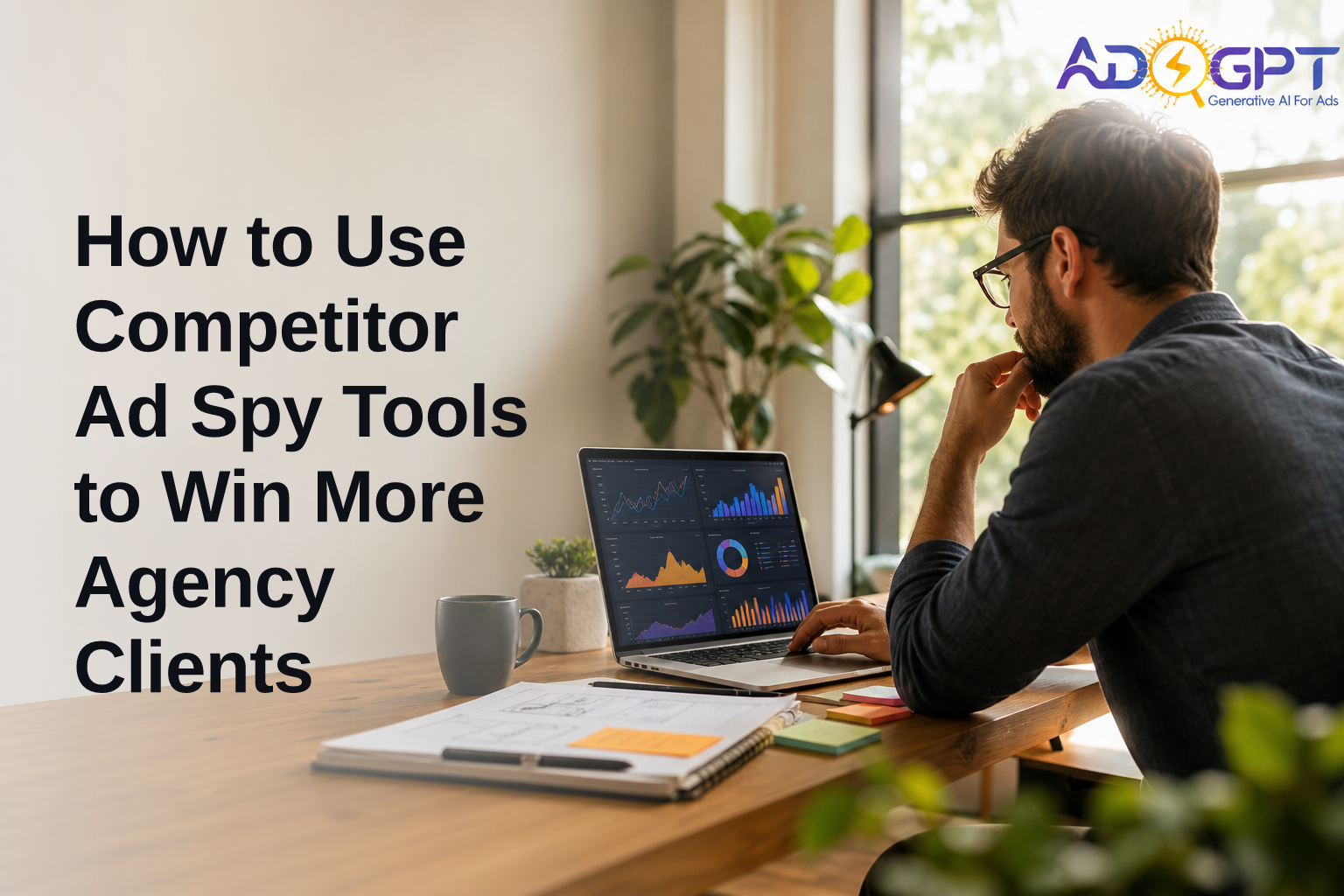
Pitch decks don’t win clients; clear proof that you can out-create their market does. A competitor ad spy tool gives you that proof in hours, not weeks.
You win more clients by showing data-backed creative gaps and fast test ideas pulled from live ads in their niche. In 2026, clients expect you to know what’s running, where, and why it works before the kickoff call. That means building a lean system that tracks creative, hooks, and formats across platforms and geos. It also means turning that data into one-page briefs your team can ship this sprint, not next quarter.
Evidence will.
For context on how paid messages shape demand, see this short primer on Advertising. But theory won’t land the deal. So let’s get practical and set up the workflow I use to prep winning audits in two to five hours per account.
 , filters for country, date, and format, with a grid of ad creatives and a chart of creative frequency by hook; muted agency brand palette; 2026 UI style)
Why Competitive Ad Intelligence Is a Non-Negotiable for Agencies in 2026
If you manage five to fifteen clients across ecom, SaaS, and local lead gen, you can’t manually track rivals’ ads. You’d miss launches, seasonal pivots, and new hooks in hours. With a competitor ad spy tool, you can see live creative across networks, compare angles, and spot gaps you can exploit next week.
In addition, your buyers are more informed. Procurement asks, “What did you learn from our market last week?” Not “What’s your process?” Therefore, intelligence is table stakes. Tools with a 500M+ ad database give you depth, while coverage across 9+ ad platforms gives you context. Without both, your audit turns into guesswork.
Moreover, creative churn is real. Even strong accounts burn out concepts in 4-6 weeks. You need a feed of what’s being tested now, not last quarter. That’s how you pitch “Here are three angles your competitors aren’t running in AU/UK yet,” and win the next retainer.
Specifically, a modern ad spy stack should help you:
A modern ad spy stack should let you track launches by brand, platform, format, and date. It must make comparing hooks, offers, and frames fast so patterns surface quickly. And it needs regional filters that reveal, for example, what wins in Canada vs. Germany.
Practical note: Keep your intel useful to creatives. Save the top 10 examples with tags like “Price-anchor,” “Problem-solution,” and “UGC demo,” and add one-sentence takeaways they can act on.
Step-by-Step: How to Build a Competitor Ad Intelligence Workflow for Your Agency
You don’t need more hours; you need a clean loop that runs every month with light upkeep. Here’s the six-step method my team follows across accounts.
- Identify each client’s top 5 competitors
- Start with sales’ “who-we-lose-to” list and your client’s CRM notes.
- Add 1-2 “category expanders” (fast growers outside the client’s size band).
- Save brand handles and domains for search consistency.
- Set up monitoring across platforms
- Add targets across Meta, TikTok, YouTube, Google, LinkedIn, X, Pinterest, Snap, and programmatic.
- Use your tool’s Competitor Intel feature to subscribe to brands and keywords.
- Turn on weekly email summaries, so your team doesn’t need to “go look.
- Analyze creative patterns and copy hooks
- Tag each ad by angle: problem-agitate-solve, risk reversal, price anchor, social proof, demo, before/after.
- Note “Insights on ad performance by region” where available to see if, for example, testimonials win in the U.S. but promos win in DACH.
- Track first frames, CTAs, and aspect ratios. Small details change scroll-stops.
- Build a swipe file per client
- Create one shared folder per account with subfolders by angle and format.
- Include a 1-slide “What this means” summary for busy execs.
- If you want a head start, see these creative teardown examples and adapt the tags.
- Use insights to brief creative teams
- Convert findings into a one-page brief: objective, angle, 3 hooks, formats, and first-frame notes.
- Add 2-3 reference ads with why they work in one sentence each.
- Then map to a sprint: two image ads, one UGC video, one 15s cut.
- Review and refresh monthly
- Prune dead angles, keep winners at the top, and flag white-space ideas for testing.
- In sprint planning, pick one “safe” and one “spicy” concept.
- For a deeper read on audit structure, scan this guide to AI-powered competitor research.
 → monitoring across 9+ platforms → pattern analysis (hooks, offers, formats) → swipe file curation → creative brief → monthly refresh; bright, simple icons; agency team collaborating)
Pro tip: Keep a standing 25-minute “intel standup” each month. One strategist brings three new examples and one test idea per client. That rhythm alone can lift your hit rate.
**Get Instant Competitive Ideas →
Also Read!
Best AI Video Ad Maker for Agencies in 2026
How to Choose the Best AI Ad Copy Generator for Your Ecommerce Store
5 Mistakes Agencies Make with Competitor Ad Spy Tools
Even good teams slip here. Avoid these, and your intel turns into booked work rather than slide filler.
Copying ads instead of extracting strategy is the first trap.
Don’t clone; extract the angle, offer type, and structure.
Then write in your client’s voice and proof so the output is original and on-brand. Only tracking one platform is the second misstep. Your client’s next win may be a TikTok hook recut for Reels, so track the whole mix, not just Meta.
Geo and Format Blindspots
Not filtering by region or market creates false positives. Offers that crush in the U.S. can flop in France, so read results through a geo lens. Filter by region before you brief the team, and localize the plan accordingly.
Quick example: A SaaS client saw rivals shift to “migration in 48 hours” offers in AU. We spun a “48h concierge import” variant and beat their lead cost by 22% in two weeks. The win came from timing and geo-specific reading, not luck.
Ignoring video ad formats leaves money on the table. In 2026, short video is the control in many niches, so log the first three seconds, on-screen captions, and CTA timing. Those details determine scroll-stops and conversions. Treating it as a one-time activity is the final mistake. Markets move, so refresh monthly, kill stale files, and tie intel updates to your sprint cadence.
Best Competitor Ad Spy Tools for Agencies: What to Look For
You need coverage, speed, and handoff.
Bigger databases improve pattern-finding, so a 500M+ competitor ad database raises your odds of spotting outliers. Aim for support across 9 or more ad platforms to avoid tunnel vision.
Strong filters for geo, date, format, and language are non-negotiable because they turn noise into briefs.
Also look for collaboration features and pricing that fit multi-client use, including seats, export limits, and how pricing scales with brands.
Tools to consider (neutral view):
- AdsGPT: Combines spy features with AI creative. It supports 9 ad platforms and a 500M+ database, and can generate 60 high-converting ads in 60 seconds. The Growth plan is $299 per month; the Scale plan is $399 per month. There’s also a free plan with 35 ad credits, no credit card required.
Social proof notes cite 10K+ happy marketers. If you need creation plus research, this is one option. – Meta Ad Library: Great for transparency on Meta placements. Limited beyond that, but still useful for baselines.
- SpyFu: Strong for search ads and keyword moves. Pair it with a creative-focused tool for social/video. – AdSpy and BigSpy: Broad social coverage for discovery. Check how fresh their feeds are for your niche.
Furthermore, check vendor trust. Vendors with SOC 2 Type II show mature security controls, which matters when you share client assets. Also, prefer tools that make export to your briefing format a two-click job.

Key Takeaways and What to Do This Week
- Competitive ad intel wins deals because it turns “we can help” into “here’s the gap and the plan.
- Use a competitor ad spy tool for breadth (9+ platforms) and depth (500M+ ads) so you don’t miss patterns.
- Build a six-step loop: pick 5 rivals, monitor, analyze hooks, curate a swipe file, brief creative, refresh monthly.
- Avoid the five traps: copying, single-platform focus, no geo filters, skipping video, and one-off audits.
- Pick tools on coverage, filters, team handoff, and pricing; add security and social proof to your checklist.
This week’s move: Pick one client. In two hours, list their five rivals, subscribe to those brands in your tool, and tag 12 ads by angle. Then write a one-page brief with three test hooks and show it on the next client call. If it lands, roll the workflow to two more accounts.

MOST POPULAR