
The best advertisement examples all do one thing well: they make people stop, feel something, and act. Whether it is a bold billboard or a ten-second video on a phone, a great ad earns attention in seconds. Yet most brands still struggle to turn good ideas into ads that perform. That is why studying real campaigns is so useful. Each one shows how clear messaging, strong visuals, and the right audience come together. In this guide, we look at classic and modern ads, explain a simple writing formula, and show how AI tools can speed up creative work. Along the way, you will see how brands test ideas quickly and keep the best performers. By the end, you will know what makes ads work and how to create your own.
Why Great Advertisement Examples Work
Strong ads share a few traits. First, they are clear. A viewer should understand the offer within three seconds. Second, they speak to one audience instead of everyone. Third, they use emotion, humour, or curiosity to create a reason to remember the brand. Finally, they make the next step obvious, such as “shop now” or “start free”. When you review advertisement examples that performed well, you will usually find all four traits. Missing even one often explains why an average ad fails to get results.
Classic Advertisement Examples That Still Teach Us
Some campaigns stay useful for decades because their lessons are timeless.
- Nike, “Just Do It” (1988): A short line that sells a mindset, not a shoe. It shows how one simple message can unite many products.
- Apple, “Think Different” (1997): The ad celebrated creative people instead of listing features. As a result, it helped revive the brand’s image.
- Dove, “Real Beauty” (2004): Real women replaced models, which sparked conversation and built trust.
- Coca-Cola, “Share a Coke” (2011): Names on bottles made a mass product feel personal.
Together, these advertisement examples prove that emotion and clarity beat complexity.
Digital Ads: What Works on Social and Video
Modern ads live on small screens and compete with endless scrolling. Therefore, the first two seconds matter most. Strong digital advertisement examples open with a clear hook, such as a question or a surprising visual. User-generated content styles also feel more authentic than polished studio spots. In addition, captions help because many people watch without sound. Brands should also resize creatives for each platform, since a 9:16 video behaves differently from a 1:1 feed image. Testing several versions is far more reliable than guessing which one will win.
Product Ads: Showing Value Fast
The best product advertisement examples show the item in use and state one clear benefit. Lifestyle shots help buyers picture the product in their own life, while clean pack shots build trust. Many teams now use product advertisement AI to turn a single photo into studio-style lifestyle images and hero shots. This saves time on shoots and lets small brands test more ideas. Even so, the idea still matters most. A great product ad answers a simple question: why should I buy this today?
How to Write an Advertisement: A Simple Formula
People who search for “how to write an advertisement examples” usually want a repeatable method. A reliable one has five steps.
- Hook: Open with a question, a bold claim, or a vivid image.
- Problem: Name the pain your audience feels.
- Solution: Show how your product removes that pain.
- Proof: Add a number, review, or demo.
- Call to action: Tell people exactly what to do next.
Keep sentences short, and write the way your customers speak.
Headlines and Hooks That Stop the Scroll
Headlines do most of the work. Strong ones are specific, short, and benefit-led. For example, “Cut reporting time in half” beats “Better software”. Questions can also work, as long as they touch a real concern. Numbers add credibility, while honest urgency encourages action. Many of the best advertisement examples rely on one sharp line. Moreover, the first line of a video script should match the headline’s promise. If the hook and the offer feel disconnected, viewers leave quickly. Write five versions of every headline, then keep the one that sounds most like your customer.
Choosing the Right Format and Platform
Each platform rewards a different style. Instagram and TikTok favour vertical video with quick cuts. LinkedIn suits clear, professional visuals and a direct business benefit. Google Display needs bold imagery and a short message that works at small sizes. YouTube allows longer storytelling. Therefore, adapt one idea into several formats rather than reposting the same file everywhere. This approach keeps the message consistent while respecting how people use each app. Always check each platform’s current specifications before exporting.
Speeding Up Creative Work With AI
Creating many ad versions by hand is slow and expensive. This is where AI for making advertisements helps. AI tools can draft copy, generate images, build short videos, and resize everything for each platform. Some tools also offer a free AI advertisement generator plan, which is a low-risk way to test the approach. Quality still depends on your brief. Give the tool a clear goal, your brand voice, and a specific audience. Then review every output before it goes live, because human judgement keeps ads accurate and on-brand.
How AdsGPT Helps You Create Ads Like These
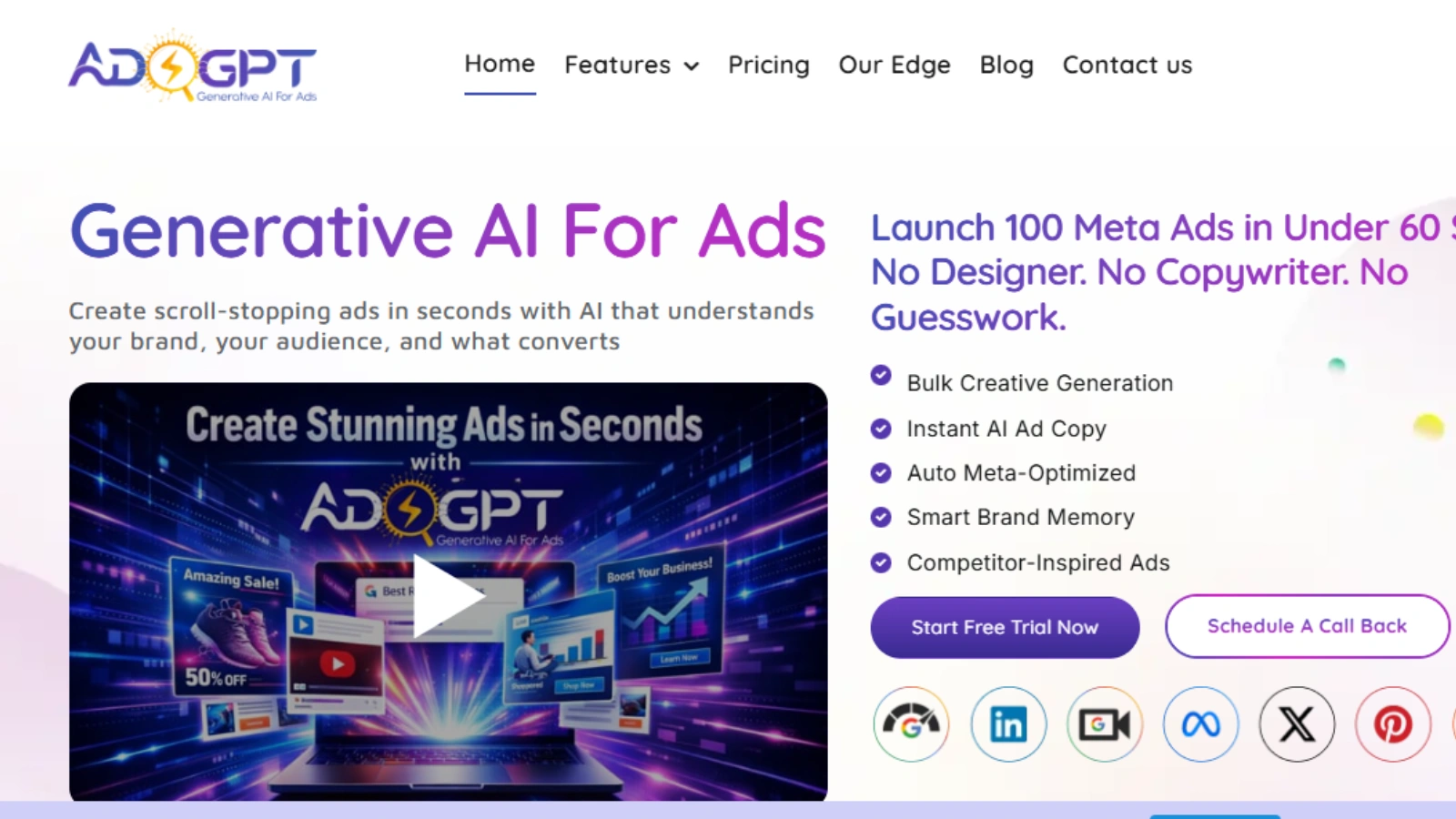
AdsGPT is an AI ads platform used by 10,000+ marketers. It turns a brief into image and video ads, so you can recreate the kind of advertisement examples above and then launch and improve them. Key features include:
- AI image ads in every platform ratio, with batch generation
- UGC video ads and AI avatar ads with lip-sync and captions
- Product Shot Studio for lifestyle shots and packshots from one photo
- Competitor: Intel to explore 500M+ ads and generate similar versions
- BrandIQ to store your logo, colours, and tone once
- Ad Factory for bulk, on-brand variations
- Direct Meta launch, AI audits, and Autopilot with safety controls
- Creatives for 9+ ad platforms
- Free plan with 35 creatives and no credit card
Together, these tools help you test more ideas without hiring a full creative team.
Testing and Measuring What Works
Even strong creative needs proof. Start by choosing one metric, such as cost per acquisition or click-through rate. Then change only one element at a time, for example, the headline or the opening visual. Run each version long enough to collect meaningful data. Afterwards, keep the winner and create fresh variations from it. Over time, this loop shows which advertisement examples in your own account perform best, which is more valuable than any generic benchmark. Record every result in a simple sheet so lessons are not lost when team members change.
Common Mistakes to Avoid
Several errors appear again and again. Many ads try to say too much, so the main message gets lost. Others ignore mobile viewing, which makes text hard to read. Some copy competitors too closely and lose their own identity. Finally, many teams stop testing after one good result. Avoid these traps by keeping one message per ad, designing for small screens, staying true to your voice, and testing continuously. Small fixes, such as a clearer first line, often lift results more than a full redesign.
Conclusion
The best advertisement examples succeed because they are clear, emotional, and built for the right audience. Learn from classic campaigns, follow a simple writing formula, and test often. AI can speed up the work, but strategy and judgement still matter. It also helps to keep a swipe file of ads you admire, so new ideas start from evidence instead of guesswork.
FAQs
1. Can AI replace a creative team?
AI boosts production and efficiency, but human judgement remains essential for setting strategies, reviewing results, and maintaining quality.
2. Is there a free way to try AI ad creation?
AdsGPT offers a free plan with 35 creatives and no credit card required.
3. How long should a video ad be?
Keep it short, often under 30 seconds, and put the main message in the first few seconds.
4. How many ad versions should I test?
Start with three to five variations and change one element at a time.
MOST POPULAR