Marketing teams today are under increasing pressure to produce more content across more channels. A single campaign may require social media videos, paid advertisements, product explainers, email assets, landing page visuals, and multiple creative variations for testing.
The challenge is no longer just creating content. It is creating the right content quickly while maintaining brand consistency and adapting to different audiences.
Traditional creative workflows often involve multiple disconnected stages. Strategy teams define campaign goals, copywriters create messaging, designers develop visuals, video teams produce assets, and marketers analyse performance. While this process can produce strong results, it can also become slow when teams need to create content at scale.
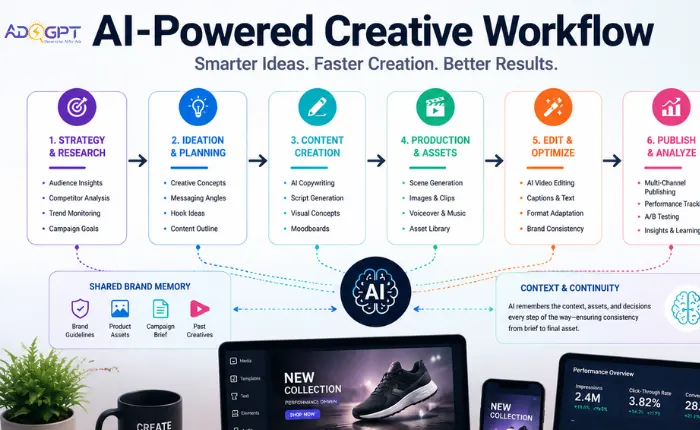
AI-powered creative workflows are changing this approach by helping marketing teams connect different stages of content production. Instead of using AI only for individual tasks, businesses are beginning to build workflows where AI supports research, ideation, creation, editing, and optimisation together.
The goal is not to remove creativity from marketing. It is to give teams more time to focus on strategy and storytelling while reducing repetitive production work.
Why Marketing Teams Need AI-Powered Creative Workflows
Modern marketing requires constant experimentation. A campaign that performs well on one platform may need a different approach for another audience or channel.
For example, a product launch may require:
- A long-form brand video
- Short social media clips
- Paid ad variations
- Customer-focused demonstrations
- Educational content
Creating each asset separately can slow teams down and create inconsistencies.
An AI-powered creative workflow helps marketing teams organise these processes more efficiently. By connecting different tools and stages, teams can move from an initial idea to finished content faster while keeping the campaign direction aligned.
Start With Strategy Before Content Creation
A common mistake with AI content creation is focusing on generation before defining the marketing goal.
AI tools can create visuals, videos, and copy quickly, but effective campaigns still need a clear understanding of the audience, message, and desired action.
Before creating content, marketing teams should define:
- Who is the campaign targeting
- What problem does the product solve
- What message needs to be communicated
- Which platforms will the content be used on
Once these foundations are clear, AI can help teams explore creative directions that match the campaign objective.
Using AI for Creative Research and Ideation
The first stage of a creative workflow is often brainstorming. Marketing teams need to develop campaign ideas, messaging angles, and content concepts that connect with audiences.
AI can support this process by helping teams analyse trends, explore content ideas, and generate creative variations.
For example, a brand launching a new fitness product can use AI to explore different campaign directions:
- A customer transformation story
- A product-focused advertisement
- A lifestyle campaign
- A social media challenge
Instead of spending hours creating initial concepts manually, teams can use AI to quickly explore possibilities and refine the strongest ideas.
Connecting Scripts, Visuals, and Production
One of the biggest challenges in marketing content creation is keeping different creative elements connected.
A campaign message should match the visuals. Product details should remain accurate. Brand tone should stay consistent across every piece of content.
AI-powered workflows are helping teams connect these stages.
For example, a marketer can move from a campaign brief to a script, then develop visual concepts and create final assets without restarting the process at every stage.
Invideo Agent fits into this type of workflow by helping teams move from ideas, scripts, and references to complete video projects. Rather than treating scripting, visual planning, generation, and editing as separate activities, it supports a connected process where creative decisions remain aligned throughout production.
This can be useful for marketing teams creating product videos, advertisements, social content, and campaign assets that need to maintain the same visual direction.
Building Scalable Video Production Workflows
Video is one of the biggest areas where marketing teams face production challenges.
Brands often need multiple versions of the same campaign for different platforms, audiences, and formats. A single advertisement may need variations for vertical video, paid campaigns, websites, and social media.
AI video workflows help teams create these variations faster.
Instead of producing every video from the beginning, marketers can adapt existing ideas into different formats while maintaining the campaign’s overall message and creative style.
This is especially valuable for performance marketing, where testing multiple creative versions is often necessary to find the strongest-performing content.
Maintaining Brand Consistency Across AI Content
As teams increase content production, maintaining consistency becomes more important.
AI can generate many creative possibilities, but without clear guidelines, different assets may feel disconnected.
A strong AI workflow should maintain:
- Brand voice
- Visual style
- Product details
- Messaging approach
- Creative direction
For example, a company running a product campaign across multiple platforms needs the product to appear the same in every video. The colors, design, and positioning should remain consistent whether the content is an advertisement, social post, or product demonstration.
AI workflows that use references and stored creative decisions help teams maintain this consistency.
How AI Agents Improve Creative Collaboration
Marketing campaigns often involve multiple teams working together. Strategists, designers, video creators, and performance marketers all contribute to the outcome.
AI agents can help simplify collaboration by maintaining context across different stages of a project. Instead of every team member repeating information or rebuilding creative direction, workflows powered by AI project memory can keep important decisions, references, and campaign details connected throughout the process.
With invideo Agent Two, teams can work with a system that remembers the context of a project throughout the workflow. It can retain creative decisions, references, and project details through stored memory, helping maintain continuity as campaigns develop across multiple stages.
For larger marketing projects, this context-aware approach can help teams coordinate areas such as visual planning, storytelling, cinematography, and effects without losing the original creative direction.
Combining Human Creativity With AI Efficiency
AI-powered workflows work best when they support human decision-making rather than replace it.
Marketing teams still need to understand their customers, develop strong ideas, and create messaging that feels authentic.
AI helps by reducing time spent on repetitive tasks such as generating variations, organizing content ideas, and supporting production processes.
The strongest workflows combine human creativity with AI efficiency. Teams can spend more time refining strategy and less time managing manual production steps.
Measuring and Improving Creative Performance
A complete AI-powered workflow does not end when content is published.
Marketing teams need to understand how creative assets perform and use those insights to improve future campaigns.
Performance data can help teams identify:
- Which messages attract attention
- Which formats perform better
- Which visuals create stronger engagement
- Which audiences respond best
AI can support this process by helping teams analyse patterns and develop new creative directions based on campaign results.
This creates a continuous improvement cycle where every campaign helps inform the next one.
The Future of AI-Powered Marketing Workflows
AI is moving marketing teams toward more connected creative systems.
Instead of using separate tools for research, writing, design, and video production, businesses are beginning to build workflows where different AI capabilities support the entire creative process.
Future marketing teams will likely rely on AI not just for generating content but for managing complex creative projects from idea to execution.
The advantage will come from creating workflows that combine speed, consistency, and strategic thinking.
Read More!
AI Ad Creative Testing: The Volume Mistake
Best AI Ad Creative Generator for Ecommerce
Final Thoughts
Building an AI-powered creative workflow is not about replacing marketing teams. It is about helping them create better content with greater efficiency.
By connecting strategy, ideation, production, and optimization, AI allows teams to scale creative output while maintaining quality and consistency.
As marketing becomes increasingly content-driven, businesses that build effective AI workflows will be better positioned to create campaigns that are faster, more adaptable, and more engaging.

MOST POPULAR