Three variants. That’s the median number of creatives brands ship into a new Meta campaign, declare it “testing,” and wait for the algorithm to work. When CPAs climb, they adjust budgets, tighten audiences, rework the landing page, and never touch the actual problem.
The creative is the targeting now. Meta’s systems route your ad to the people most likely to respond to that specific creative. Ship three mediocre variants, and you’ve handed the algorithm three mediocre signals. That’s not a test; it’s a ceiling you built yourself.
Listen to the blog.
The Real Cost of a Thin Creative Library
CPCs are already climbing. Research from 2025 shows cost-per-click rising roughly 10% year-over-year, and AI-driven automation is pricing newer players out of auctions where they used to compete on targeting precision alone. When your creative pool runs shallow, every dollar you spend trains the algorithm on a narrow signal, and you pay for that inefficiency at auction.
There’s also the fatigue curve, and it moves faster than most teams realize. Ad optimization research shows creative performance scores begin declining weeks before CPA visibly spikes. Brands that catch this early and ship fresh variants immediately hold performance. Brands that wait for the CPA signal, which is nearly everyone, are already in recovery mode by the time they act.
Recovery mode is expensive. Design briefs, copywriter revisions, video edits: a traditional production loop takes days or weeks you don’t have when a winning creative is burning out in real time.
What “Enough” Creative Volume Actually Looks Like
No universal number exists, but a useful frame: you need variation across at least three dimensions simultaneously: format (static image, UGC video, B-roll, avatar), emotional hook, and offer framing. Swap only headlines across five otherwise identical static images, and you haven’t tested format. Vary images but keep the same urgency angle on every execution, and you haven’t tested emotional register.
Meaningful testing across all three dimensions means 15–30 variants per product line, per quarter, with ongoing refreshes as fatigue sets in. Most teams can’t produce that. Not because they lack ideas, but because production is the bottleneck.
How Batch Generation Changes the Equation
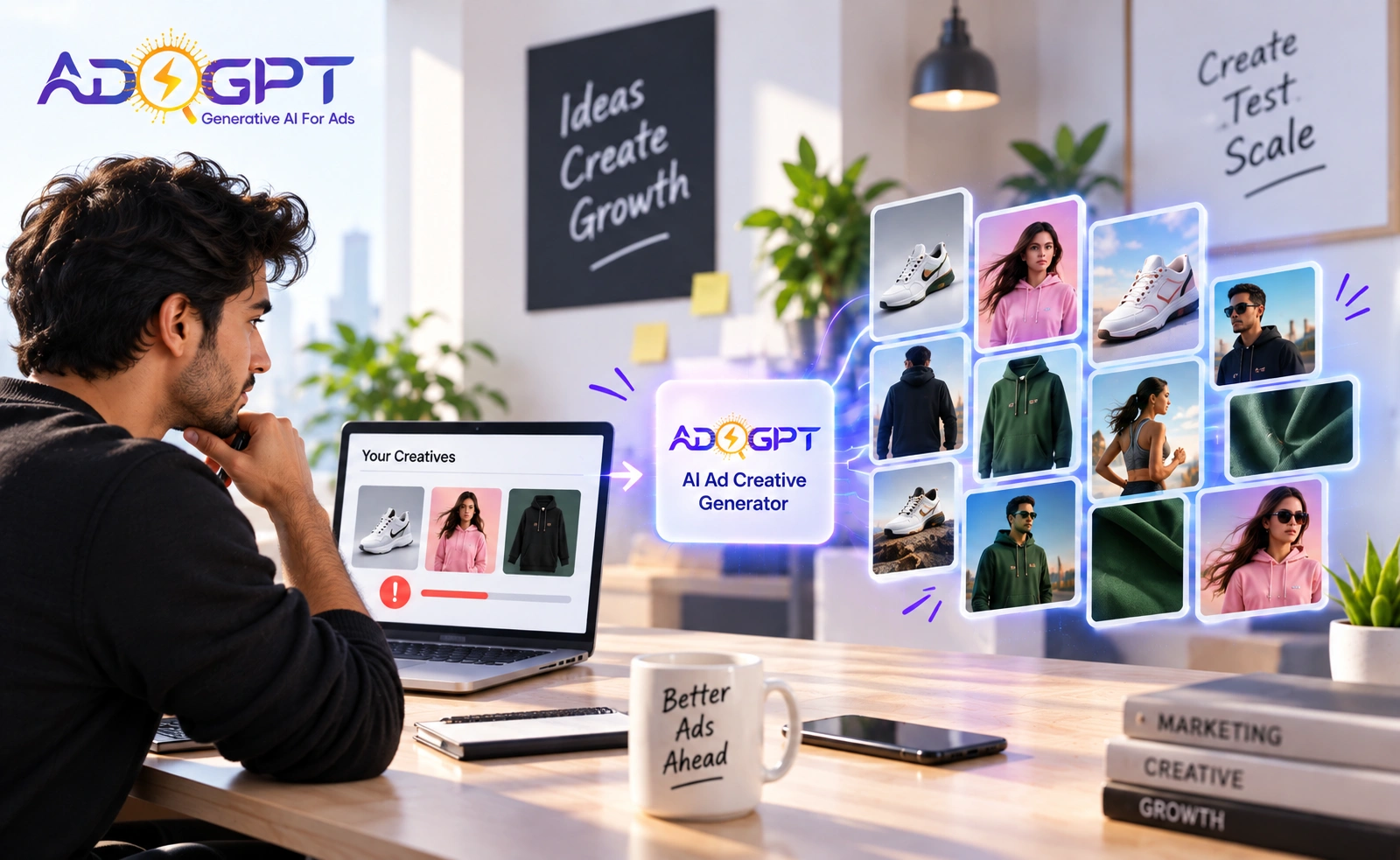
This is where AdsGPT, an AI ad creative generator, does something structurally different. You’re not swapping one slow production cycle for a slightly faster one. The batch workflow lets you generate image ads, UGC videos, B-roll clips, and AI Avatar Ads from a single prompt, simultaneously, in one pass, sized to spec for eight platforms.
That matters because format decisions are where most teams hemorrhage time. Internal debates about “should this be video or static” kill momentum. When you can produce both in the same session and let real performance data decide, you’ve removed an entire category of speculation from your process.
The format question also has a data-backed starting answer: UGC Video Ads convert up to 4× better than polished brand content, per AdsGPT’s platform data. That doesn’t mean every campaign should lead with UGC, but “we’re not a UGC brand” is a creative choice you should make with evidence, not instinct. Skipping the format because it feels off-brand before you’ve tested it is leaving the most likely winner on the table.
The Recreate Workflow for Scaling Winners
Finding a winning creative is half the problem. Extracting its value before fatigue sets in is the other half, and most teams get this wrong in one of two ways.
They either leave the winner running until performance collapses (passive, expensive in the long run), or they brief a manual remix through designers and wait days for turnaround (slow, breaks momentum exactly when you need to move fast).
AdsGPT’s Click Recreate feature connects performance data directly to production. One click on a winning creative generates five fresh variations immediately, same core concept, different execution. When creative scores start declining, which they will, reliably, before your CPA climbs, you already have the next wave queued. You’re not reacting. You’re iterating on a system.
Scaling also works differently when you have depth. Increasing budget on a single tired creative just accelerates fatigue. Five fresh variants of a proven winner give the algorithm something to optimize against at higher spend levels. The relationship between creative volume and ROAS lift is not subtle; more testable variation means faster signal, faster learning, and more defensible performance at scale.
Competitor Intelligence as a Brief, Not Just Research
Most brands treat competitor ad research as a quarterly ritual. Someone pulls examples, pastes them into a slide, and the deck influences nothing currently live.
AdsGPT’s Competitor Intel database contains 500 million+ ads across platforms. The workflow that matters isn’t browsing; it’s the one-click remix. You find a competitor ad that’s clearly working in your category, and you remix it for your brand in the same session. The brief writes itself from a real-world performance signal rather than internal guessing.
This is especially useful when entering unfamiliar formats. If you’ve never run AI Avatar Ads and you’re uncertain how your category handles them, seeing dozens of live examples from competitors before you brief your own is a categorically different starting point than a blank canvas. Research and production happen in the same tool, same session. No handoff. No delay between insight and execution.
Also Read!
The Production Cost Argument
The obvious objection to high creative volume: it’s expensive. Traditional workflows, briefing designers, coordinating copywriters, managing video editors, waiting on revisions, can make a 20-creative batch feel prohibitive regardless of strategy.
The 80% lower production cost AdsGPT cites against traditional agency workflows reflects how much of that cost is labor coordination rather than actual creative thinking. When one platform handles image ads, UGC Video Ads, Product B-roll Video, and AI Avatar Ads without separate vendors for each format, the coordination overhead collapses.
The economics change what’s possible. A team that previously tested three creatives per quarter because of budget constraints can now test thirty. That’s not the same game played faster; it’s a different game entirely. BCG research found shopping-related GenAI use grew 35% in 2025. Brands building creative production infrastructure now, while competitors are still treating AI as interesting rather than operational, will accumulate data advantages that compound and genuinely close slowly once established.
What Autopilot Adds to the Volume Strategy
Batch generation and the Recreate workflow solve the supply side of creative testing. The demand side, knowing which active ads to pause, refresh, or scale, still requires judgment and attention.
AdsGPT’s Autopilot audits live Meta ads continuously and optimizes around the clock. The undo log is worth noting specifically. It means AI-driven changes can be reversed, which addresses the real reason most teams don’t trust automated optimization: they can’t see what changed or undo it when something goes wrong. That’s a structural complaint about most ad automation tools, and an audit trail matters when you’re accountable to clients or internal stakeholders who ask questions after the fact.
Publishing live Meta ads without leaving AdsGPT- add a CTA, pick a creative, it goes live- removes the context-switching that kills momentum on high-volume programs. From “new variant generated” to “live in campaign” should be minutes, not a day-long import process. That gap compounds badly when you’re running a program that depends on fast iteration.
The Threshold Worth Knowing
Fewer than ten active creatives across a campaign means the algorithm is making optimization decisions on thin signal. Depending on spend level, it may not have learned anything meaningful yet; it’s just distributing budget across insufficient options.
AdsGPT accounts with consistent creative output through batch generation and Recreate workflows have seen an average 4.8× ROAS improvement within 60 days. That’s an outcome of volume and iteration speed, not a magic number, but it illustrates what happens when the algorithm actually has enough signal to optimize rather than guess.
If your current process can’t produce and refresh 15+ variants per month without heroic effort, the bottleneck isn’t strategy. It’s production infrastructure. The ad optimization checklist covers exactly what to track once creatives are live. For context on how AI ad generators compare on production volume specifically, the AdsGPT vs other AI tools comparison is worth reading before you commit to a workflow.
Stop treating creative production as the constraint that limits how much you can test. Build the infrastructure to test at the speed the algorithm actually needs, and then use performance data, not instinct, to decide what to scale.


MOST POPULAR