Most Meta advertisers blame the algorithm when performance stalls. Wrong diagnosis. The algorithm is working fine. It’s starving.
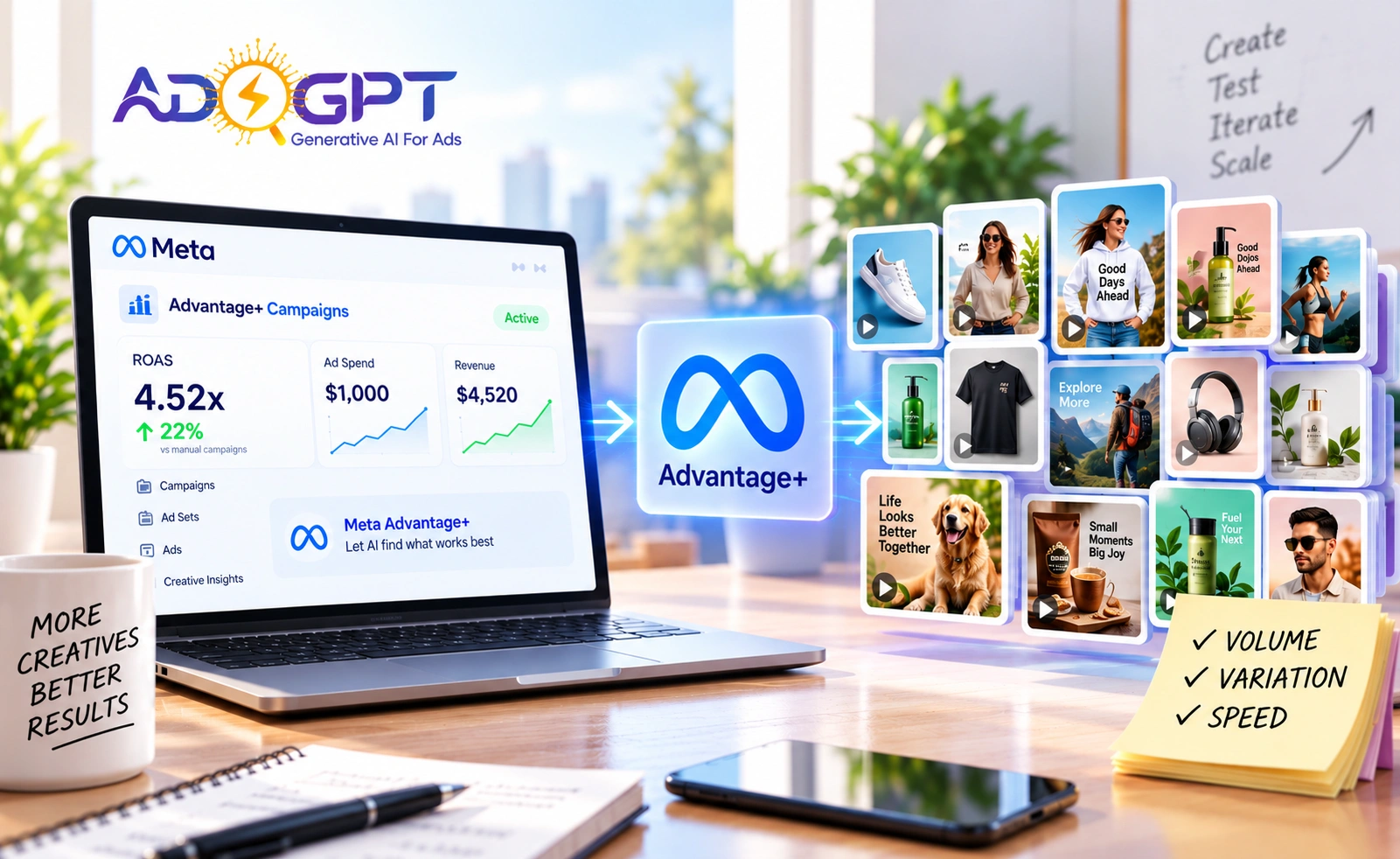
Meta’s Advantage+ campaign budget automatically redistributes spend in real time toward whichever ad sets and creatives are converting. The system is genuinely good at this. But it needs raw material to optimize against — creative variants, not one polished hero video and two static images. When you give it three assets, it burns through them in days, performance cliffs, and you’re back to blaming the platform.
This is the mistake growth teams make constantly: heavy investment in campaign structure and audience targeting, creative treated as an afterthought. Meanwhile, advertisers running Advantage+ campaigns achieved an average return of $4.52 for every $1 spent — roughly 22% higher than manually managed campaigns, per Meta’s own Q1 2025 earnings data. That gap doesn’t come from bidding genius. It comes from the algorithm having enough creative diversity to find what resonates.
The brands closing that gap aren’t hiring bigger design teams. They’ve solved the creative volume problem at the production layer — the same layer where AI is already proving itself at scale. Heinz’s AI ketchup campaign cleared 800 million views; Nutella’s AI-generated “Nutella Unica” sold 7 million jars in a single month, each jar carrying a distinct AI-generated design. The mechanism isn’t magic — it’s volume, variation, and speed to market.
Why Creative Fatigue Hits Faster Than You Expect
Here’s the uncomfortable math. A decent-sized Meta audience might see your creative multiple times a week. Frequency climbs, CTR drops, CPM rises to compensate, and ROAS collapses — sometimes within ten days of launching a new ad set. The platform’s auction dynamics, audience fragmentation, and creative fatigue cycles move faster than humans can reasonably respond to, as any senior paid ads manager will tell you.
The traditional answer was to brief an agency, wait two weeks, receive three concepts, and repeat. That cycle is simply incompatible with modern Meta pacing. By the time the new creative lands, your best-performing audience segment has already churned past it.
The fix isn’t a better brief. It’s a different production model entirely.
The Batch Production Workflow That Actually Works
AdsGPT is built around a specific insight: creative volume and creative quality are not in tension if you automate production correctly. Here’s the workflow DTC brands and growth marketers are actually running.
Step 1: Mine What’s Already Winning
Before generating anything, spend fifteen minutes in competitor research. AdsGPT’s Competitor Intel database contains 500 million+ ads across platforms. Search your category, filter by recency, and look for patterns in hooks, formats, and emotional angles — what’s your competitor leaning into: social proof or transformation? You’re not copying. You’re identifying the creative territory that’s already earning attention in your market.
Once you spot a strong concept, one-click remix it for your brand. Most people get this backwards: they start from a blank prompt when they should be starting from proven creative signals. For a closer look at extracting competitive intelligence without guesswork, the DTC brand Meta ad hooks case study walks through exactly this process.
Also Read!
Step 2: Generate a Full Batch From One Prompt
From a single creative brief, AdsGPT’s Ad Factory generates image ads, UGC videos, B-roll clips, and AI avatar ads simultaneously — not sequentially. Dynamic image styles span 3D, realistic, and anime, so the algorithm gets genuinely distinct visual treatments to test, not just resized copies of the same asset. A brand memory feature locks your style and tone across the entire batch, so output variety doesn’t come at the cost of brand consistency.
Why does format variety matter for Advantage+? Because the algorithm selects between creative formats within your campaign, not just between audiences. A static image that hooks a cold audience might underperform against a UGC video that converts up to 4× better than polished brand content for a warm retargeting segment. Constrain the algorithm to one format, and you’ve already constrained its optimization ceiling.
The practical output from a single batch session: image ads in multiple aspect ratios, a B-roll clip for Reels and YouTube Shorts, at minimum one UGC-style or avatar video. Five to ten distinct assets before you’ve written a single brief to a freelancer.
Step 3: Export Sized-to-Spec and Launch Without Leaving
Creative production time isn’t just generation — it’s resizing, reformatting, uploading. AdsGPT exports sized-to-spec creatives for eight platforms and lets you publish directly to a live Meta ad without switching tools. Pick a creative, add a CTA, it’s live. The friction between “this looks good” and “this is running” shrinks to minutes.
For teams deciding which formats to prioritize before launching, the Meta ad formats guide is worth reading alongside this workflow — format choice affects delivery and cost in ways batch production alone won’t solve.
Step 4: Scale Winners, Not Guesses
Once your initial batch has run a few days, you’ll see which creative is pulling. Most brands stop here — they found a winner, they scale budget behind it, and two weeks later they’re back to the fatigue problem because they’re running one asset hard.
The better move: click Recreate on the winning creative and generate five fresh variations. Same hook, same emotional angle, different visual execution. You’re feeding Advantage+ a cluster of related creatives that all point toward the proven insight, giving the algorithm variation without abandoning what’s working.
That’s the difference between a creative strategy and a creative habit. One produces a winner occasionally. The other produces a continuous supply of near-winners the algorithm can keep optimizing against.

Where Autopilot Fits In
AdsGPT’s Autopilot runs an AI audit of your Meta ads around the clock, with an undo log. This is not a replacement for the production workflow above — it operates on a different layer. Autopilot manages what’s already live. The batch production workflow manages what you’re feeding into the system.
Two distinct jobs. Creative production determines the ceiling of what’s possible. Runtime optimization determines how close you get to that ceiling. Most underperforming teams have focused exclusively on the second job while neglecting the first.
The Meta ad creative fatigue fix breaks down exactly what creative exhaustion looks like in your account metrics and when to trigger a new production cycle — useful if you’re diagnosing an existing campaign.
What 80% Lower Production Cost Actually Means in Practice
AdsGPT reports 80% lower production cost versus a traditional agency workflow. Worth unpacking what that displacement actually looks like, because it’s not just cheaper design work.
A traditional creative cycle chains together a designer for static ads, a video editor for motion, a copywriter for variants, and a separate research process for competitive intelligence. Four distinct skill sets, each with their own turnaround times and revision loops. The batch workflow described above replaces all four for the initial production run. A single prompt — specifying product, offer, emotional angle, and target audience — outputs across all those format types at once.
That’s not a marginal speed improvement. It’s a structural change in how creative production scales. Agencies and in-house teams running Growth and Scale plans are using this to handle client volume that would have previously required headcount additions.
The One Thing That Still Requires Human Judgment
AI batch production replaces creative production. It does not replace creative strategy. Knowing which emotional hook to test — scarcity versus aspiration versus social proof — still requires a human who understands the audience. Knowing when a winning creative is running out of steam, and in which segments, still requires someone reading the data.
What the batch workflow eliminates is the bottleneck between a good idea and a testable asset. That bottleneck — waiting two weeks for a freelancer to deliver three concepts — is what makes creative testing economically impractical for most teams. When you can move from insight to ten tested formats in an afternoon, the entire economics of creative experimentation shift.
Meta’s Advantage+ is a powerful optimization engine. Feed it three assets, and it will do its best with what it has. Feed it a continuous rotation of tested, varied, on-brand creative, and you start approaching what the platform’s AI is actually designed to deliver.
The ceiling isn’t the algorithm. It’s always been the creative supply.
Ready to break the creative bottleneck? Start your free AdsGPT trial — 35 creatives, no credit card required, and your first batch takes less time than writing a design brief.

MOST POPULAR