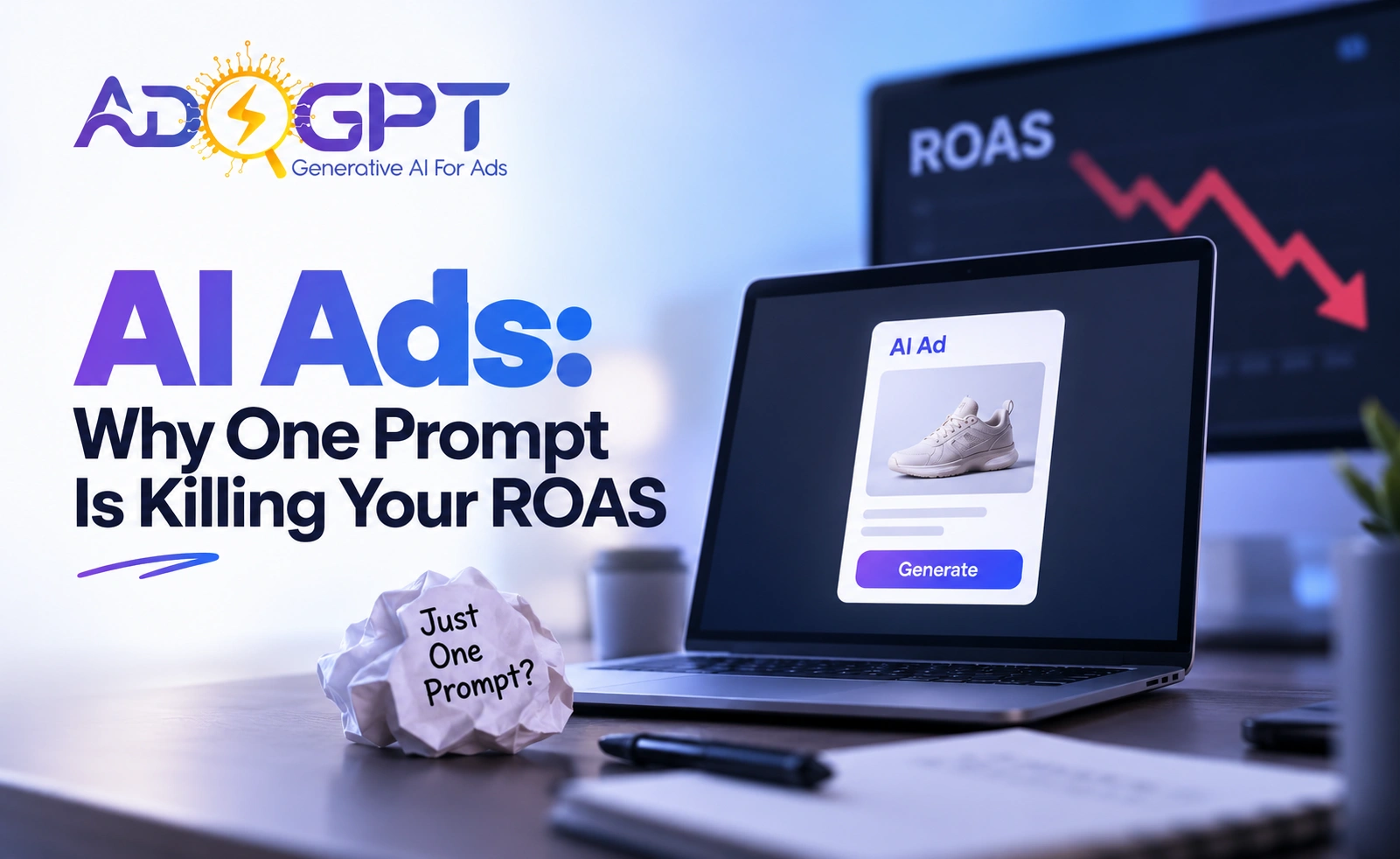
Generating a single AI ad and publishing it is not a strategy. It is a coin flip, and right now, the coin is landing tails more often than most marketers want to admit.
A BCG study found that shopping-related GenAI use grew 35% in 2025, yet adoption of structured AI creative workflows has not kept pace. Brands are adding AI tools. They are not changing how they think about creative volume, and that gap is where ROAS goes to die. Meanwhile, the backlash against generic “AI slop” aesthetics is real and getting louder. Marketers on Facebook Ads forums are noting that the AI slop penalty is brutal right now; indistinguishable outputs that lack creative intent are getting penalised by audiences and algorithms alike.
So is AI creative dead? Not even close. The problem is structural, not technological.
In a hurry? Listen to the blog instead!
The Real Reason AI Ads Underperform
The divide is not between teams using AI and teams avoiding it. It is between teams running batch-variation workflows and teams generating one creative at a time and hoping.
Here is what the single-prompt approach looks like in practice: open an AI ad generator, type a prompt, generate one or two images, pick the prettier one, publish it, and wonder why ROAS did not move. Then blame the tool, or worse, scale budget against an underperforming creative, which produces more of the same outcome at greater cost.
The structural problem is testability. A single creative cannot tell you whether the format failed, the headline failed, the visual hook failed, or all three. You have no signal. You have noise dressed up as a data point.
Teams consistently extracting gains from AI creative tools treat AI not as a replacement for creative judgment, but as a batch production engine. They run the volume that makes testing statistically meaningful, and they build the loop that compounds over time.
What “Batch Thinking” Actually Looks Like
With AdsGPT, the core workflow inverts the typical creative bottleneck. Submit a single prompt and get image ads, UGC videos, B-roll clips, and AI avatar ads in parallel, all sized to spec for eight platforms, ready to drop directly into your ad manager.
That is not the impressive part. The impressive part is what happens after you find a winner.
The Click Recreate function takes a high-performing creative and generates five fresh variations for scaling. Not five minor tweaks, five independent takes on the same winning structure. This is how you prevent creative fatigue without restarting your brief from scratch every time an ad goes stale.
Most teams never get here. They are still trying to coax one good creative out of a tool capable of producing hundreds. The production ceiling is gone. The bottleneck is now the willingness to treat creative as a testing asset rather than a finished product.
The Competitor Intelligence Step Most Teams Skip
Before you generate anything, there is a step that separates informed creative from guesswork: understand what is already winning in your category.
AdsGPT’s Competitor Intel database contains 500M+ ads filterable by industry, platform, region, and format. The workflow is blunt: search for ads in your vertical, identify what formats and angles are getting traction, and one-click remix them for your brand. You are not copying; you are starting from a proven signal instead of a blank prompt.
This matters because AI creative tools are only as good as the direction you give them. Garbage brief, garbage batch. A brief built on half a billion real ad signals is a fundamentally different input from one assembled out of intuition alone.
The competitor ad analysis workflow inside AdsGPT surfaces what is working and generates variants adapted to your brand in the same motion. Knowing that a particular format is saturated in your vertical before you generate a hundred iterations of it saves more than time; it saves the testing budget you would have spent confirming the obvious.
Also Read!
Format Choice Is Not Optional
One of the most expensive silent mistakes in AI ad production: generating the wrong format for the wrong placement and wondering why performance is flat.
Format is not a visual preference. It is a conversion mechanism. Platform-specific constraints are real; Google Ads demand clarity and precision; Meta and LinkedIn allow more expressive messaging. An AI ad generator that does not adapt copy and format automatically to platform requirements is adding friction, not removing it.
More critically: UGC Video Ads convert up to 4× better than polished brand content. That figure is not an edge case; it is the research backing an industry-wide pivot away from high-production aesthetics. Consumers trust imperfect more than perfect right now, and your format selection has to reflect that reality. The gap between “looks authentic” and “looks corporate” is exactly where conversion rates live.
AdsGPT’s UGC Video Ads and AI Avatar Ads formats exist for this reason. Product B-roll Video serves a different need: YouTube Shorts, Reels, product showcases, and requires different pacing and framing than a UGC testimonial clip. Choosing the wrong format for a placement is not a budget problem. It is a structure problem that budget cannot fix.
The Testing Loop That Actually Compounds
Here is the workflow that separates teams generating 4.8× higher ROAS within six weeks from teams treading water:
- Start with competitor intelligence. Search the 500M+ ad database for your category. Identify two or three angle archetypes that appear repeatedly; these are not trends; they are proven structures.
- Generate in batch. Use Ad Factory to produce image ads, UGC video, and B-roll against each angle from a single prompt. Export sized-to-spec for your platforms.
- Launch fast, not wide. Pick a creative, add a CTA, and publish a live Meta ad without leaving AdsGPT. Speed matters here; the faster you get signal, the faster you can act on it.
- Recreate the winner immediately. The moment a creative shows traction, hit Click Recreate for five variations. Do not wait until the original fatigues; you want variations in queue before that happens.
- Let Autopilot run the overnight audit. AdsGPT’s Autopilot audits and optimises Meta ads around the clock with an undo log. You are not replacing your judgment; you are extending it into hours you are not working.
This loop compounds because each winning creative informs the next batch brief. Within weeks, prompt quality improves, format selection sharpens, and the signal-to-noise ratio of your testing goes up. The teams that understand this are the ones building durable creative systems, not just running one-off campaigns.
What to Stop Doing
Publishing without a human review pass. AI creative needs a checkpoint before it goes live. A structured review is not bureaucracy; it is how you catch outputs that look plausible but miss the brand. Much of the backlash against AI ads is a story about insufficient review before publishing, not insufficient AI capability.
Testing one variation at a time. A single creative cannot isolate whether the format, the headline, or the visual hook failed. Batch generation exists to give you simultaneous signal across variables. Use it.
Scaling before you have signal. Underperforming AI ads usually fail because of structural misalignment, not budget size. Losses don’t surface on day one; they show up in week three, when habits clash with new workflows, and no one has built the review checkpoints that catch drift. Get signal at low spend first. Then scale.

The Cost Argument Is Real, But It Is Not the Main Argument
Yes, AdsGPT cuts production cost by 80% versus a traditional agency workflow; that figure comes from the platform’s own published data. The Creator plan, the most popular, runs $99/month for 1,250 Ad Credits. There is a free plan with 35 creatives if you want to test the batch workflow before committing.
But cost reduction is the wrong reason to adopt this approach. The right reason is iteration speed. An agency workflow that takes five days per concept cannot run the testing loops that compound ROAS. A batch AI ad generator that produces dozens of sized-to-spec creatives from a single prompt can, and the compounding effect is structural, not incremental.
One prompt is a lottery ticket. A batch-variation workflow is a compounding system. The difference is not the tool. It is the thinking behind how you use it.
Start your free AdsGPT trial and run your first creative batch today, no credit card required.

MOST POPULAR