Most ad accounts don’t have a targeting problem. They have a creative volume problem, testing three ads a month when the winning teams are testing three a day.
This is the workflow that closes that gap. It runs inside AdsGPT you feed in a brief, and it returns production-ready ad creative and copy across every format, and you push winners live without leaving the platform. Every step below names the exact AdsGPT feature you use and what you get out of it.
Why Creative Is the Only Lever Left in 2026
Broad targeting and automated bidding, Advantage and Performance Max, have become the defaults. The algorithm now decides who sees your ad. What you control is what they see.
That shift makes creativity the primary variable left to move CPA and ROAS. The data is clear: AI-generated creative consistently achieves 12% higher CTR on Meta across a dataset of 50,000+ ad variations, outperforming hand-made ads on click engagement. Meanwhile, nearly 90% of advertisers say they will use generative AI to build video ads, according to IAB’s 2025 Video Ad Spend report, a signal that the production playbook is shifting industry-wide.
The math follows. A team shipping 4 new creatives a month gets far fewer data points than a team shipping 24. Same budget, same audience, but one team is buying six times as many chances at a breakout ad. Volume isn’t vanity; it’s probability.
What “Creative Testing” Actually Means
Real testing operates at three levels. Confusing them is why most accounts plateau:
- Concept: the core angle or message (“save time” vs. “look professional” vs. “beat a competitor”). The biggest swings live here.
- Format: Static image vs. video, UGC-style vs. studio, carousel vs. single image.
- Variation: The hook, headline, and CTA. Smaller individual lifts compound over time.
The most common mistake: pouring hours into variation testing on a concept that was never going to work. Test concepts widely first, then iterate on survivors.
The Step-by-Step AI Creative Testing Workflow
Step 1: Write One Tight Brief
Before you generate anything, define the inputs that produce on-target creativity. You need the product’s one-line promise, the target buyer, the primary pain, the offer, and two or three proof points. Write those down before you open any tool.
A vague brief produces vague ads. Spend 15 minutes here, and everything downstream sharpens. This brief becomes the seed for every format AdsGPT produces, from static AI ad creatives to UGC video ads and AI Avatar Ads. One brief, every format, no reformatting between tools.
Step 2: Generate Across Angles, Not Just Wording
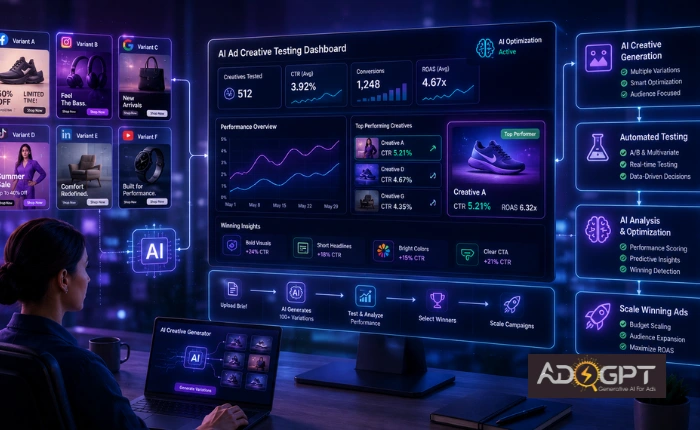
This is where volume happens. Feed your brief into AdsGPT and ask for creative across five to eight distinct angles: problem-agitate, social proof, objection-handling, direct comparison, urgency, and a founder or origin story. Each angle gets its own headline, primary text, and CTA, already structured for the placement, so you’re not reformatting by hand.
Here’s what a single brief can return. For a DTC supplement brand, three angle outputs might look like:
- Problem-agitate: “You’ve tried every focus hack on the internet. Here’s what actually works and the science behind it.”
- Social proof: “Thousands of orders shipped. One capsule, one hour, noticeably clearer thinking.”
- Objection-handling: “No jitters. No crash. No subscription trap. Just 30 days, risk-free.”
Each of those is a testable concept, not a headline swap. An AI ad generator producing 50 variants per hour versus 5 variants over several days is the concrete velocity shift, and that’s a ceiling a manual copywriting workflow simply cannot reach.
Ready to generate your first batch of six variations right now? Start your free AdsGPT trial →
Step 3: Batch Into a Structured Test
Take your top three concepts from Step 2. For each, carry forward two hooks; that’s six ad variations in one launch. Run them in a single campaign so the algorithm distributes budget to what performs.
For video formats, AdsGPT’s Ad Factory earns its place here. It batches on-brand ad variations across all formats and platforms in one pass. Your six concepts don’t need to be manually resized for Meta, Google, and LinkedIn separately. AdsGPT generates copy optimised for Google, Meta, LinkedIn, and Twitter natively; the platform handles placement specs so you don’t.
Teams using this approach experienced a 50% reduction in prototype-to-launch time, increasing test volume and ROI without adding headcount. Six variations from one brief, launched weekly, put you at roughly 24 tested ads a month, the volume threshold where the flywheel starts compounding.
Step 4: Set Kill and Scale Rules Before You Launch
Decide your exit criteria before a single dollar is spent so emotion doesn’t run the account:
- Kill signal: A variation spends well past your target CPA without a single conversion, or its CTR sits meaningfully below the ad set average after a statistically meaningful impression window. Pull it before it drains the budget that could go to candidates still in the running.
- Scale signal: A variation beats your target CPA consistently over a meaningful conversion window; feed its angle back into Step 1 as the seed for your next batch.
Once a winner is in market, AdsGPT’s Autopilot can audit and optimise your Meta ads around the clock, flagging degrading performance before you’d catch it manually. Creative fatigue is real. A top performer that isn’t refreshed loses ground fast, and the compounding defence is a standing refresh pipeline, not a reactive scramble.
Step 5: Iterate on winners and retire losers.
When a concept wins, mine it. Click Recreate on the winning ad inside AdsGP, T and you get five fresh variations of that same angle: new hooks, new proof points, new CTAs. One winning idea becomes a family of ads that keeps the account fed for months.
AI-optimised ad designs produce a 30% boost in engagement and conversions compared to traditional ad designs, but that lift only compounds when you’re continuously refreshing with winner-derived variants rather than starting from scratch each cycle.
The platform has generated over 1 million ads for 10,000+ marketers, with winning creatives delivering 4.8× higher ROAS within six weeks. That’s the outcome of the flywheel, not a one-time batch.
Common Testing Mistakes AI Won’t Fix for You
Tooling accelerates a good process and a bad one just as fast.
- Testing too many variables at once: If you change concept, format, and audience simultaneously, a win tells you nothing repeatable. Isolate the variable that matters most each round.
- Judging too early: Statistical noise is brutal at low volume. Give each variation enough impressions and spend enough to clear randomness before you call it.
- Ignoring the hook on the video: The first three seconds of a short-form video decide the majority of the outcome. Test hooks aggressively; they’re the cheapest high-impact variable in the mix.
- Never write down why a winner won: Keep a simple log of winning angles, formats, and proof points. That log is your best brief seed for the next batch, and it compounds the same way your creative library does.
One More Lever: Competitor Creative Intelligence
Before writing your next brief from scratch, check what’s already working in your category. AdsGPT’s competitor research workflow lets you spy on competitor ads across platforms and one-click remix them for your brand, pulling from a 500M+ ad database. That’s not copying; it’s using the market’s own performance data to inform your angle selection before you spend a dollar testing.
If a competitor is running a heavy social-proof angle and scaling spend, that concept is already validated. You can enter the test at the variation level rather than the concept level, saving the most expensive testing cycles for truly original angles. For a deeper look at how AI creative tools perform in real account conditions, the case study data is worth reading before you set your testing structure.
Start Shipping More Winning Ads
If your account is stuck testing a handful of ads a month, the constraint isn’t audience targeting or budget; it’s creative throughput. More tested concepts in the market mean more chances to find the angle that carries the account. At 80% lower production cost versus a traditional agency workflow, the economics of running a weekly batch-and-test loop shift dramatically.
Write one brief. Use AdsGPT’s AI Ad Creatives and Ad Factory to generate six variations across your strongest angles. Set your kill and scale rules. Launch. Then repeat it next week with the winner’s angle as your new seed.
That’s the flywheel. Accounts that get it spinning pull away from competitors still deliberating over a single headline.
Start your free AdsGPT trial and ship your next batch of tested ads today →

MOST POPULAR