
Start your free trial, no credit card →
Effective paraphrasing boils down to this: restate a source’s idea in fresh language and a new structure while preserving the original meaning, and give credit to the source. That’s it. This paraphrase effectively complete guide gives you a clear, five-step method to restate ideas in your own voice without losing meaning or risking plagiarism.
You finish a report at 11:52 p.m. It reads fine, until you compare it to the source and see twin lines everywhere. By 2026, editors, professors, and search engines expect nothing less because clear paraphrasing shows you understand the idea, not just the words.
For fast reference, you’ll learn a repeatable process, see before/after examples, and get short practice drills. You’ll also see where paraphrasing goes wrong and which tools can help. Throughout, the focus is education first, so you can write with confidence in class, at work, and for the web.

What Is Paraphrasing and Why Does It Matter?
Paraphrasing means restating someone else’s idea in your own words and sentence structure while keeping the same meaning. You still credit the source. Unlike quoting, you don’t copy the exact wording. Unlike summarizing, you don’t shorten to only the main point; you restate the full idea at a similar level of detail.
For a deeper primer, see the overview on Paraphrase (Wikipedia). That page shows how writers have paraphrased for centuries to explain, translate, and teach. Today, the same skill helps you show understanding and avoid over-quoting.
Why it matters:
- Academic integrity: You must show original thought and honest credit. Paraphrasing with a citation proves you understood the source, and it keeps you within academic rules against plagiarism. The Harvard Writing Center’s guidance on using sources is a helpful model of clear citation practice: Harvard Writing Center — Using Sources. – SEO content: Search engines reward pages that add value.
Fresh language, added context, and clear sourcing help your page avoid thin or duplicate content. For practical pointers, see Google’s guidance on helpful content. – Professional communication: Great paraphrasing helps you brief leaders, recap customer calls, and align teams. You show you listened, can explain it plainly, and can tailor the tone to your audience.
In this section and throughout, you’ll see the phrase paraphrase effectively complete guide used as a signal: you’re building a skill that protects trust, in school, at work, and online.
Paraphrase vs. Summarize vs. Quote
- Paraphrase: Restate the idea at similar detail in new words and structure; cite the source.
- Summarize: Condense to the core points; much shorter; still cite the source.
- Quote: Use the exact words; use quotation marks and a citation.
How to Paraphrase in 5 Steps (With Examples)
Here’s a simple, reliable process you can use in 2026 and beyond. Use it as a checklist from this paraphrase effectively complete guide.
-
Read and understand fully
Read the passage twice. Define any terms you don’t know. Ask: “What is the core claim, and what supports it? -
Set the original aside
Look away. Close the tab. This forces recall, which boosts understanding and reduces copying. -
Write the idea in your own words
Explain it as if you’re telling a teammate. Use your normal tone. Aim for the same level of detail as the original. -
Change sentence structure and vocabulary
Vary syntax. Combine or split sentences. Swap in plain synonyms only where the meaning stays intact. Keep any key terms that are necessary (e.g., “photosynthesis”). -
Compare and cite
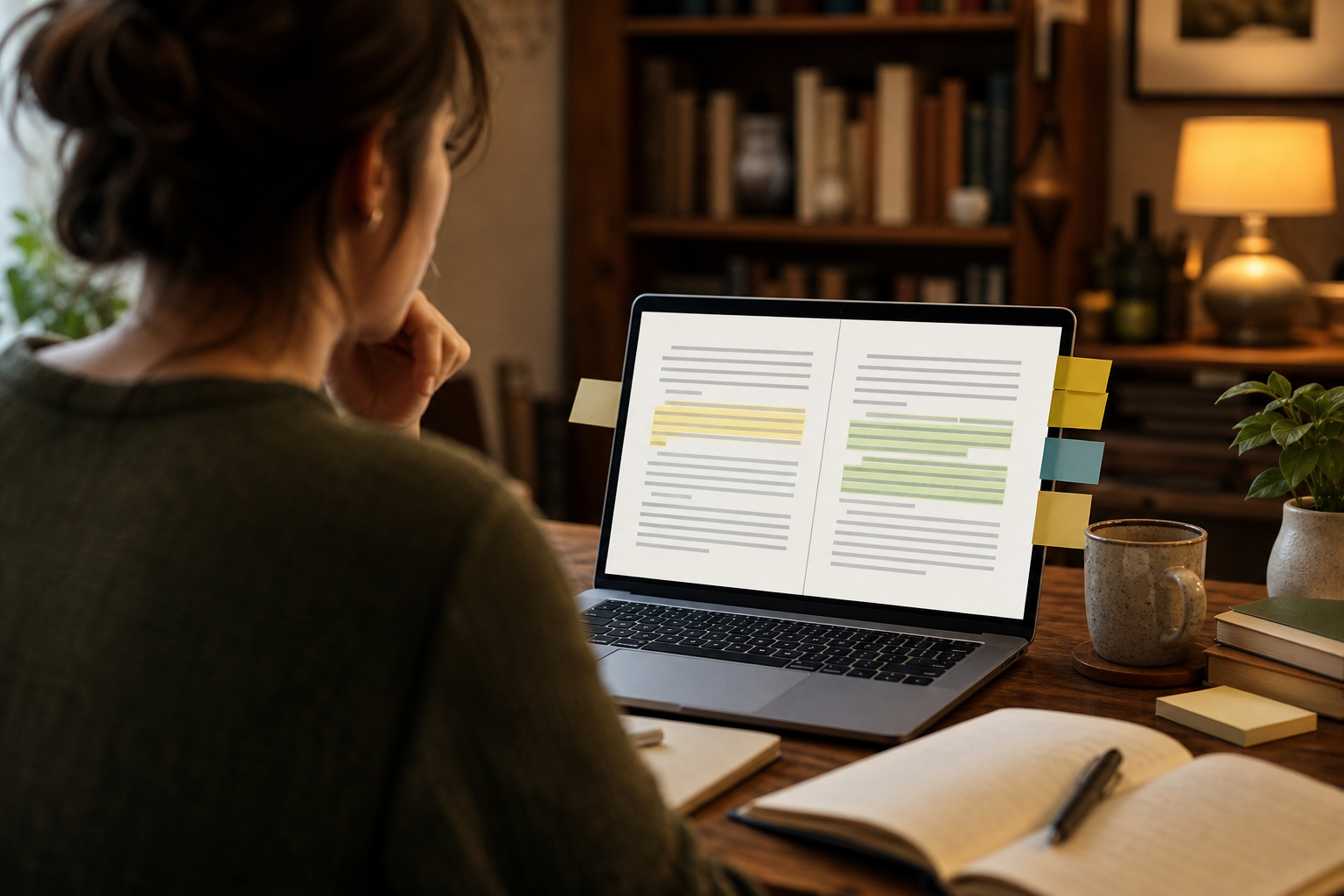
Lay your draft next to the source. Fix any close phrasing or mirrored structure. Add a proper citation in your style (APA, MLA, Chicago) or your company style guide.
Before/After Examples
Example A.
Original:
“Regular physical activity improves cardiovascular health by lowering blood pressure, enhancing endothelial function, and reducing systemic inflammation.
Poor paraphrase (too close):
“Routine physical activity improves heart health by reducing blood pressure, improving endothelial function, and lowering systemic inflammation.
Better paraphrase:
“Exercise supports heart health in several ways: it can bring down blood pressure, keep blood vessel linings working well, and curb body-wide inflammation.
Why it works: New sentence structure and plain words, same meaning, no key facts lost.
Example B.
Original:
“Our Q2 churn decreased after we launched in-app onboarding and weekly webinars for new users.
Better paraphrase:
“After we added in-app onboarding and a weekly intro webinar, fewer customers canceled in Q2.
Why it works: It keeps the cause and effect, shifts to everyday language, and changes sentence structure.
Pro tip: If your paraphrase looks like the original with only swapped synonyms, it’s patchwriting. Go back to Step 2 and draft from memory.
Also Read!
Common Paraphrasing Mistakes That Lead to Plagiarism
Several pitfalls can turn good intent into plagiarism. You can avoid them with a quick final check, especially the last two items below from this paraphrase effectively complete guide.
- Patchwriting: You change only a few words, keep the same order, and mirror the rhythm of the source. This is not true paraphrasing and may still count as plagiarism.
- Losing the original meaning: In the urge to be “different,” you may distort a claim or remove a key qualifier. If the meaning shifts, it’s inaccurate even if the words are new.
- Failing to cite: Paraphrasing still needs a citation. If the idea came from a source—even if it’s common in your field—credit it unless your style guide says it’s common knowledge.
- Copying sentence structure: If multiple sentences map one-to-one with the source, you’re too close. Reshuffle the order. Merge two short sentences. Or explain a concept, then give its examples (or vice versa).
- Over-reliance on AI with no review: Drafts from AI tools are starting points, not final text. You’re responsible for checking meaning, tone, and citations. Tools can miss nuance or invent claims.
“If your draft and the source read like twins, it isn’t yours yet. Fix the structure first, then the words.”
If you’re unsure, compare side-by-side and read aloud. Also, scan a respected guide such as the Harvard Writing Center page linked earlier for examples of fair use of sources. A 60-second check now protects hours of repair work later.
Tools and Resources for Better Paraphrasing
Tools won’t think for you, but they can speed checks and polish. Use them to support the process you learned above, not to replace it. As developers.google.com notes in its advice on helpful content, tools should add value for readers, not just rephrase text to “beat” detection.
Useful categories:
- Thesauruses: Use to spark word choices, not to swap every term. Meaning comes first.
- Readability checkers: Aim for clear, short sentences and concrete words.
- Plagiarism detectors: Catch patchwriting and missing citations before others do.
- AI assistants: Draft alternatives, then revise by hand for voice, accuracy, and citations.
For ad copy specifically, AdsGPT generates ad copies via AI prompts and includes an ad chat platform for generating ad copies and discussing ad analytics. The platform supports 9 ad platforms and gives access to a 500M+ competitor ad database, with 10K+ happy marketers using it. It also offers a free plan with 35 ad credits, no credit card required, and paid plans with no watermark and 17-second video ad limits on the free tier. As of 2026, it is SOC 2 Type II certified, which adds a layer of security assurance for teams.
You can also try tools like QuillBot or Grammarly for sentence rewrites and clarity checks. However, always compare the output to the source, fix the structure, and add citations. Your judgment is the key step.
Try instant rewrites, free today →
What to Do Next: Practice Exercises to Sharpen Your Paraphrasing
Small, real tasks build skill fast. Set a 20-minute timer and work through one exercise from this paraphrase effectively complete guide each day this week.
Exercise 1.
-
Pick one short news paragraph from a major outlet. – Read it twice, close the tab, and explain it in your own words in 3–4 sentences.
-
Reopen the tab and compare. Fix any mirrored structure. Add a citation line noting the outlet, date, and author.
Exercise 2.
- Grab a past email or report you wrote.
- Paraphrase one dense paragraph for a new audience (e.g., a client vs. a teammate).
- Aim for clearer structure: start with the claim, add one proof point, then a concrete example.
Exercise 3.
- Share your paraphrase with a peer and ask, “Did the meaning stay the same?
- Run a plagiarism checker to spot close phrasing. Fix and note what you changed: sentence order, word choice, or both.
Mini self-check before you ship
- Did I restate the idea at a similar level of detail?
- Is the structure clearly different from the source?
- Did I cite the source?

Key Takeaways
- True paraphrasing = new words and new structure + same meaning + citation.
- Set the source aside, draft from memory, then compare and fix close phrasing.
- Patchwriting, missing citations, and copied sentence structure are the big risks.
- Tools can help, but your review for meaning and credit is what makes it sound.
- Use this 5-step process and quick drills to build a reliable, fast habit.
What to Do This Week
Block three 20-minute sessions on your calendar. In session one, paraphrase a news paragraph. In session two, rewrite an old email for a new reader. In session three, check your work with a peer or a plagiarism detector, then save your notes as a personal checklist for 2026 projects.

MOST POPULAR