Start your free trial, no credit card →
To get more conversions, state one big promise, prove it fast, and make the next step obvious. You’ll create persuasive ads actually convert by pairing a sharp benefit with real proof and tight targeting.
Here’s the quick answer: pick one goal, speak to one pain, lead with one benefit, and give one clear action. Then back it with social proof, keep the design scannable, and test two to three variants right away. That is how you raise click-through and drop your cost per result.
In 2026, ad platforms reward relevance and users reward clarity. So, your job is not to “be clever.” Your job is to make choice easy. The steps below show you how to do that, with examples you can copy today.
What Makes an Ad Persuasive? The Psychology Behind Ads That Work
A persuasive ad moves someone from “maybe later” to “let me click now” with a clear promise, credible proof, and an easy path forward. It shifts belief in seconds. If you want to create persuasive ads actually convert, start with human psychology, not platform tricks.
Robert Cialdini’s research points to reliable triggers you can use. Scarcity (“Only 200 seats left”) nudges action by highlighting what’s rare. Social proof (“10K+ customers”) shows safety in numbers.
Authority (expert or brand credibility) lowers risk. Reciprocity (give value first) opens people up to say yes. For background, see Robert Cialdini.
Emotions drive clicks, while reason seals the deal post-click. For example, Apple’s “1984” built an emotional world, rebellion and freedom, then the product paid it off. On the other hand, M&M’s “Melts in your mouth, not in your hand” is a rational claim that solves a real mess. Both work because they speak to what the buyer cares about.
Moreover, emotional cues spark attention and memory. A parent seeing a spot about safety feels first, then checks the details. Conversely, a B2B buyer may need a proof point (like a case study quote) to justify the spend. Therefore, a good ad blends a feeling with a fact.
Quick mental models you can borrow
- Scarcity: “Ends Friday at midnight.” Use with a real deadline, not fake urgency.
- Social proof: “10K+ happy marketers.” Be specific and truthful.
- Authority: “SOC 2 Type II.” Certifications reduce fear of risk.
- Reciprocity: “Free audit template.” Give value before asking for the click.
7 Steps to Create Persuasive Ads From Scratch
If you want to create persuasive ads actually convert, build them in this order. The craft is the strategy.
Step 1: Define one clear objective
Pick one outcome per ad: book a demo, start a trial, or download a guide. As a result, your headline, image, and CTA can all point to the same goal. Mixed goals kill performance.
Step 2: Research audience pain points
Interview five users this week. Ask, “What was going on the day you looked for a tool like this?” Then mine reviews and support tickets. Specifically, note the words they use. Those words become your hooks.
Step 3: Lead with a benefit-driven hook
Translate features into a promise. “Invoice in 2 minutes” beats “Automated invoicing software.” Moreover, add who it is for: “Invoice in 2 minutes for freelance designers.” Clarity wins attention.
Step 4: Use a proven copy formula (PAS or AIDA)
- PAS: Problem → Agitate → Solve. “Missed deadlines? Projects slip, clients churn. Plan your week in 10 minutes.
- AIDA: Attention → Interest → Desire → Action. Hook with a sharp claim, add proof, then invite the click.
Therefore, write three hooks in PAS and three in AIDA. Test them.
Step 5: Add social proof
Use hard evidence: review counts, user numbers, or a short quote with a name and role. For example, “10K+ happy marketers” is clear and credible. However, keep it short. Your proof should not drown your promise.
Step 6: Design for visual hierarchy
Make the promise the largest element. Place the main visual next to it. Then put a bold CTA below. In addition, remove anything that doesn’t earn its spot. Fewer elements mean faster scanning and more clicks.
Step 7: Test and iterate with A/B variants
Launch two to three variants per audience: change the hook, the image, and the CTA verb. Furthermore, kill losers fast and feed winners new angles. In 2026, speed of testing is a moat.
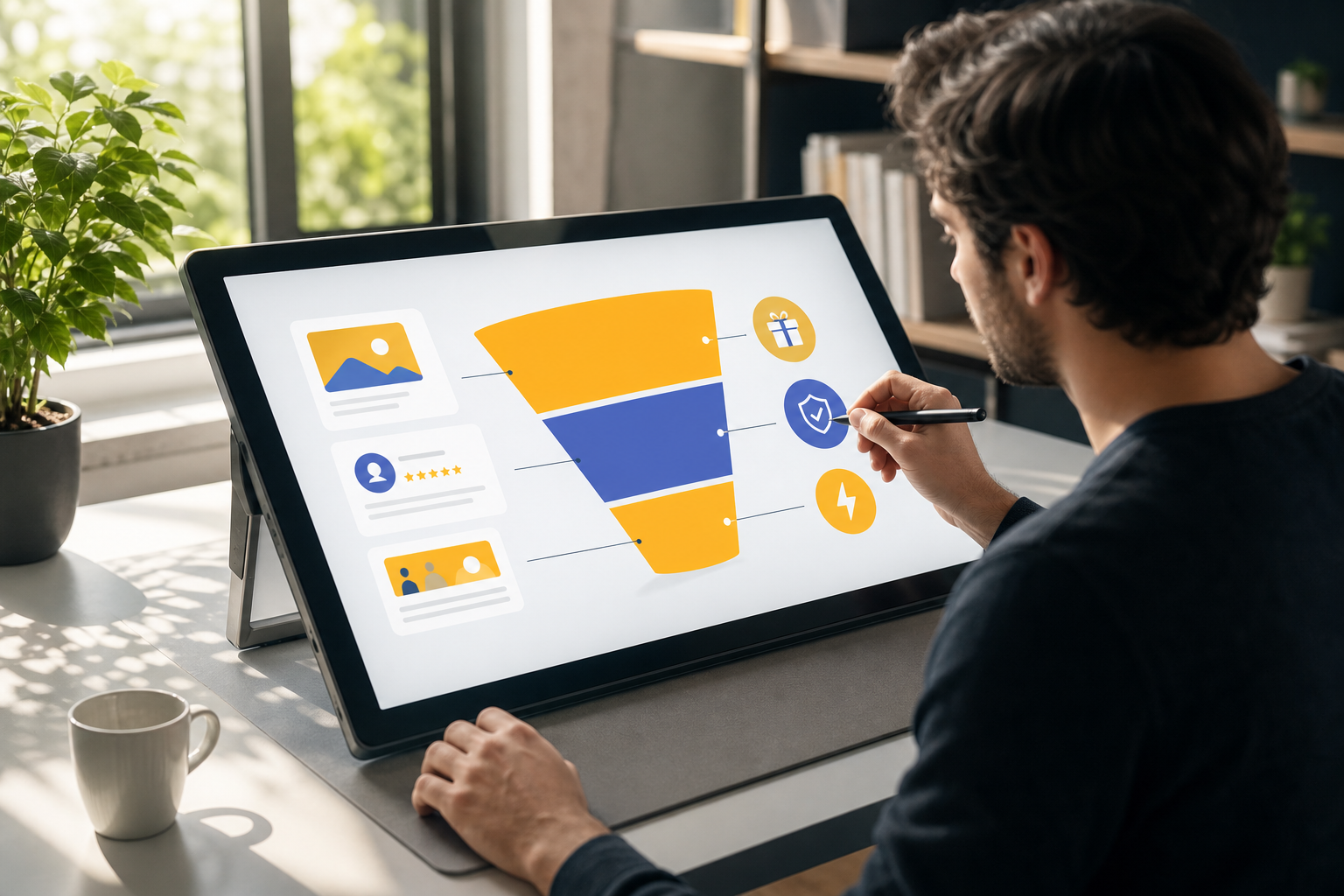
 , Proof, Design, A/B Test; each block includes a short example; clean sans-serif style)
Get instant ad ideas, free today →
Also Read!
5 Common Mistakes That Kill Ad Persuasion
You can create persuasive ads actually convert only if you avoid the traps below. Each has a simple fix you can ship today.
Mistake 1: Feature-dumping instead of benefits
Listing specs forces the user to do the math. They won’t. The fix: write “So you can…” after each feature. Then keep only the benefit that matters for this audience.
Mistake 2: Weak or generic CTAs
“Learn more” is a stall, not a step. The fix: make the next action clear and valuable. For example, “Start free for 7 days” or “Book a 15‑minute demo.” Action + value beats filler.
Mistake 3: Ignoring platform norms
A square image on a vertical feed looks off. The fix: match creative to the feed. Use vertical video for short-form feeds, and punchy first frames. In addition, front-load the hook in the first 2–3 seconds.
Mistake 4: No audience segmentation
One ad for “everyone” hits no one. The fix: split by role, pain, or stage. For example, “For founders under $1M ARR” vs. “For growth leads at $5M+.” Speak to the job, not the crowd.
Mistake 5: Skipping competitor research
Guessing costs budget. The fix: scan live libraries to see what messages run long, then build a fresh angle. However, don’t copy. Borrow the insight, not the headline.
“Clarity beats clever. Specific beats vague. One promise beats three.”
Tools and Resources for Building Persuasive Ad Creatives
The right toolkit helps you move from idea to live test in under an hour. To create persuasive ads actually convert, pair fast design with real-world proof and clean copy.
For design, Canva gives you quick layouts and brand kits that keep fonts and colors tight. For research, Meta Ad Library and Google Ads Transparency Center show which angles appear at scale. Moreover, they help you avoid oversights before you ship.
For copy clarity, Hemingway Editor forces short sentences and plain words. In addition, a landing page builder like Unbounce lets you match message to page without waiting on a sprint. That match, ad to page, lifts conversions with no extra spend.
For AI-generated concepts and variants, tools like AdsGPT can speed the heavy lift: it generates 60 high-converting ads in 60 seconds, taps a 500M+ competitor ad database, and supports 9 ad platforms. It also offers a free plan with 35 ad credits and no watermark on paid plans, and it’s SOC 2 Type II aligned for security. As social proof, 10K+ happy marketers use it today. Use it as a draft engine, then refine with your own voice.
Use this kit to:
- Move from research to launch in under 60 minutes.
- Match each ad to a tight audience segment.
- Ship clean copy and congruent landing pages.
Furthermore, in 2026, speed plus accuracy wins. Build a stack you’ll actually use, not a museum of tools.
Key Takeaways

- One promise, one proof, one action. That’s the spine of every high-converting ad.
- Use PAS or AIDA to turn pains into hooks people can’t ignore.
- Add credible proof: numbers, certifications, or short quotes with names.
- Design for fast scanning: big promise, strong visual, bold CTA.
- Test two to three variants, kill fast, and feed the winners more angles.
What to Do This Week: Your Persuasive Ad Action Plan
You can create persuasive ads actually convert in five focused days. Here’s a concrete plan you can follow without guesswork.
- Day 1 — Audit your current ads: List every active ad with its goal, hook, proof, and CTA. Cut anything that doesn’t serve a single goal. Save winners to a swipe file.
- Day 2 — Study competitor winners: Scan live libraries for 30 minutes. Note three repeated angles per rival. Write down gaps you can own. Do not copy; extract themes.
- Day 3 — Rewrite headlines with PAS: Draft 10 hooks. For each, write a Problem, Agitate it in one line, and Solve with your benefit. Pick the top three to test.
- Day 4 — Redesign one visual: Make the promise the largest element. Add one image that shows the result. Place a bold CTA below. Remove extra badges and fluff.
- Day 5 — Launch an A/B test: Ship your three variants to one audience. Change only the hook per variant. Check first 500 impressions, kill the laggard, and scale the winner.
Ship this week. Learn next week. Then repeat. Small, fast loops beat big, slow plans.
Start testing winning ad variants now →
Moreover, keep a simple scoreboard: cost per result, click-through rate, and conversion rate. Therefore, you’ll see, in plain numbers, which ideas earn their keep in 2026.

MOST POPULAR