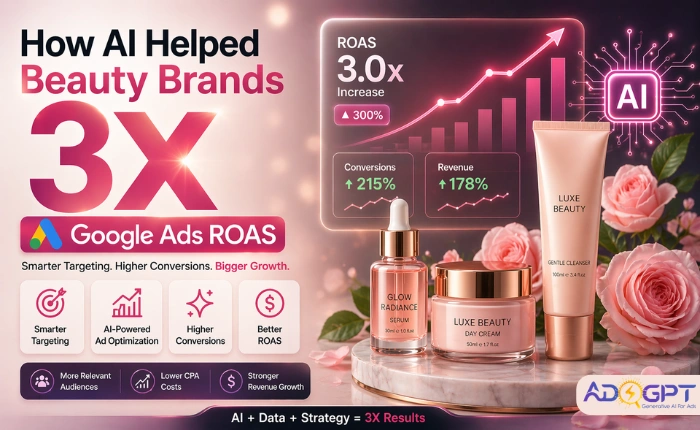
When your ROAS triples, people want to know your secret
Something unusual began unfolding inside a small, emerging beauty brand running Google Ads. The budgets remained steady. Targeting saw little to no change. Yet, over time, revenue from those campaigns quietly tripled.
There was no high-profile creative agency brought in. No costly production overhaul behind the scenes. Instead, the shift came from how the brand approached creating and testing its product ads.
That shift proved significant because beauty ecommerce has long struggled with a core challenge: producing enough high-quality creative, fast enough, to stay competitive. For most brands, the process is slow, expensive, and often reactive.
Like many others, this young beauty brand once relied on a limited set of polished assets—some product images, a couple of messaging angles—and expected performance to scale from there.
It rarely did.
What set this brand apart was a change in mindset. Instead of treating creative as a fixed asset, they began treating it as a variable. They adopted an AI advertisement generator to produce a wide range of creative variations at scale, continuously feeding fresh inputs into their campaigns.
The impact wasn’t incremental. It was transformative.
This wasn’t simply about writing better copy. It was about increasing creative volume and diversity—and in doing so, fundamentally changing how product ads performed within Google’s system.
What followed offers a closer look at what changed, why it worked, and how the same approach can be applied without guesswork.
Read Aloud!
Why Beauty Brands Are Winning With AI-powered Google Ads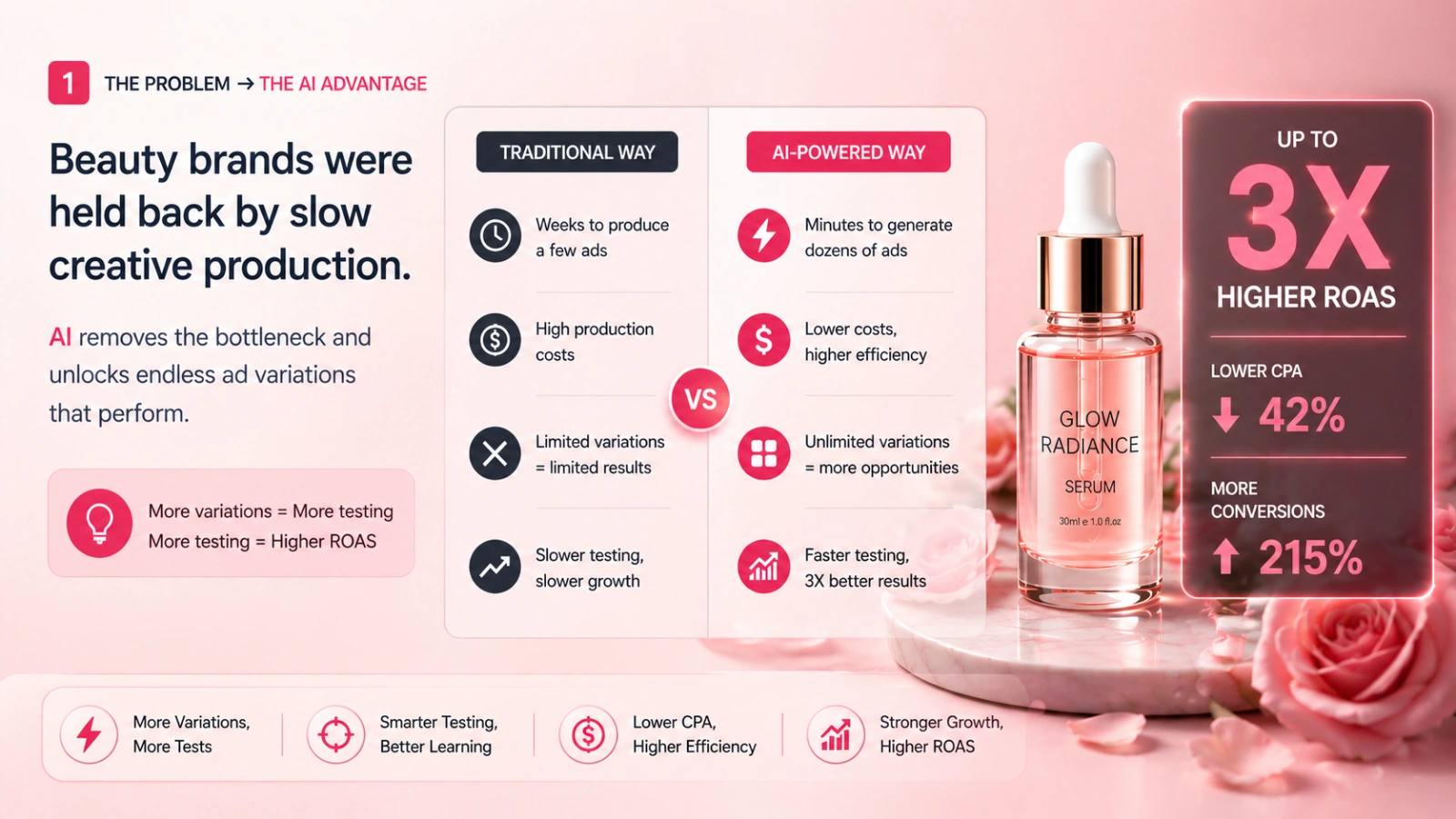
An emerging beauty brand began increasing its returns from Google Ads by pairing AI-generated product ads with Performance Max and Shopping campaigns. These campaign types depend heavily on diverse creative inputs to optimize effectively.
To support this, the brand introduced an AI advertisement generator, enabling it to produce multiple variations of headlines, visuals, and descriptions in a fraction of the usual time. This gave the algorithm a wider range of combinations to test and learn from.
As the volume and diversity of creative increased, so did performance. The campaigns learned faster, cost per conversion dropped, and overall ROAS improved significantly. The advantage did not come from a single breakthrough idea, but from the brand’s ability to scale and iterate creative quickly.
The Beauty Industry’s Google Ads Problem Was Never budget – It Was Creative Velocity.
Most teams assumed that poor performance in Google Ads came down to targeting or bidding. That turned out to be only part of the picture.
For an emerging beauty brand, the real constraint was creative supply.
They began by looking at a single product through multiple lenses. A moisturizer, for instance, could be positioned around hydration, sensitive skin, anti-aging, fragrance-free formulas, or dermatologist approval. Each of these represented a distinct message with its own appeal.
However, their existing product ads did not reflect that range. Like many brands, they relied on a limited set of assets from a single photoshoot, paired with a standard product description and perhaps one promotional hook.
It was not enough.
As they adapted their approach, they also began to understand how Google’s Performance Max system actually worked. It combined different creative assets and tested countless variations to identify what converted best. The system performed better when it had more high-quality inputs to work with.
By providing only a few assets, the brand had been limiting the system’s ability to learn and optimize.
Creative production had been the bottleneck all along. Photoshoots required time. Agencies needed briefs, revisions, and approvals. By the time new ads were ready, the moment for testing them had often passed.
The issue was never the budget. It was the brand’s inability to produce enough creative, quickly enough, to match how Google Ads truly optimized.
What Actually Changed: How These Brands Started Using AI To Build Product Ads At Scale
The shift did not come from better targeting. It came from changing how product ads were created.
Instead of relying on manual workflows, brands began using an AI advertisement generator to produce dozens of variations in a single session.
The difference in process is striking.
Before, a team would brief an agency, wait weeks, and receive a handful of assets. Testing cycles were slow, and insights came late.
After, they could generate 20 to 50 variations in an afternoon. Those variations included headlines, descriptions, and creative angles designed for Google Ads formats.
That speed changed everything.
Performance Max campaigns benefit directly from this approach. They require a wide range of inputs to identify what works. AI-generated variation feeds that need without increasing production cost.
From Product Image To Live Google Ad In Minutes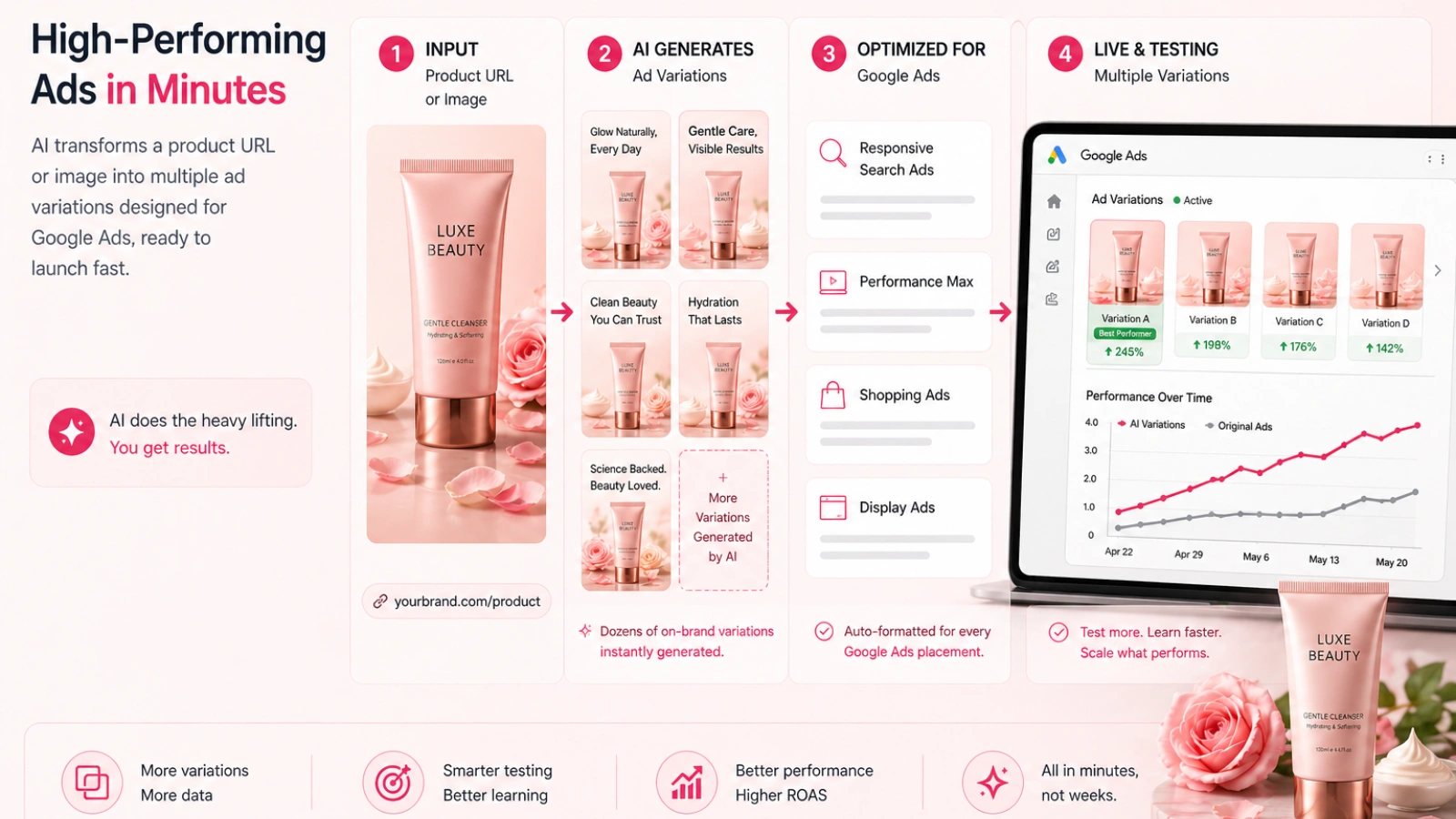
The workflow is surprisingly simple.
You start with a product URL or image. The AI advertisement generator analyzes it and produces multiple headlines, descriptions, and creative concepts.
These outputs are already structured for Google Ads, including responsive search ads and asset groups.
Within a short time, you move from raw product data to live campaigns running multiple variations.
What used to take a week now takes a few hours.
The Creative Diversity Principle: Why Google Rewards More Variations
Google’s system is built to test combinations. Each asset is a piece of a larger puzzle.
When you increase the number of unique inputs, you increase the number of combinations the system can evaluate.
That leads to faster learning.
In beauty, this matters even more. Each product can be framed in multiple ways, and each framing appeals to a different audience segment.
Using AI, brands can generate all those variations at once. Instead of guessing which message works, they let the system find the answer through testing.
That is why more diverse product ads often lead to better results in Google Ads.
Real results, real campaigns: what 3x ROAS actually looked like in practice
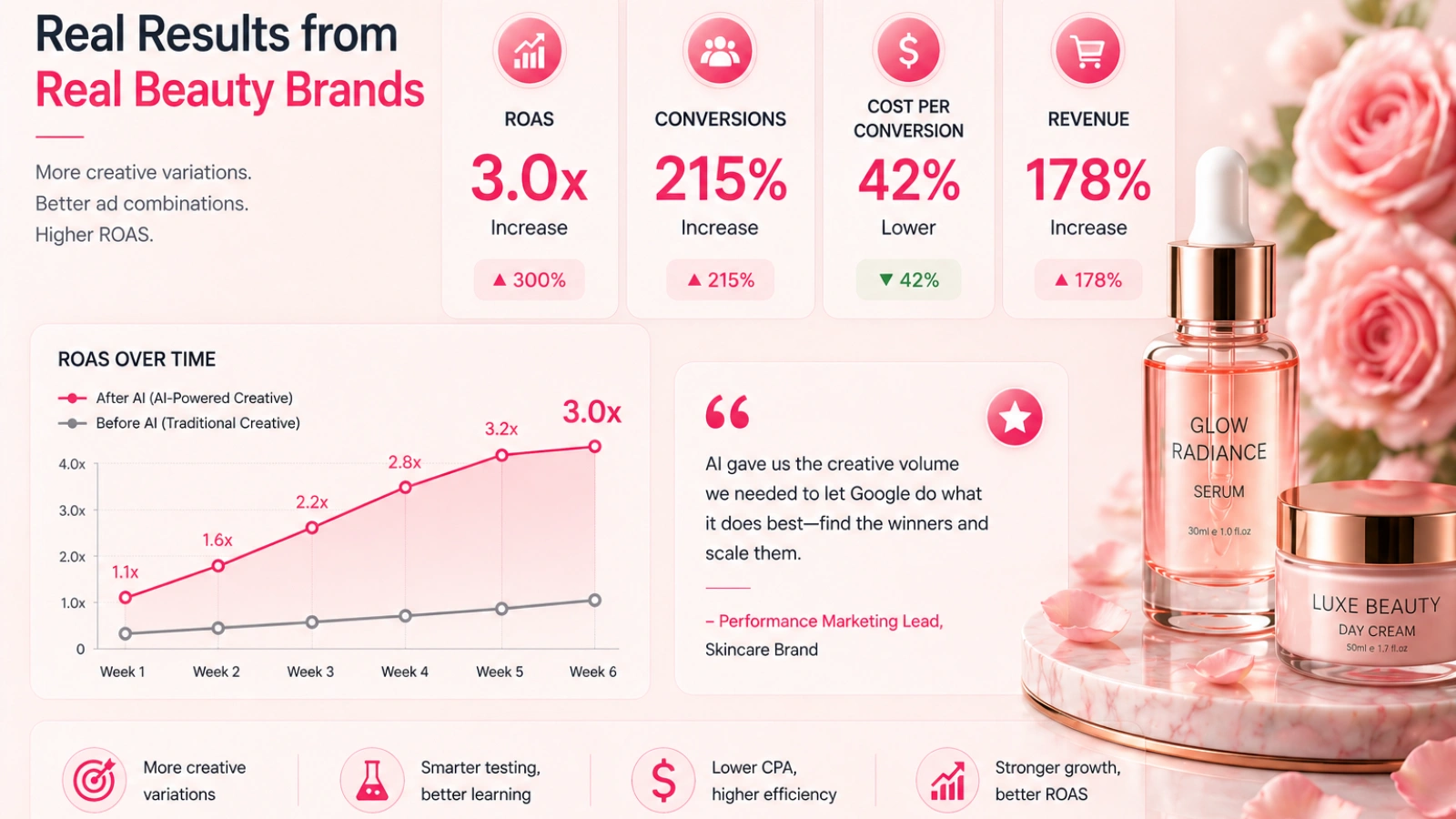
The outcomes were not driven by luck. They came from structured testing at scale.
An emerging skincare brand provided a clear example. While running Google Ads with a limited set of creatives, its initial ROAS stayed around 1.8x.
After shifting its approach, the brand introduced AI-generated variations and began testing more than 40 different product ads across Performance Max and Shopping campaigns.
One insight surfaced quickly. Messaging built around “fragrance-free for sensitive skin” consistently outperformed more generic descriptions.
The brand leaned into that angle and scaled it across campaigns.
Within eight weeks, ROAS rose to 5.2x.
A similar shift happened within another growing cosmetics brand that managed a wide product catalog. Creating ads manually for every SKU had never been practical.
By using an AI advertisement generator, the brand produced shade-specific creatives for more than 100 products. Each variation addressed a distinct use case or audience segment.
That level of granularity had not been possible before.
The result extended beyond improved performance. It accelerated learning. Campaigns began identifying winning angles within days instead of weeks.
In both cases, the gains came from giving Google Ads more data and variation to work with, not from changing the algorithm itself.
The Framework: How To Replicate This For Your E-commerce Brand In 4 Steps
The approach is practical. You can start without rebuilding your entire strategy.
Step 1: Audit your current assets
Open your existing Google Ads campaigns and count your creative variations. Most brands find they have fewer than six.
That is your baseline.
Step 2: Define your creative angles
Before generating anything, map out 4 to 6 distinct angles for each product. These could include use cases, features, audience segments, or emotional outcomes.
Each angle becomes a testing hypothesis for your product ads.
Step 3: Generate at scale
Use an AI advertisement generator to create variations for each angle. Focus on outputs that match Google’s formats, including headlines and descriptions.
The goal is not perfection. It is diversity.
Step 4: Feed, measure, and iterate
Upload the assets into Performance Max campaigns. Let them run for a few weeks, then review performance data.
Remove weak performers. Generate new variations to replace them.
This cycle is where the gains compound.
The Mistakes That Cancel Out Your ROAS Gains Before They Start
Scaling creative does not guarantee success. Certain mistakes can limit results quickly.
One common issue is producing variations that are too similar. If every ad says the same thing, the system has nothing new to learn.
Another problem comes from poor product data. Even the best product ads cannot perform well if the underlying feed is weak.
Some teams treat AI output as final. That leads to inconsistencies in brand voice or compliance issues, especially in beauty categories.
There is also the timing factor. Campaigns in Google Ads need time to learn. Cutting them too early often prevents them from reaching full performance.
Finally, many brands try to automate everything before they have enough data. Without conversions, even the best setup will struggle.
How AdsGPT Fits Into This System – And Why Beauty Marketers Are Adopting It Fast
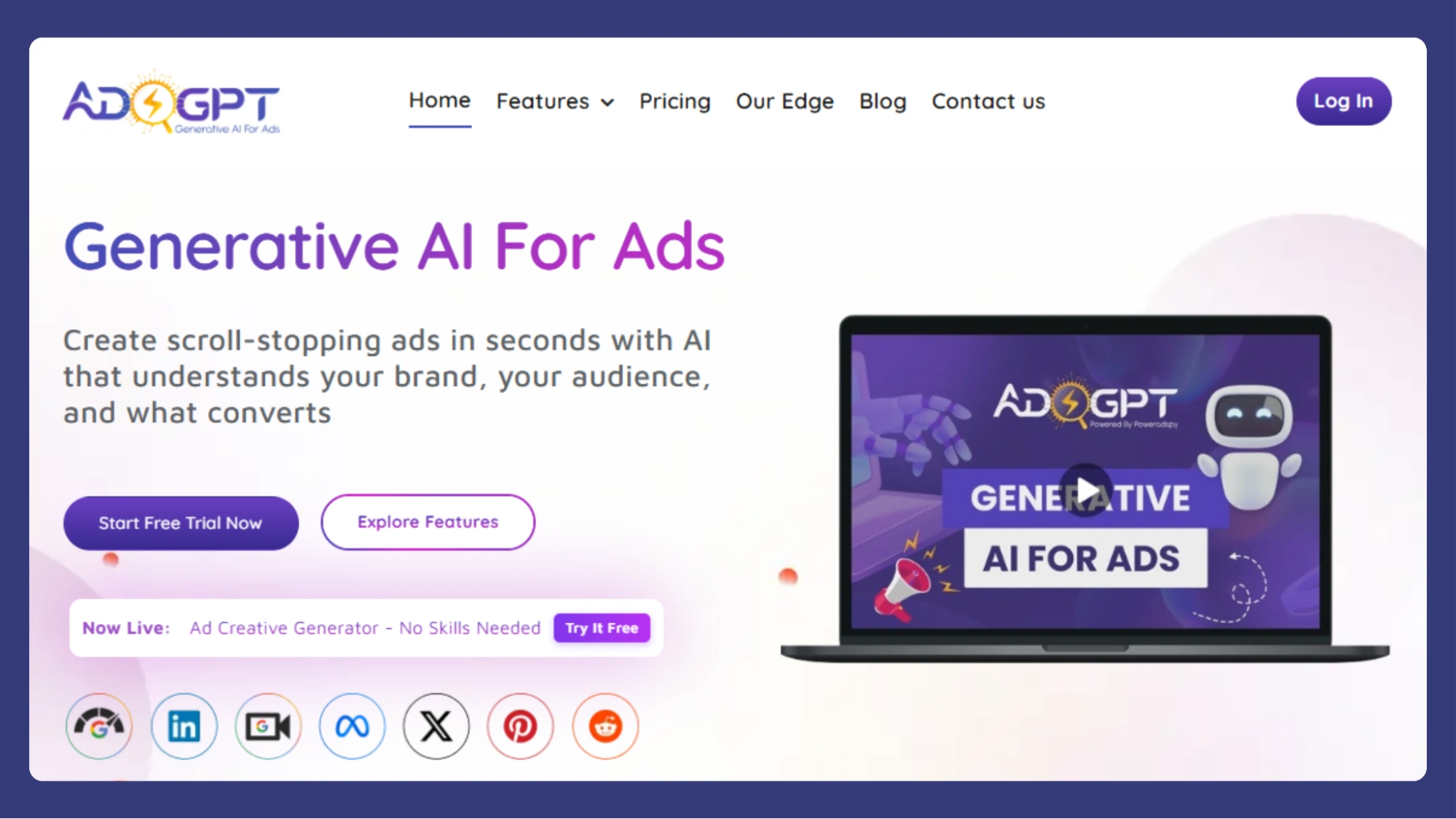
At some point, the question becomes practical. How do you produce this level of creativity consistently?
That is where tools like AdsGPT come in.
It addresses the exact problem outlined earlier: creative velocity.
Instead of manually building assets, you input a product URL or a brief. The system generates multiple variations tailored for Google Ads formats.
Key capabilities include:
- Generates multiple ad variations per product from a single input
- Outputs structured assets for responsive and Performance Max campaigns
- Supports angle-based creative generation across use cases and audiences
- Enables fast iteration cycles aligned with campaign data
- Built specifically for ecommerce teams running product ads at scale
The value is not just speed. It is consistency. You can maintain a steady flow of new creative without overloading your team.
The Deeper Shift: Why The Brands Winning On Google Ads In 2025 Think Like Media Companies
The real change is not the tool. It is the mindset.
Winning brands no longer think of advertising as a fixed set of campaigns. They think of it as a continuous production system.
They produce creative at scale and let Google Ads decide what works.
That approach mirrors how media companies operate. They test constantly, learn quickly, and double down on what resonates.
AI simply makes that process accessible.
As Google’s systems evolve, this dynamic will become more pronounced. Campaigns will rely even more on diverse inputs and contextual relevance.
Brands that already treat creative as a scalable resource will adapt faster. Others will struggle to keep up.
Read More!
The algorithm is ready. The only question is whether your creative is
Google’s system was already capable of finding the right customers. That was no longer the limitation for an emerging beauty brand.
The real constraint remained creative supply.
The brands that managed to scale their results did not increase their budgets. Instead, they focused on giving Google Ads more creative inputs to work with, allowing the system to optimize more effectively.
What once required significant time and resources had now become accessible to any e-commerce brand willing to adapt.
For this emerging beauty brand, the turning point came from a simple exercise. They reviewed their active campaigns and counted how many genuine creative variations were actually in play.
The number was lower than expected.
That realization made the opportunity obvious.
Frequently asked questions
Can AI-generated ads really improve Google Ads ROAS, or is it just hype?
The improvement comes from data, not magic. More diverse product ads give Google’s system better signals, which leads to more efficient optimization.
How many ad variations do I need to see results?
Most campaigns benefit from at least 15 variations per asset group. Many brands start far below that, which limits performance in Google Ads.
Do I need a large budget to make this work?
Not necessarily. What matters is consistent conversion data. Even smaller budgets can work if campaigns generate enough activity to learn.
Will AI-generated ads meet compliance requirements in beauty?
They should be reviewed. An AI advertisement generator creates drafts, but final approval should always involve human oversight.
What is the difference between Performance Max and Shopping ads?
Shopping focuses on product listings and gives more control. Performance Max uses automation across channels and benefits more from creative variation.

MOST POPULAR