The gap between spotting a competitor’s winning ad and shipping your own version of it is where most creative budgets quietly bleed out.
I’ve watched this pattern repeat for years. A growth marketer finds a competitor’s creative that’s clearly running hard: long flight, heavy spend signals, consistent placement. They screenshot it. Drop it in Slack. Tag the designer. Write a brief. Wait three days. Revise twice. Upload to the ad manager. By that point, the market has moved. The creative window they spotted is gone, or worse, everyone else caught it too.
The root cause isn’t slow designers or bad briefs. It’s that most teams treat competitor research and ad creation as two separate workflows, two different tools, two different people, two different calendars. That split is the bottleneck.
Listen to the Podcast now!
Why the Two-Step Process Breaks Down
 Manual competitor analysis is, as anyone who’s done it honestly knows, a grind. You’re juggling the Meta Ad Library, your paid spy tool, and a spreadsheet you last updated six weeks ago. The problem isn’t data; it’s translation. You find something interesting, then you have to communicate that insight to someone else, who has to interpret it, then execute it, then get it back to you for review. Each handoff costs time and loses fidelity.
The research on AI-powered competitor ad insights makes this clear: the value of competitor intelligence is almost entirely in acting on it quickly. Data that sits in a spreadsheet for four days isn’t intelligence; it’s history.
There’s also a creative drift problem. The brief says “make something like this competitor ad, same energy, different brand.” But what arrives from the designer is filtered through their interpretation, their aesthetic defaults, their available time. The final creative is two or three degrees removed from the original insight that triggered the whole process.
What Collapsing the Workflow Actually Looks Like
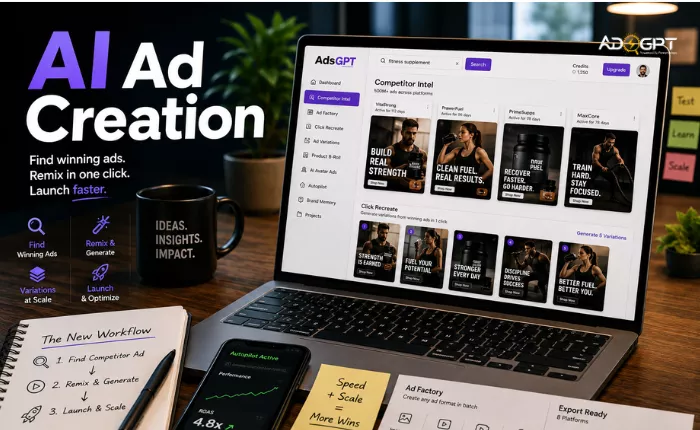
With AdsGPT, the workflow isn’t research-then-create. It’s research-as-creation. The platform’s Competitor Intel database holds 500 million+ ads across platforms. You search, you find a competitor creative that’s clearly performing, and you one-click remix it for your brand, right there, no export, no brief, no handoff.
That single step collapses what used to be a multi-day process into minutes. And the output isn’t a mock-up to send for feedback; it’s a sized-to-spec creative ready for eight different platforms.
This matters more than most teams realize. The signal decay on a competitor creative insight is fast. Acting on it within hours versus acting on it within days is often the difference between a well-timed test and a stale idea.
The Scaling Problem Nobody Warns You About
Here’s the counterintuitive part: finding the winning creative isn’t the hard part. Scaling it is.
Most teams discover a strong performer and then do one of two things. They run it until it dies, until frequency kills performance and the creative fatigues. Or they try to manually produce variations, which takes almost as long as creating the original and usually produces worse creative because the team is working from memory rather than data.
AdsGPT’s approach here is the Click Recreate function: pick a winning creative, click Recreate, and the platform generates five fresh variations for scaling. Not one variation you have to approve and revise: five, in batch. The underlying logic is that creative testing at scale requires volume, and volume requires removing the human bottleneck from variation production.
This connects directly to why studying competitor ad creative alone isn’t enough; you need a system to turn what you learn into production-ready volume, fast.
The Format Question That Most Guides Skip
When marketers think about competitor research, they almost always focus on copy and offer, headline, hook, CTA. Format gets ignored. That’s a mistake.
UGC Video Ads convert up to 4× better than polished brand content. Meanwhile, IAB research shows 86% of buyers are already using or planning to use generative AI for video ad creative. If you’re watching what your competitors run and only thinking “what are they saying,” you’re missing half the signal. The format, UGC video, B-roll product clip, avatar-led ad, static image — is itself a creative decision with real performance implications.
AdsGPT’s Ad Factory handles this directly: from a single prompt, you can generate image ads, UGC videos, B-roll clips, and AI Avatar Ads in batch. That means when you identify a competitor using UGC-style creative effectively, you can test the same format for your brand in the same session, without spinning up a separate video production workflow.
The platform’s Product B-roll Video feature is particularly useful here for product-focused brands. A competitor running strong YouTube Shorts or Reels content is telling you something about what that audience responds to. Being able to test a B-roll response to that in the same tool you used to find the insight removes an entire production layer.
Brand Consistency at Speed: The Real Trade-Off
There’s a legitimate concern about moving this fast: if you’re remixing competitor creative and generating variations in batch, how do you keep it on-brand?
The honest answer is that this is a real trade-off, and it’s one worth managing explicitly. AdsGPT includes a brand memory feature — documented in detail here — that maintains consistent style and tone across ads. It also supports dynamic image styles including 3D, realistic, and anime, and ad customization for Meta, Google, LinkedIn, and Pinterest.
That said, brand memory is a floor, not a ceiling. Fast production at volume will occasionally produce creative that feels slightly off. The discipline is building a fast review loop, not a slow approval process, but a genuine five-minute gut check before anything goes live. The volume advantage of this workflow is real enough that discarding some output still leaves you ahead on speed and cost versus a traditional agency workflow.
Speaking of cost: AdsGPT reports an 80% lower production cost versus traditional agency workflows. Accounts also see 4.8× higher ROAS from winning creatives within 6 weeks on average. Both figures point to the same thing — the economics shift dramatically when research and creation aren’t separate line items.
Also Read
Top 10 Static Ads To Inspire Your 2025 Campaigns
How AI Can Help You Stay Ahead With Competitor Ad Insights?
Where Autopilot Fits In
Once you have volume running, the optimization layer matters. AdsGPT’s Autopilot feature audits and optimizes Meta ads around the clock, with an undo log. This is the part of the workflow most teams discover last, after they’ve already built a production rhythm.
The smarter order is to build the optimization layer in at the start. If you’re generating creative in batch and testing at volume, you need something watching performance continuously — not a weekly check-in where half the budget has already been spent on a losing creative.
Real-time competitor monitoring, which AdsGPT surfaces as a named feature, feeds back into this loop. Competitor ad frequency and timing data can surface optimal campaign scheduling windows — information that’s only useful if you can act on it before your competitors do.
The One Workflow Change Worth Making This Week
If your team currently uses a separate spy tool, a design tool, and an ad manager, hand off work between them, pick one campaign and run the entire cycle inside a single tool instead. Search competitors. Remix the strongest creative. Generate five variations in batch, export to spec, and launch. Note the hours that disappear.
The insight isn’t that AI makes creative faster. It’s that the bottleneck was never creative production; it was the handoffs between disconnected tools. Remove the handoffs and the speed compounds.
AdsGPT has now generated over 1 million ads on the platform. That number reflects a workflow shift, not just a feature adoption. Teams aren’t using it as a supplement to their existing process. They’re replacing the process.
The free plan covers 35 creatives with no credit card required. That’s enough to run a real competitor research cycle and ship actual test creative before you commit to anything. Start your free AdsGPT trial and run the full workflow, start to finish, on your next campaign.

MOST POPULAR