Case Study • Meta Advertising • Ad Creatives AI • Shopify Growth
Introduction: Why Creative Fatigue Is Killing Your Meta Ads
There’s a specific kind of dread every Meta advertiser knows. You launch a campaign, the creative hits, ROAS climbs, and you scale with confidence. Then, slowly, quietly, the numbers start sliding. CTR drops. CPA creeps up. You increase the budget, hoping to push through, but the algorithm just burns more money showing the same exhausted ad to the same exhausted audience.
That’s creative fatigue. And in 2026, it’s killing more ad accounts than bad targeting ever did.
Meta’s algorithm is brilliant at finding your ideal customer, but it can’t manufacture audience attention. When people have seen your ad four, five, or six times, they stop engaging. Frequency scores climb. Relevance scores fall. The algorithm interprets declining engagement as a signal to charge you more per impression. It’s a downward spiral, and the only way out is fresh creativity.
The problem? Producing fresh, varied, high-quality creative consistently is expensive, slow, and hard to scale. A professional video shoot costs thousands. A freelance designer takes days. An agency creative refresh takes weeks. By the time new ads are ready, performance has already collapsed.
This is exactly the gap that ad creatives AI is designed to close, and this is the story of how one Shopify seller used it to turn a single winning ad into 50 performance-tested variants in less than two hours.
“Creative fatigue is the #1 silent killer of profitable Meta campaigns. Most advertisers don’t realize it until CPA has already doubled.”
The Problem: One Winning Ad That Stopped Converting
Meet Priya. She runs a Shopify store selling premium skincare products for women over 35. In Q3 2025, she found her “unicorn” ad: a clean before-and-after video with a bold hook, “I tried 47 serums. This one actually worked.”
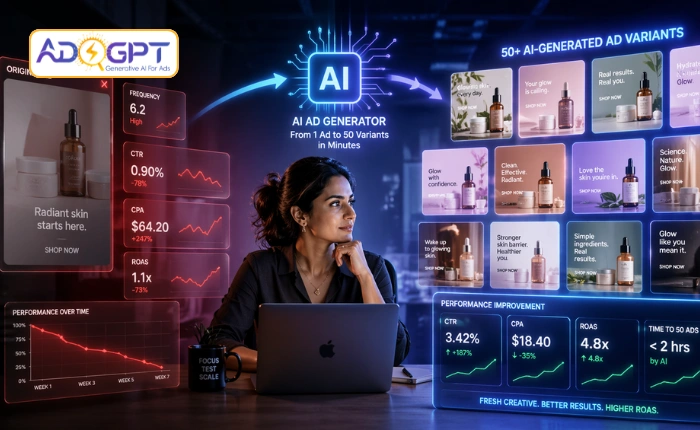
For six weeks, that ad was a machine. CTR held above 3.2%. ROAS consistently hit 4.1x. She scaled from $80/day to $400/day, and the economics kept working. Then week seven arrived.
| Week | CTR | CPA | ROAS | Frequency |
|---|---|---|---|---|
| Week 1–3 | 3.2% | $18.40 | 4.1x | 1.3 |
| Week 4 | 2.8% | $22.10 | 3.5x | 2.1 |
| Week 5 | 2.1% | $29.60 | 2.6x | 3.4 |
| Week 6 | 1.4% | $41.80 | 1.8x | 4.9 |
| Week 7 | 0.9% | $64.20 | 1.1x | 6.2 |
The pattern is unmistakable. As frequency climbed above 3.0, every performance metric collapsed. By week seven, Priya was spending $64 to acquire a customer she’d been acquiring for $18 just a month earlier. The ad hadn’t changed. The product hadn’t changed. The audience had simply seen it too many times.
Signs of Creative Fatigue Most Advertisers Ignore
Priya’s story is common. But the warning signs are often misread as targeting problems, seasonality, or platform issues. Here’s what creative fatigue actually looks like before it becomes a crisis:
- Frequency above 2.5 with declining CTR
- CPA is increasing while the audience size stays constant
- The comment section is filling with “I’ve seen this ad everywhere.”
- Relevance/quality score dropping with no changes to targeting
- ROAS is degrading progressively week over week
- Diminishing returns even after budget reduction
If two or more of these are true simultaneously, you don’t have a targeting problem. You have a creative problem.
The Real Challenge: Scaling Ads Without a Creative System
When Priya recognized the pattern, her first instinct was the same as most advertisers: commission new creatives. She reached out to a freelance video editor and a UGC creator she’d worked with before.
Two weeks. That’s how long it took to get two new video ads. By the time they launched, her account had spent $3,800 at unprofitable CPAs. The new ads performed, briefly, before the fatigue cycle started again.
The root issue wasn’t that Priya couldn’t find good creative. It’s that she had no system for producing content at the speed at which Meta consumes it.
“Meta’s algorithm doesn’t slow down for your production timeline. To stay ahead of creative fatigue, you need to produce faster than the algorithm burns through your creatives.”
Why Most Shopify Sellers Struggle with Creative at Scale
- Limited budget for professional shoots or video production
- No in-house designer or creative team
- Slow iteration cycles, days or weeks between new creative tests
- No structured testing methodology, launching ads based on gut feel
- Over-reliance on a single “winning” creative instead of a rotating portfolio
- No way to systematically analyze what makes a creative perform
The Turning Point: Switching to an Ad Generator AI
Priya’s turning point came through a conversation in a Shopify founders community. Another seller mentioned they’d started using AdsGPT, an AI-powered ad generator, to produce creative variations at scale. In two hours, they’d gone from one winning concept to 40 testable variants.
Priya was skeptical. She’d tried generic AI tools before and found the output generic, technically correct, but creatively hollow. AdsGPT was different. Instead of asking her to describe an ad from scratch, it started by analyzing her existing best performer, extracting the structural elements that drove engagement, and using those as the foundation for generating variations.
This is the core insight behind ad creatives AI done right: you’re not replacing creative thinking with automation. You’re using AI to multiply the creative thinking you’ve already validated.
| Traditional Method | Ad Generator AI |
|---|---|
| 2–4 weeks per creative refresh | 50+ variants in under 2 hours |
| $500–$3,000 per production cycle | Fraction of the per-creative cost |
| 2–5 new variants per cycle | Dozens of variants per session |
| Gut-feel creative decisions | Data-driven hook and angle analysis |
| One-off production | Repeatable, scalable system |
| Manual testing matrix | AI-suggested testing combinations |
Strategy Breakdown: How Ad Creatives AI Generated 50 Variants
Step 1: Analyzing the Original Winning Ad
Before generating anything, Priya fed her original winning ad into AdsGPT for structural analysis. The AI broke down the creative into its component performance elements:
- Hook type: Personal testimonial with a specific number (“47 serums”)
- Visual structure: Close-up before-and-after skin comparison
- Emotional driver: Frustration relief + aspirational outcome
- CTA structure: Implied urgency without hard sell
- Copy length: Short-form, under 15 words on screen
This analysis became the blueprint. Rather than starting from a blank page, every subsequent variant was engineered to preserve the structural elements that had driven performance, while varying the surface-level execution to prevent fatigue.
Step 2: Creating High-Converting Hooks Using Ad Creatives AI
The hook is the ad. If the first three seconds don’t stop the scroll, nothing else matters. AdsGPT generated 15 distinct hooks across three proven emotional architectures:
Problem-Based Hooks (targeting pain points directly):
- “Why does your moisturizer stop working after 30 days?”
- “I spent $2,400 on skincare last year. Here’s what actually changed my skin.”
- “Dermatologists won’t tell you this about serums.”
Benefit-Driven Hooks (leading with the outcome):
- “Visibly smaller pores in 14 days. Dermatologist-tested.”
- “My skin at 42 looks better than it did at 32.”
- “The serum that made my SPF routine actually work.”
Curiosity-Driven Hooks (open loops that demand resolution):
- “There are 3 ingredients in most serums that age your skin faster.”
- “I only wash my face once a day now. Here’s why.”
- “Every skincare influencer is wrong about vitamin C.”
Step 3: Generating Multiple Creative Angles at Scale
With 15 validated hooks, AdsGPT generated creative briefs across five distinct ad formats:
| Format | Psychological Trigger | Variants Generated | Best Funnel Stage |
|---|---|---|---|
| UGC-style testimonials | Social proof/relatability | 10 variants | Top of funnel |
| Product demonstrations | Curiosity/proof | 8 variants | Middle of funnel |
| Before & after | Aspirational outcome | 8 variants | Top/Middle |
| Customer testimonials | Trust/validation | 10 variants | Middle of funnel |
| Lifestyle creatives | Identity/aspiration | 8 variants | Top of funnel |
| Problem/solution | Pain-point recognition | 6 variants | Top of funnel |
Step 4: Using Ad Generator AI for Copy Variations
Visual variation alone isn’t enough. Meta’s algorithm tests creative combinations. AdsGPT generated copy across three tonal registers for each hook:
- Short-form direct response: Under 20 words. Punchy, specific, action-driven.
- Emotional narrative: 50–80 words. Story-led, empathetic, identity-focused.
- Long-form educational: 100–150 words. Builds credibility, overcomes objections, earns the click.
Step 5: Building a Creative Testing Matrix
The final step was combining the components systematically:
| Component | Options | Combinations |
|---|---|---|
| Hooks | 15 | – |
| Ad formats | 6 | – |
| Copy tones | 3 | – |
| Total unique combinations | – | 270+ |
| Priority test batch | – | 50 variants |
From one validated concept, Priya had a structured library of 50 priority test variants, each one a deliberate combination of proven elements rather than a random guess.
Execution on Meta: Testing and Scaling with Multiple Creatives
Priya organized variants into thematic ad sets based on hook type, each with $30/day:
- Ad Set 1: Problem-based hooks (5 ads)
- Ad Set 2: Benefit-driven hooks (5 ads)
- Ad Set 3: Curiosity hooks (5 ads)
- Ad Set 4: Format test, UGC vs product demo (6 ads)
- Ad Set 5: Copy length test, short vs long (6 ads)
Decision rule: After 72 hours and 1,000+ impressions, any ad with a CTR below 1.5% or a CPA above $35 was paused. Winners (CTR > 2.5%, CPA < $25) were isolated into a scaling campaign. Within the first week, 12 ads emerged as clear winners, six from the curiosity hook set, four combining short-form copy with before-and-after visuals, and two UGC-style testimonials with benefit-driven hooks.

Results: How Ad Creatives AI Improved Performance
Increased CTR and Engagement
Average CTR across the 12 winning creatives settled at 3.7%, a 187% improvement over the fatigued original ad’s 1.4% CTR. Engagement quality also improved: comment sentiment was positive, share rates increased, and frequency-driven drop-off disappeared entirely as the rotation system kept each creative fresh.
Reduced CPA with Better Creative Rotation
The average CPA across winning creatives came in at $19.80, a 35% reduction from the $30+ CPA during the creative fatigue period. More importantly, CPA remained stable over the following four weeks because creative rotation prevented any single ad from accumulating damaging frequency.
Higher ROAS with Scalable Creative Testing
ROAS climbed from a low of 1.1x (during peak fatigue) to a sustained 4.8x, exceeding even the original ad’s peak performance of 4.1x. This ROAS was now sustainable and scalable, not a diminishing window before the next creative cliff.
Faster Production Using Ad Generator AI
Priya’s previous creative refresh cycle took 10–14 days and cost $800–1,200 per cycle. The AdsGPT-powered workflow produced 50 strategic variants in under two hours for a fraction of the cost.
| Metric | Pre-AI (Fatigued) | Post-AI (Peak) | Change |
|---|---|---|---|
| CTR | 1.4% | 3.7% | +187% ↑ |
| CPA | $64.20 | $19.80 | -69% ↓ |
| ROAS | 1.1x | 4.8x | +336% ↑ |
| Creative refresh time | 10–14 days | < 2 hours | 98% faster ↑ |
| Cost per cycle | $800–1,200 | Fraction of cost | ~90% lower ↓ |
| Active test variants | 1 | 50 | 50x more data ↑ |
Why Ad Creatives AI Works Better Than Traditional Methods
Speed vs. Manual Design
Generating 50 genuinely distinct, strategically structured ad variants manually would take a skilled team several days. An ad generator AI does it in hours, without fatigue, without writer’s block, and with consistent application of direct-response principles.
Data-Driven Creative Decisions
Traditional creative production relies heavily on experience and intuition. Ad creatives AI combines that intuition with pattern recognition across thousands of high-performing ads, suggesting hook structures, copy frameworks, and format combinations that have demonstrated performance at scale.
Continuous Iteration Without Bottlenecks
When you have a repeatable AI-powered system, creative refreshes become routine rather than crisis management. You’re not scrambling to replace a failing ad; you’re proactively rotating fresh creative before fatigue sets in.
Key Learnings for Shopify Sellers Using Ad Generator AI
Rule 1: Always test multiple creatives simultaneously.
Never launch a single ad and wait. Launch five to ten variants from day one. A single creative is a coin flip; a portfolio of tested variants is a system.
Rule 2: Never rely on a single winning ad.
Every winning ad has an expiration date. The moment you find a winner, start building the next wave of variants using ad creatives AI, before you need to, not after performance collapses.
Rule 3: Refresh creatives weekly, not monthly.
High-spend accounts can fatigue a creative in days. Once average frequency crosses 3.0 on a cold audience, rotate immediately.
Rule 4: Build a repeatable creative system.
The goal isn’t one batch of 50 ads. It’s a recurring workflow: analyze winners, extract structural elements, generate variants, test systematically, scale what works, and retire what doesn’t.
How to Beat Creative Fatigue on Meta (Actionable Framework)
| Phase | Action | Tool/Method | Timeframe |
|---|---|---|---|
| 1. ANALYZE | Audit active creatives for fatigue signals (frequency > 2.5, declining CTR) | Meta Ads Manager | 30 min |
| 2. EXTRACT | Identify top-performing structural elements from winners | AdsGPT analysis | 20 min |
| 3. GENERATE | Produce 30–50 new variants across hook types, formats, and copy tones | AdsGPT ad generator AI | 60–90 min |
| 4. PRIORITIZE | Select the top 15–20 variants based on strategic diversity | Creative testing matrix | 20 min |
| 5. LAUNCH | Upload to themed ad sets at $25–40/day per set | Meta Ads Manager | 30 min |
| 6. EVALUATE | After 72 hrs + 1,000 impressions: pause losers, scale winners | Meta Ads Manager | 30 min |
| 7. ITERATE | Feed winner data back into Step 2; repeat | AdsGPT + Meta | Ongoing |
The full cycle, from creative audit to live test variants, takes approximately 3–4 hours.
Without ad creatives AI, the equivalent process took 10–14 days.
Conclusion: The Future of Meta Ads Is Ad Creatives AI
Priya’s story isn’t exceptional; it’s becoming the new baseline for advertisers who want to compete on Meta in 2026.
The platforms have changed. Audiences scroll faster, see more ads, and develop banner blindness quicker than ever before. Meta’s algorithm is sophisticated enough to find the right person for your product, but it cannot create the creative that makes them stop scrolling. That responsibility sits entirely with the advertiser.
Brand Consistency that continues producing creative slowly, in small volumes, without systematic testing, is always in reactive mode, scrambling to replace failing ads instead of proactively building a creative pipeline that stays ahead of fatigue.
Ad creatives AI doesn’t remove the need for creative thinking. It amplifies it. Priya’s insight, “I tried 47 serums. This one actually worked”, was human. The system that turned that insight into 50 battle-tested variants was AI. That combination is the future of performance advertising.
The advertisers who figure this out first build compounding advantages, larger creative libraries, richer performance data, faster learning cycles, and ultimately, a structural edge over competitors still running on manual production timelines.
Scale Your Ads with AdsGPT (Ad Generator AI)
Stop Letting Creative Fatigue Drain Your Ad Budget
AdsGPT turns your single winning ad into 50+ performance-tested variants in under 2 hours.
- ✅ Generate 50+ unique ad creatives instantly
- ✅ Beat creative fatigue before it beats your ROAS
- ✅ Built for Shopify sellers and Meta advertisers
- ✅ No design skills or creative brief required

MOST POPULAR