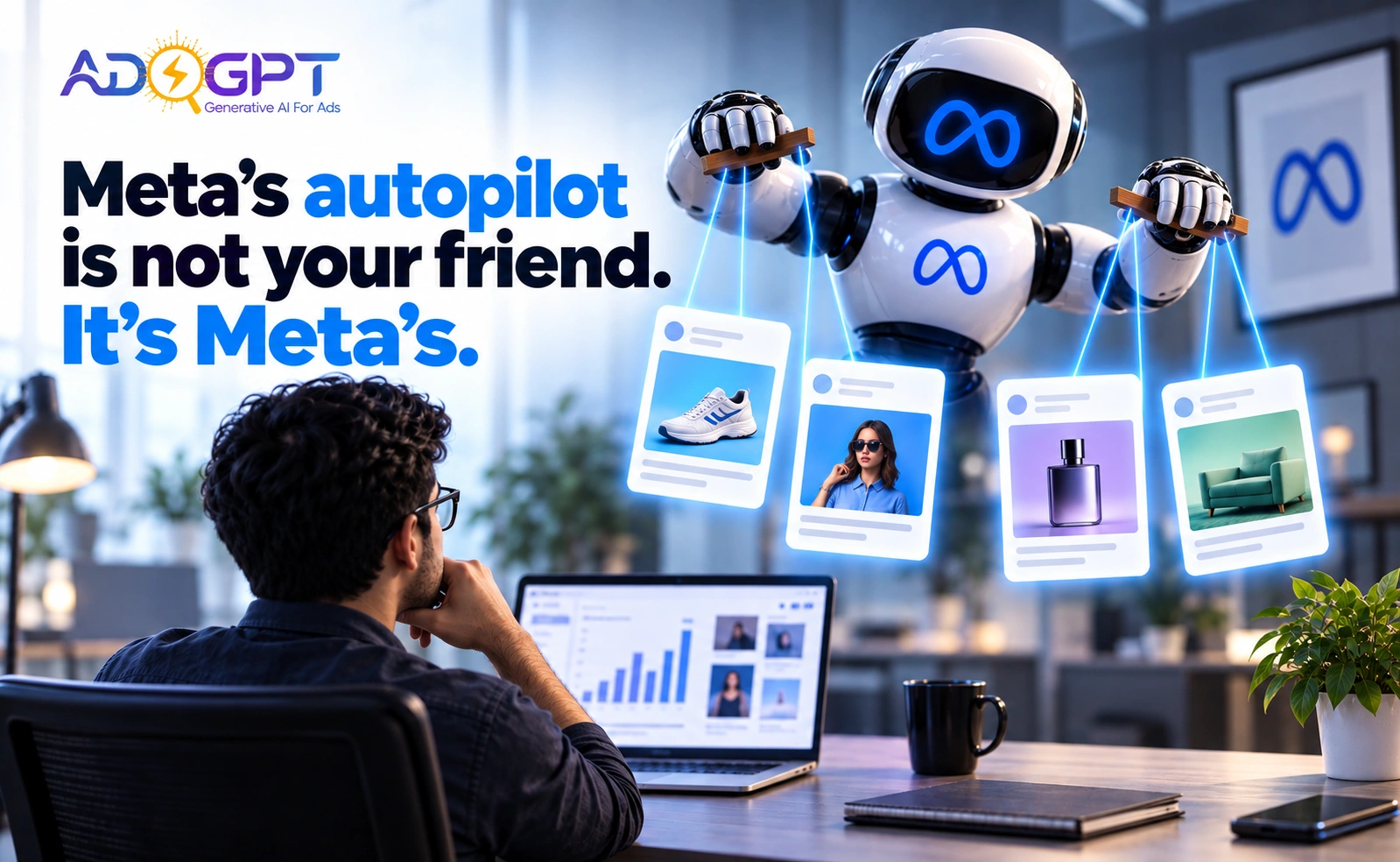
Meta’s autopilot is not your friend. It’s Meta’s.
That distinction has a dollar cost. As a sharp analysis from CXL puts it: “Platforms don’t optimize for your business; they optimize for theirs. Google optimizes for clicks. Meta optimizes for form fills.“ None of them care whether your sales team can close the lead. Your job is to guide the machine, not surrender the wheel to it.
Most growth marketers get this wrong in the same direction. They automate the wrong layer, handing platform algorithms total control over budget, bidding, and audience, then wondering why ROAS degrades after week three. Meanwhile, the one layer that determines whether any of it works, creative, gets one or two static images refreshed whenever someone remembers. This article is about flipping that equation.
Listen to the blog.
The Automation Layer You’re Getting Wrong
Platform automation is real and useful. Meta’s budget-pacing signals, Google’s smart bidding- these tools process data at a scale no human team can match. A Fluency analysis on AI ad budgeting notes that AI can identify spend shifts, like a campaign that reliably converts better on weekends, and adjust pacing automatically, flagging overspending risks before they compound.
But the algorithm optimizes ruthlessly for its objective function and nothing else. As the Berkeley California Management Review observes, an unchecked AI might serve sensationalistic headlines or violate brand tone just to grab clicks, or overspend on a short-term-ROI audience while destroying your longer-term strategy. Platform autopilot has no concept of your brand. It sees a signal; it chases it.
So what does a smarter automation stack look like? It starts with creative, and earlier in the process than most teams think.
Why Creative Is the Real Lever
Ad performance lives and dies on creative. Not the bid. Not the audience segment. The creative.
Here’s what most teams skip: if you’re running one or two creative variants, the platform optimizer has almost nothing to work with. It picks a winner fast, often within 48 hours, and dumps all spend into it. Then that winner fatigues. ROAS drops. The team scrambles to produce new work. The designer is busy. The brief takes three days. You’re back to one creative and a declining account.
The answer is volume. Specifically, continuous creative volume with a feedback loop built in.
AdsGPT‘s Ad Factory is built exactly for this. A single prompt generates image ads, UGC videos, B-roll clips, and AI avatar ads in batch, simultaneously, not sequentially. When a creative is working, you click Recreate and get five fresh variations ready for scaling, sized to spec for eight platforms. The whole flow, brief to export to live Meta ad, happens without leaving the tool. Accounts that run this way see 4.8× higher ROAS from winning creatives within six weeks, based on average account performance after 60 days.
That’s not a convenience feature. That’s a structural change in how fast your creative testing cycle can move.
What “Winning Creative” Actually Means In Practice
A common mistake: marketers treat creative testing as a one-time setup. Run three variants, pick a winner, move on. But a creative winner at week one is often a loser by week six; audience saturation is real, and platform optimizers accelerate it by over-serving the top performer.
The right model is a rotation. You need a pipeline that constantly feeds fresh variants into the mix, retiring fatigued creatives before they drag down account-level quality scores.
AdsGPT’s Autopilot feature addresses exactly this: the AI audits and optimizes your Meta ads around the clock, with an undo log. That undo log matters more than it sounds. Fully automated optimization without rollback capability is how accounts get wrecked overnight. An AI making creative decisions without a human-readable audit trail, and without single-click rollback, is precisely the unchecked-automation failure mode the Berkeley CMR piece flags. The undo log changes the risk calculus. You’re not choosing between human control and AI speed. You get both.
The Competitor Intelligence Step Most Teams Skip
Before you generate a single creative, there’s a step most teams skip because it used to be expensive: real competitor ad research.
The old workflow is someone manually pulling ads from Meta’s Ad Library, screenshotting, building a swipe file, and briefing from what they see. Hours of work. Incomplete. Already stale by the time creative ships.
AdsGPT’s Competitor Intel database contains 500 million+ ads across platforms. The workflow isn’t “browse and take notes.” It’s search, find a winning competitor ad, and one-click remix it for your brand. The tool generates original variations based on competitor creative, not copies, but structurally similar ads rebuilt around your own product and voice.
This matters because the biggest mistake in creative testing is starting from a blank brief. You’re guessing at what resonates. Competitor ads that have been running for weeks or months are a signal. Starting your own creative from that signal compresses the iteration cycle significantly.
The Format Question Nobody Asks Until It’s Too Late
Static image or video? Most teams default to static because it’s faster to produce. That’s a compounding mistake.
UGC Video Ads convert up to 4× better than polished brand content, per AdsGPT’s platform data. Four times. That’s not a marginal lift; that’s a different category of result. And yet UGC video is the format most DTC brands chronically under-invest in, because producing authentic-feeling video at scale used to require real creators, real shoots, real editing cycles.
AdsGPT’s UGC Video Ads and AI Avatar Ads features close that gap. You’re not replacing human creators for every piece of content; you’re using AI-generated UGC to run the volume of testing that static image budgets used to fund, but in the format that actually converts. For brands running YouTube Shorts and Reels alongside Meta placements, Product B-roll Video handles platform-specific sizing. Export to spec for all eight platforms at once. No reformatting, no “can someone resize this for Stories.”
A Practical Framework: What To Automate and What To Own
Here’s how to structure the stack based on what actually works:
Control yourself: The creative brief, prompt quality drives output quality, and a vague prompt produces generic ads. Creative retirement decisions: pull underperformers before they contaminate account quality scores. Audience architecture: don’t over-segment; give the algorithm room to learn.
Automate with guardrails: Creative generation: use Ad Factory to produce variants in batch, not one at a time. Competitor research: search the 500M+ ad database before every new creative sprint, not occasionally. Platform optimization: use AdsGPT Autopilot with the undo log active, never on blind trust.
Measure against real KPIs: The ad optimization checklist framework tracks click-through rates, conversion rates, cost-per-click, and return on ad spend. Those four metrics, reviewed weekly, catch creative fatigue before it becomes budget waste. The accounts that see durable ROAS gains aren’t the ones who set up the best automation and walked away. They built a tight creative testing loop and fed it consistently.

The Actual Cost Of Getting This Wrong
Traditional agency workflow costs 80% more to produce the same creative volume as an AI-assisted approach. That’s the production cost. The deeper cost is the opportunity cost of running fewer tests.
Every week you run one creative variant instead of five is a week the algorithm is optimizing a local maximum. You’re paying for reach and clicks but not learning what actually resonates. You can’t out-optimize a platform on its own turf, but you can feed it better inputs than your competitors do.
For a head-to-head look at how AdsGPT’s approach holds up against other tools on the market, this breakdown of AdsGPT versus other AI ad generation platforms is worth reading before you make a platform decision.
The brands winning on paid social right now aren’t outspending the competition. They’re out-testing them, with a creative pipeline fast enough to stay ahead of fatigue and a feedback loop tight enough to catch signals before the algorithm buries them. That’s the real automation advantage. Not handing the wheel to Meta. Taking it back.
Start your free AdsGPT trial, 35 creatives included, no credit card required.

MOST POPULAR