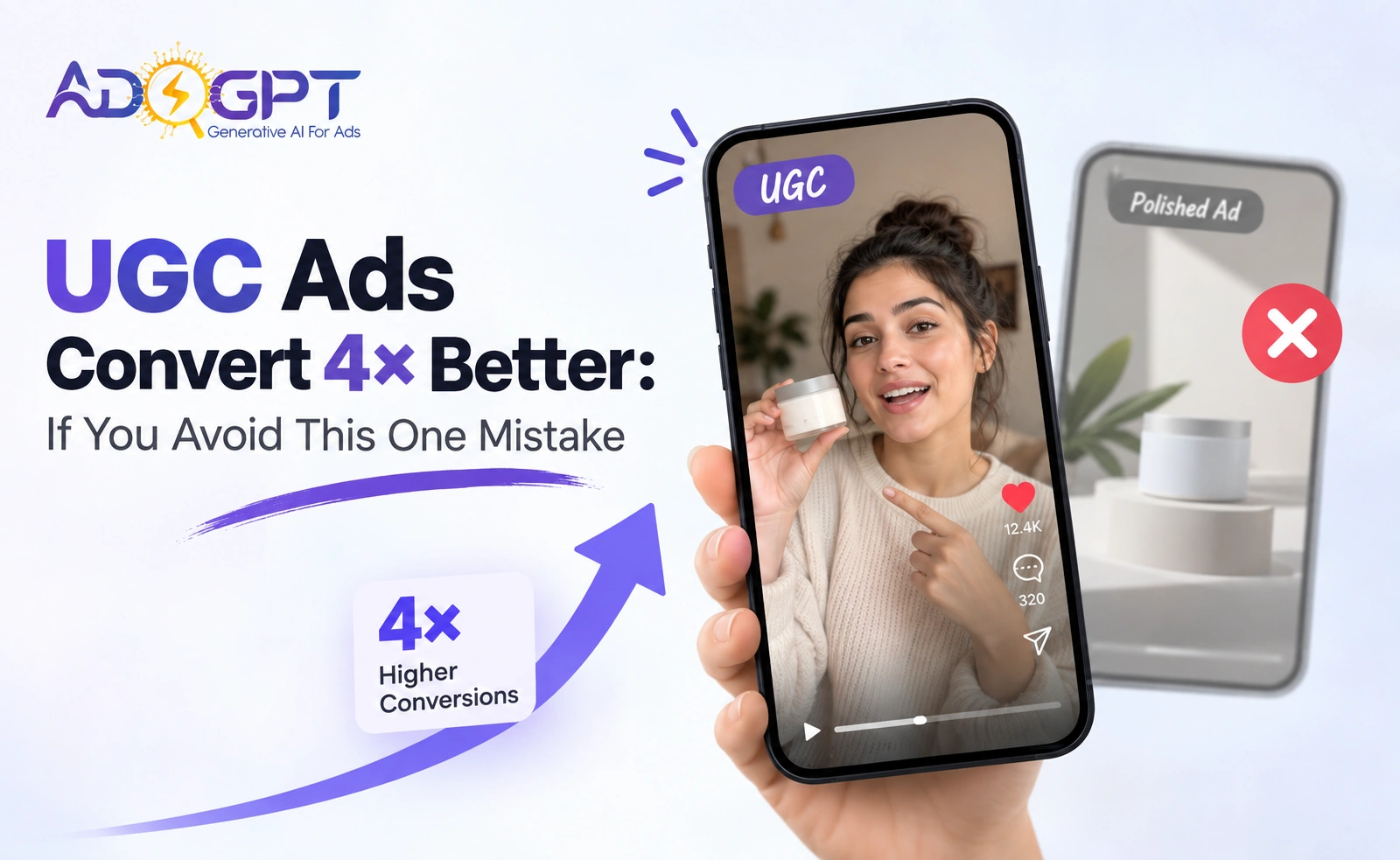
Most DTC brands discover UGC ads convert better, immediately try to make their UGC look more professional, and wonder why performance collapses. That is the mistake. Everything else is downstream of it.
AdsGPT data shows UGC Video Ads convert up to 4× better than polished brand content. That number gets cited in pitch decks constantly. What gets ignored is the mechanism behind it, and the mechanism is exactly what most production workflows destroy.
Listen to the blog:
What Actually Makes UGC Work
UGC converts because it doesn’t look like an ad. Pattern interruption, not production value. A shaky iPhone clip of someone talking directly at camera registers as social content; a perfectly color-graded testimonial with logo bugs and licensed music registers as an ad to be scrolled past. The brain’s ad-blindness filter trips on the second one within milliseconds.
This is not a theory. IAB research finds 86% of buyers are already using or planning to use generative AI to build video ad creative, a clear signal that the industry has accepted AI-assisted production as the path forward. But the brands winning with UGC aren’t just replacing human creators with AI and calling it done. They’re rethinking the entire production loop.
The costly mistake isn’t using AI. It’s using AI to produce polished UGC, which is an oxymoron, or, just as damaging, producing authentic-looking UGC in quantities too small to actually test anything.
The Volume Problem Nobody Talks About
Here’s the part that gets skipped in most UGC guides: one good UGC clip isn’t a strategy. It’s a lottery ticket.
You don’t know which hook lands until you test it. You don’t know whether the talking-head format outperforms the voiceover-with-text format until you run both. You don’t know whether the “I tried this for 30 days” angle beats the “three things I wish I’d known” angle for your specific audience without real data from your real audience. You need volume to find out.
Traditional UGC production- finding creators, briefing them, waiting on deliverables, editing, resizing for eight platforms- costs time and money at every step. Brands replacing those agency workflows with AI ad creation are seeing production costs drop dramatically; AdsGPT puts the figure at 80% lower versus a traditional agency workflow. That cost reduction matters not just for the budget line. It removes the bottleneck that prevents teams from testing at the volume required to find actual winners.
When each UGC video costs hundreds of dollars and days of calendar time, teams make three. When it costs a fraction of that and takes minutes, teams make thirty. Thirty gives you signal. Three gives you anecdote.
The AI-Assisted UGC Workflow That Actually Compounds
AdsGPT’s UGC Video Ads feature generates creator-style video content from a prompt, no filming, no casting, no editing timeline. The output is designed to look like the kind of organic video that performs on Reels, Shorts, and TikTok: direct-to-camera delivery, minimal production sheen, the visual texture of content made by a real person on a real device.
Pair that with AI Avatar Ads for spokesperson-style video without hiring talent, and Product B-roll Video for the cutaway shots that support a talking-head structure, and you have a complete UGC production system inside a single platform. The workflow that produces real results looks like this:
- Brief the batch, not the single asset. Instead of generating one UGC video, use Ad Factory to generate multiple formats simultaneously from a single prompt: different hooks, different angles, different creative structures. You’re running parallel experiments, not a sequential process. This is where the volume advantage compounds.
- Size to spec before you export. AdsGPT exports creatives sized for eight platforms, so a UGC clip generated for Reels doesn’t require manual cropping before it runs on YouTube Shorts or as a Meta Story. That step alone eliminates a surprisingly large chunk of production overhead for teams running cross-platform campaigns.
- Launch and identify the threshold winner. Not the “best” creative, the one that crosses the performance threshold that justifies scaling. Click-through rate, conversion rate, cost-per-click, and return on ad spend are the metrics that an AI ad optimization workflow tracks to surface that signal early.
- Recreate from the winner immediately. AdsGPT’s Recreate function generates five fresh variations from whichever creative is performing. This matters because the mechanism behind a winning UGC ad- the hook structure, the emotional frame, the pacing- can be extracted and recombined without duplicating the original. You’re scaling a proven pattern, not gambling on a repeat of a lucky asset.
Why Competitor Research Sharpens This, Not Replaces It
A tempting shortcut: skip original ideation entirely and remix what competitors are running. AdsGPT’s Competitor Intel database covers 500 million+ ads across platforms, and the one-click remix workflow generates brand-specific variations from any ad you find there. Select a competitor ad, and AdsGPT generates similar yet original variations tuned to your brand’s voice.
Used correctly, this is a real creative accelerant. UGC formats that are already converting in your category carry signal worth studying. If a competitor’s talking-head hook structure is performing, remixing it for your brand’s voice and offer is faster than building a hypothesis from scratch.
Used as a replacement for your own testing loop, it breaks. By the time an ad appears in any research database, it’s already mid-lifecycle. You’re chasing a format the algorithm is beginning to fatigue on, with an audience that’s already seen the template. Reading competitor ad research correctly means using it to inform your brief, not to copy the output.
The right relationship: competitor intel seeds your batch. Your own data tells you what to recreate.
Also Read!
Where Meta’s Direction Makes This Urgent Right Now
This isn’t purely a creative efficiency argument. The ad platform itself is moving in ways that reward volume and punish the “find one winner, run it forever” approach.
Meta’s AI video generation tools reached a $10 billion combined revenue run-rate in Q4 2025, growing nearly three times faster than overall ad revenue, which tells you advertisers aren’t experimenting with AI creative; they’re scaling spend through it. Meta’s algorithm has shifted further toward automation and AI-powered optimization, which means creative variety feeds the machine better than a single static winner ever could.
More creative variation equals more signal for the optimization algorithm, which equals better targeting over time. Teams producing 30 UGC variants per week feed that loop. Teams producing three don’t compete on the same terms.
AdsGPT’s Autopilot feature runs continuous audits and optimization on live Meta ads around the clock, with an undo log for every change. But Autopilot can only optimize what exists. Thin creative libraries limit what any AI optimization layer can achieve. Volume is the prerequisite, not the afterthought.
The One Thing to Get Right Before Any of This
Resist the instinct to add every brand element, tighten every cut, and color-correct every frame. The discomfort of releasing something that looks less polished is the point. The scroll-stopping quality of real UGC comes from its imperfection, and that imperfection is precisely what AI-generated UGC is built to replicate at scale.
From there, the competitive advantage isn’t the individual asset. It’s the speed and consistency of the testing loop. Generate in batch. Ship to platforms sized-to-spec. Identify the winner. Recreate five variations. Repeat.
That loop, run continuously, is what produces accounts averaging 4.8× higher ROAS from winning creatives within six weeks. Not because any single ad is exceptional, but because enough ads were tested fast enough to find out which pattern actually works for a specific audience. The brands still producing UGC three clips at a time, polishing each one until it stops feeling like UGC, are funding that discovery for everyone else.
Ready to run a real UGC testing loop without the production overhead? Start your free AdsGPT trial: 35 creatives, no credit card required.

MOST POPULAR