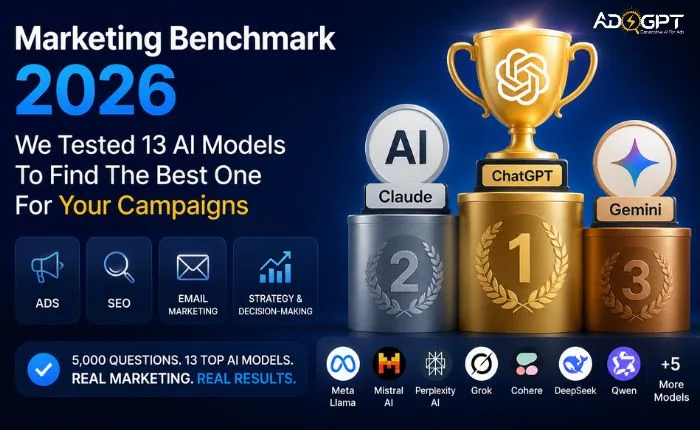
Choosing the right AI for marketing work used to mean guessing based on hype. Now, a detailed marketing benchmark has put 13 popular AI models, including ChatGPT, Claude, Gemini, and Llama, through a 5,000-question exam covering ads, SEO, email marketing, and real-world decision-making.
The results are surprising: the gap between the top performers is razor-thin, and the “best” AI depends entirely on what you need it for. In this post, we’ll break down what the marketing benchmark tested, who came out on top, what it means for marketers like you, and how a platform like AdsGPT fits into the picture when it comes to turning AI insight into real ad creative.
Listen To The Podcast Now!
What Does “Benchmark” Mean in Marketing?
Before diving into the results, it helps to understand the benchmark’s meaning in marketing. A benchmark is simply a standard or reference point you measure performance against, whether that’s your click-through rate compared to industry averages, your Competitor Analysis findings, or, in this case, how well an AI model performs against a fixed set of marketing questions.
A good marketing benchmark removes guesswork. Instead of relying on marketing claims or anecdotal experiences, it gives you measurable, comparable data. That’s exactly what this AI marketing benchmark aimed to do: create a fair, repeatable test that anyone can run, so marketers can make informed decisions about which AI tools to trust with real work, rather than choosing based on brand reputation alone.
How the AI Marketing Benchmark Was Built?
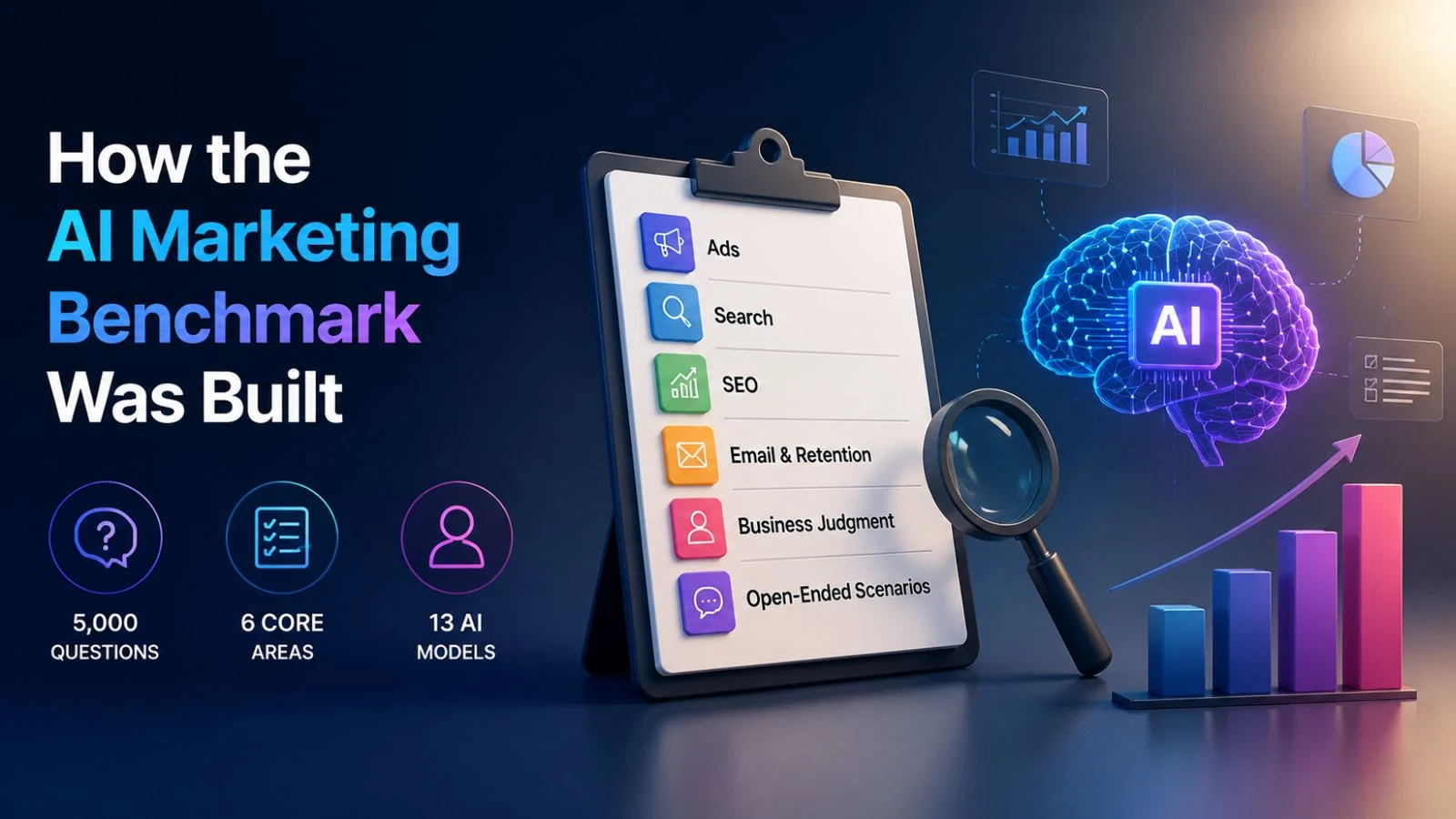
The benchmark used 5,000 questions spread across six core marketing areas: Facebook and Instagram ads, Google ads, SEO, email and retention, business judgment, and open-ended scenarios. These scenarios included situations like “your campaign just tanked, what’s your next move?”
For factual questions, there was a clear right answer. For scenario-based questions, a separate AI acted as the grader, checking responses against a rubric, similar to a teacher grading essays against a marking guide.
Thirteen AI assistants took the test, including the latest versions of ChatGPT, Claude, Gemini, and Llama. This structure makes the marketing benchmark one of the more comprehensive comparisons available, since it tests both knowledge and judgment rather than just trivia recall, which is where most AI comparisons fall short.
The Leaderboard: Who Came Out on Top:
Here’s where the marketing benchmark gets interesting. GPT-5.5 topped the leaderboard at 94/100, followed closely by GPT-5.4 at 92/100. But the real story is what came next: Gemini 3.5 Flash, Claude Sonnet 4.6, Gemini 3.1 Pro Preview, and Gemini 2.5 Pro all scored 91/100, with Claude Opus 4.7 right behind.
That means seven AI models from three different companies are within 3 points of each other. Six more models, smaller versions, older releases, and Llama scored between 80 and 90.
What this marketing benchmark really shows is that there’s no single “winner” anymore. The era of one model dramatically outperforming everything else is over. For marketers, this is good news; it means more flexibility in choosing tools without sacrificing quality.
What Surprised the Researchers Most?
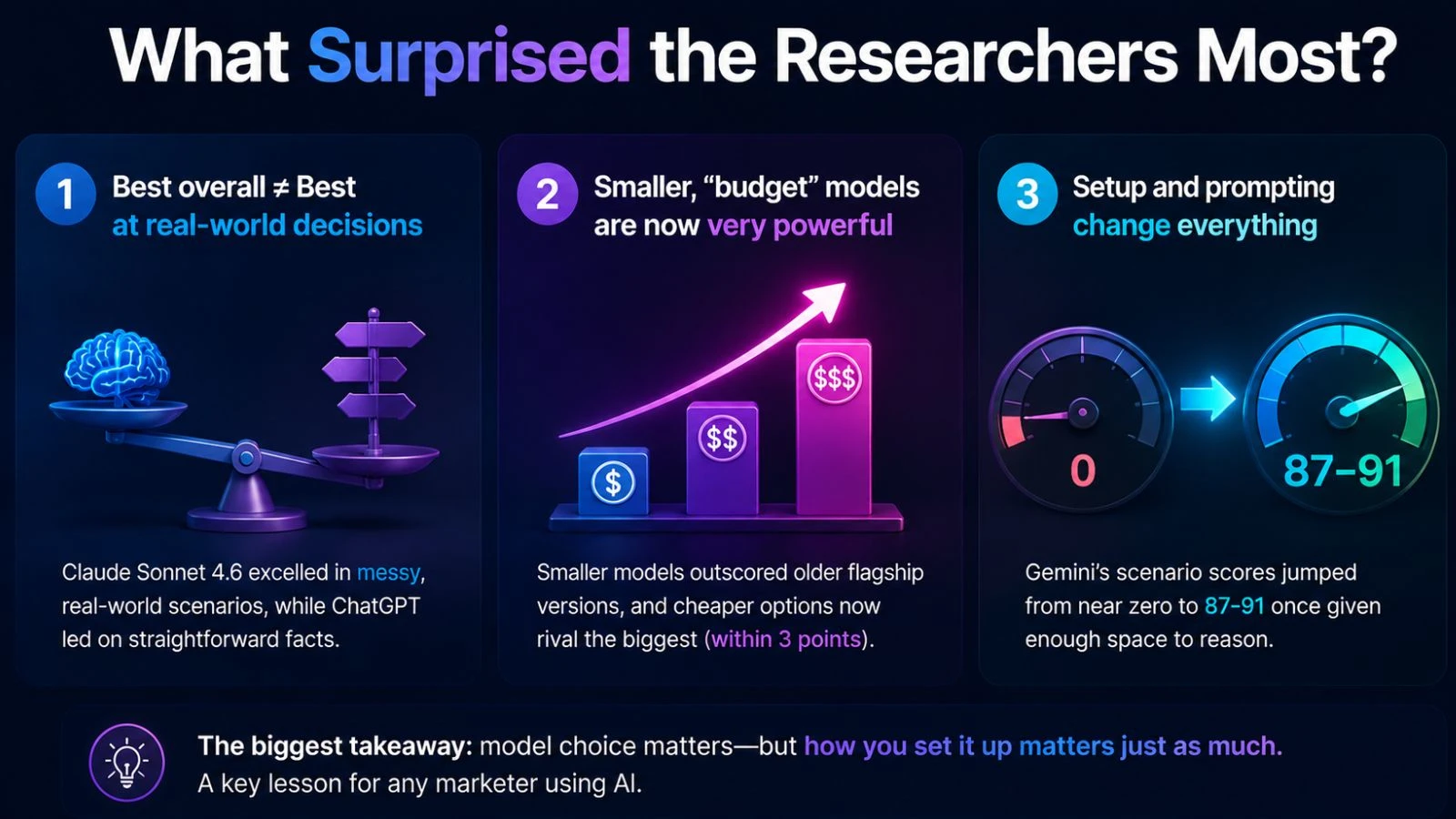
A few findings from this marketing benchmark challenge common assumptions. First, the AI that scored highest overall wasn’t necessarily the best at handling messy, real-world decisions. On scenario questions, like responding to a CEO who wants to shift budget without data backing it, Claude Sonnet 4.6 actually performed best, while ChatGPT remained stronger on straightforward factual questions.
Second, “budget” AI models have improved dramatically. Claude Haiku 4.5, Anthropic’s smallest model, outscored a previous ChatGPT flagship. Gemini’s cheaper Flash version landed within 3 points of Google’s largest models. For small businesses or solo marketers, this means you likely don’t need to pay for the most expensive AI tier to get strong results.
Third, and perhaps most importantly, the team initially scored Gemini models very poorly on scenario questions, some near zero. It turned out the models weren’t given enough space to reason before answering. Once fixed, Gemini’s scores jumped to 87-91. This is a reminder that how you set up and prompt an AI matters just as much as which model you choose, a lesson that applies directly to any marketing benchmark you run yourself.
Benchmarking in Service-Based Marketing:
While much of this benchmark focused on ads, SEO, and email, the principles extend naturally to benchmarking in service marketing as well. Service-based businesses, agencies, consultants, and SaaS companies rely heavily on judgment-based decisions: how to respond to client feedback, how to position a service against competitors, or how to handle a campaign that underperforms.
This is exactly the category where the marketing benchmark found the widest gap between AI models, from 52/100 to 88/100. For service marketers, this matters because the AI you choose for strategic thinking (not just content generation) can significantly affect the quality of advice you’re getting. A marketing benchmark like this one gives service-based teams a data point on which AI leans for client-facing strategy versus routine content tasks.
Where Digital Marketing Benchmarks Fit Into Your Strategy?
Beyond AI model comparisons, digital marketing benchmarks are something every marketer should track. CTR averages, conversion rates, CPA by industry, and email open rates all serve as reference points for your own campaigns.
The AI marketing benchmark discussed here adds a new layer to that conversation: it’s not just about benchmarking your campaign metrics, but benchmarking the tools and AI assistants helping you create and optimize those campaigns. As AI becomes more embedded in marketing workflows, knowing which models perform best on which tasks becomes its own kind of digital marketing benchmark worth tracking.
Also Read:
How AdsGPT Fits Into This Picture?
Understanding which AI excels at marketing judgment is useful, but turning that insight into actual ad creative is where most marketers get stuck. That’s where AdsGPT comes in. AdsGPT is built specifically for marketers who need to move from idea to launched ad fast, without a design or copywriting team.
Here’s what AdsGPT offers:
- AI Ad Creatives – Generate scroll-stopping image ads for Meta, Google, LinkedIn, Pinterest, and more in under 60 seconds, in multiple styles and ratios.
- UGC & AI Avatar Video Ads – Create authentic talking-head videos and product B-roll clips without filming or casting.
- Competitor Intel – Search any brand across a 500M+ ad database to see what’s working, then generate a similar creative for your own brand.
- BrandIQ – Save your logo, colors, tone, and tagline once,e so every output stays on-brand automatically.
- Ads Manager & Autopilot – Connect Meta Ads, get AI-audited campaign insights, and let automation optimize your ads with safety controls in place.
For marketers who’ve used this marketing benchmark to choose an AI for strategy, AdsGPT becomes the execution layer, turning that strategic thinking into real, platform-ready creative across nine ad networks, all from a single prompt.
Conclusion:
This marketing benchmark makes one thing clear: there’s no universal “best” AI for marketing, only the best fit for your specific task, whether that’s factual accuracy, strategic judgment, or budget-friendly performance. The smartest approach is testing models against your own campaigns and prompts, just as the benchmark itself was refined through testing.
FAQ:
Q1: What is a marketing benchmark?
Ans: It’s a standardized test or reference point used to measure and compare performance. In this case, it refers to a structured exam used to evaluate how well different AI models handle real marketing tasks like ads, SEO, and email.
Q2: Which AI scored highest in the marketing benchmark?
Ans: GPT-5.5 topped the leaderboard at 94/100, with six other models from different companies scoring within 3 points.
Q3: Which AI is best for marketing strategy and decision-making?
Ans: Claude Sonnet 4.6 performed best on real-world, judgment-based scenario questions, ahead of most other models tested.
Q4: Do cheaper AI models perform well on marketing tasks?
Ans: Yes, budget models like Claude Haiku 4.5 and Gemini 2.5 Flash now rival or beat previous flagship versions on this benchmark.
Q5: Can I run this marketing benchmark myself?
Ans: Yes, the full benchmark, questions, and grading script are open source and available on GitHub for anyone to test.
MOST POPULAR