Introduction: The Hidden Cost of the “Creative Bottleneck”
For most high-growth startups, the biggest line item on the P&L isn’t just the ad spend, it’s the cost of feeding the machine. In the current Meta landscape, where Advantage+ and broad targeting do the heavy lifting, your only real lever for growth is creative.
But there’s a massive problem: The traditional agency model is broken.
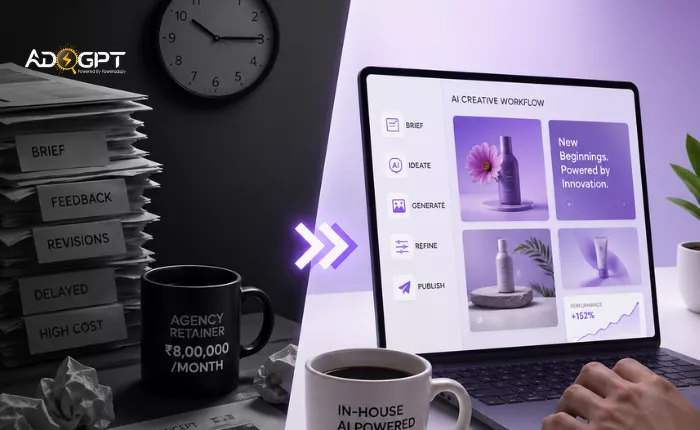
A high-growth D2C startup (let’s call them “The Brand”) was paying a top-tier creative agency a ₹8,00,000 monthly retainer. For that price, they received 12 high-production videos and 20 static graphics per month. On paper, it looked great. In practice, it was a disaster.
The Meta algorithm would “burn through” those 12 videos in the first 10 days. For the remaining 20 days of the month, the account suffered from severe creative fatigue. CTRs would plummet, CPAs would double, and the marketing team would spend their days in “status calls” waiting for the agency to deliver the next batch.
They were trapped in a cycle of high costs and slow turnarounds. To break free, they didn’t need more designers; they needed a systematic ai ad maker workflow. This is the story of how they killed the retainer and built an in-house creative lab using AdsGPT.
“We were paying for ‘art,’ but what we actually needed was ‘volume that converts.’ Our agency couldn’t keep up with the algorithm. We realized that an — Head of Growth
Listen To The podcast now
The Problem: The ₹8,00,000 Monthly Bleed
The Brand was operating in a hyper-competitive category (Personal Care). In this space, an ad’s “shelf life” is often less than a week.
The Agency Workflow:
- Briefing: 2 days of back-and-forth emails.
- Production: 7–10 days for first drafts.
- Revisions: 3 days for feedback.
- Delivery: Total 14 days for a single batch of ads.
By the time an ad was live, the market trends had often shifted. Furthermore, the agency’s creative was based on “gut feel” rather than data. When a ₹1,00,000 video failed to perform, the loss was both financial and temporal.
The Financial Reality of Creative Fatigue:
| Metric | Week 1 (Fresh Creative) | Week 3 (Fatigued Creative) |
| Spend | ₹5,00,000 | ₹5,00,000 |
| CTR | 2.8% | 1.1% |
| CPA | ₹450 | ₹920 |
| ROAS | 3.8x | 1.6x |
The Brand was essentially losing ₹470 on every single acquisition by the third week of every month because they couldn’t refresh their creative fast enough. They needed a way to generate hundreds of variants, not dozens. They needed a robust ai content generator to handle the messaging and an ai ad maker to handle the visual execution.
The Turning Point: In-Sourcing the Creative Lab
The leadership made a radical decision: Fire the agency and move creative production in-house. However, they didn’t hire five new designers. Instead, they hired one junior creative strategist and equipped them with AdsGPT.
The goal wasn’t to produce “prettier” ads. The goal was to produce “smarter” ads at 10x the speed.
By utilizing an ai ad maker, they shifted from a Production-First mindset to a Testing-First mindset. Instead of betting ₹8L on a few “hero” videos, they would bet on a high-velocity testing framework.
The Strategy: How an AI Ad Maker Replaced a 10-Person Team
The new workflow was built on four pillars of AI-driven production.
1. Deconstructing the “Winning DNA”
The startup fed their historic best-performing ads into AdsGPT. The ai content generator within the platform analyzed the scripts, hooks, and visual transitions. It identified that their audience responded best to:
- Hook: “Stop doing [Common Habit]”
- Visual: Split-screen (Problem vs. Solution)
- Tone: Scientific but accessible
2. Mass-Generating High-Converting Hooks
The most critical part of any Meta ad is the first 3 seconds. Using AdsGPT as their primary ai content generator, the team generated 100 different hook variations for a single product.
- Logic-based hooks: “The science behind [Product]…”
- Fear-based hooks: “Why your current routine is failing…”
- Social proof hooks: “Why 50,000+ people switched to…”
This would have taken a copywriter a week. The ai ad maker did it in 90 seconds.
3. Visual Iteration at Scale
With the hooks ready, the team used the ai ad maker to pair these hooks with different visual backgrounds, UGC (User Generated Content) clips, and product shots.
Instead of one “Before/After” video, they now had:
- 10 variants with different text overlays.
- 5 variants with different background music.
- 8 variants with different CTA (Call to Action) buttons.
4. The 48-Hour Feedback Loop
Because the cost of production dropped to nearly zero, the team could afford to be ruthless. They launched “Micro-Tests.” Any ad that didn’t hit a target CTR within 48 hours was killed and replaced by a new variant generated by the ai ad maker.
The Execution: The AdsGPT Workflow Breakdown
Here is exactly how the startup structured their internal “AI Creative Lab”:
Step 1: The “Seed” Concept
The creative strategist identifies a trend (e.g., “Minimalist Skincare”).
Step 2: Ideation via AI Content Generator
They prompt AdsGPT: “Generate 10 provocative hooks for a minimalist moisturizer targeting busy professionals.” The AI provides data-backed angles.
Step 3: Asset Assembly in the AI Ad Maker
The strategist uploads raw product photos or 10-second phone clips. The ai ad maker automatically applies high-converting templates, adds captions, and adjusts the aspect ratios for Reels, Stories, and Feeds.
Step 4: The Multi-Variant Export
In one click, the strategist exports 20 versions of the ad.
- Variant A: Focuses on “Time Saving.”
- Variant B: Focuses on “Ingredient Purity.”
- Variant C: Focuses on “Dermatologist Approval.”
Step 5: Automated Testing
These are uploaded to a Meta “Sandboxed” campaign. The winners are scaled; the losers provide data for the next AI prompt.
Results: Numbers That Killed the Agency Model
After 90 days of using AdsGPT as their core ai ad maker, the results were undeniable.
- Financial Impact:
The ₹8,00,000 monthly retainer was eliminated. Even after accounting for the software subscription and the junior hire’s salary, the startup was saving ₹6,50,000 per month. Over a year, this added ₹78 Lakhs directly to their bottom line. - Performance Metrics:
| Metric | Agency Period | AI-In-House Period | Change |
| Ads Produced/Mo | 32 | 450+ | +1,300% |
| Average CTR | 1.2% | 2.9% | +141% |
| Average CPA | ₹720 | ₹410 | -43% |
| Time to Market | 14 Days | 2 Hours | 99% Faste |
| r |
- Beating Creative Fatigue:
Because the ai ad maker allowed for infinite variations, the Brand never saw the “third-week slump.” As soon as an ad’s performance dipped by 10%, a new batch of 50 variants was ready to take its place.
Why the “AI Ad Maker” Workflow is Superior to Traditional Creative
Elimination of Ego
Agencies often fall in love with their “creative vision.” They are slow to change an ad because “it fits the brand aesthetic.” An ai ad maker doesn’t have an ego. It only cares about what the data says. If a “ugly” high-contrast ad performs better, the AI generates more of it.
The Power of the AI Content Generator
The ai content generator doesn’t get writer’s block. It has analyzed millions of successful ads across the globe. When the startup needed to expand into a new demographic (e.g., Men’s Grooming), the AI immediately knew which emotional triggers to use, saving weeks of market research.
Creative Velocity as a Competitive Advantage
In 2025/2026, the winner on Meta is the one who can test the most ideas. By using an ai ad maker, the startup was essentially “out-learning” their competitors. While other brands were waiting for agency approval, this startup was already on their 5th iteration of a winning concept.
Strategic Learnings: How to Transition to an AI-First Workflow
For other brands looking to ditch the retainer and adopt an ai ad maker, the startup shared these three “Golden Rules”:
Rule #1: Quality In, Quality Out
An ai ad maker is a multiplier. If you give it bad raw assets, it will give you a high volume of bad ads. The startup invested in one high-quality photoshoot per quarter to provide “seed” assets for the AI.
Rule #2: The Strategist is the Pilot
You don’t need a designer, but you do need a Strategist. Someone needs to look at the Meta dashboard, identify why an ad is failing, and tell the ai content generator how to pivot.
Rule #3: Embrace the “Ugly” Ad
Some of the highest-performing ads generated by the ai ad maker were the simplest, plain text on a solid background or a simple unboxing clip with a bold hook. Don’t let “production value” get in the way of “performance value.”
The New Standard for Meta Advertising
The era of the “Retainer Agency” is fading. As Meta’s targeting becomes more automated, the only way for a brand to maintain a competitive edge is through creative volume and iteration speed.
The Brand’s success proves that a single person equipped with a powerful ai ad maker like AdsGPT can outperform a full-service creative agency. They didn’t just save ₹8L/month; they gained total control over their growth trajectory.
By treating creative as a “data problem” rather than an “art problem,” and by using an ai content generator to fuel their messaging, they turned their marketing department from a cost center into a profit-generating machine.
Take Control of Your Creative Workflow with AdsGPT
Stop being a victim of slow agency timelines and high retainers.
AdsGPT is the ultimate ai ad maker designed for brands that need to scale. Whether you are a Shopify seller or a high-growth startup, our platform gives you the tools to:
- Generate 100+ High-Converting Ads in minutes, not weeks.
- Leverage a Powerful AI Content Generator to write hooks that stop the scroll.
- Beat Creative Fatigue with automated visual variations.
- Reduce your CPA by testing more angles than your competitors.
Is your ₹8L retainer actually delivering 10x ROI? If not, it’s time to switch.
→ Start Your Free Trial of AdsGPT – The Leading AI Ad Maker ←
MOST POPULAR