Spent the budget. Launched hundreds of ads. Checked the dashboard over and over… still nothing. Just silence.
Ever wondered why some ads vanish into the digital void while others, the simple, catchy ones, seem to follow you around the internet? It isn’t magic, and it isn’t just a “big brand” budget. It’s persuasive advertising. Those ads that “stick” are built on psychological triggers that turn a random scroll into an intentional click. If you’re tired of shouting into the void, it’s time to stop focusing on volume and start focusing on the art of persuasion.
Listen to the podcast!
What Are Persuasive Ad Copies?
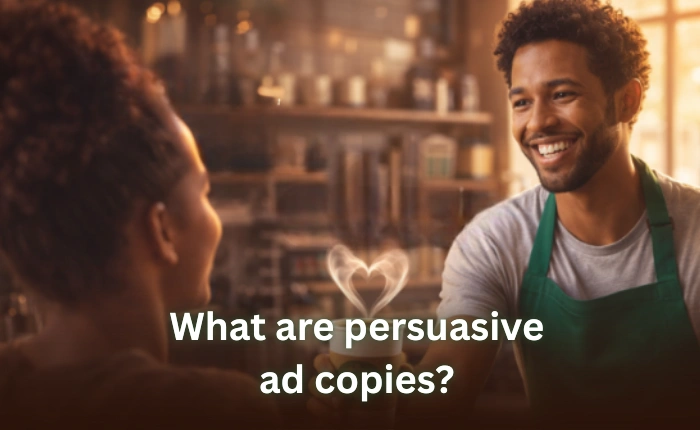
Ever noticed how Starbucks doesn’t sell “caffeinated bean water” but feeling?
Their copy often says things like, “Your daily commute just got a lot better” or “A break you actually deserve.”
The professional sees Starbucks as a place with Wi-Fi and a consistent caffeine kick to power through meetings. It’s the persuasive ad copy that works. A local sees it as a small daily luxury a treat for themselves in the middle of a hectic day.
Their ad copy doesn’t talk about roast profiles but routine. It personifies the “Friendly Barista” who knows your name and makes your day easier. Persuasive ad copy is the strategic application of linguistic psychological triggers—specifically ethos, pathos, and logos to align a brand’s value proposition with a consumer’s internal motivations. Its purpose is to influence attitude and behavior to achieve a measurable conversion goal.
In simple words, it is an art to make someone feel like your product is the missing piece of their day..
So next time you write a copy ad, don’t ask, “What does my product do?”
Ask, “How does this make someone’s day a little better?”
Sell the feeling, not the thing. People buy emotions first, features second.
How to Make Your Ads Persuasive
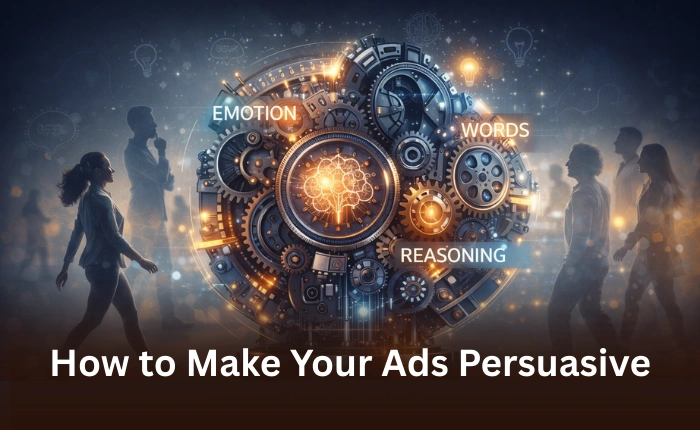
Writing persuasive ad copies is not just about adding words on paper; it’s about building a machine with the capability to move people. Whether you are running a multi-million-dollar company or a beloved local shop, understanding the anatomy of persuasive ad copies is the most important skill you can have.
Why?
If you know the structure and the psychology behind the ad and how to use words, emotion, and reasoning to appeal to someone, you will not throw random ideas but well-designed messages that actually resonate with your audience. You move from “guessing” what might work to “knowing” what will work.
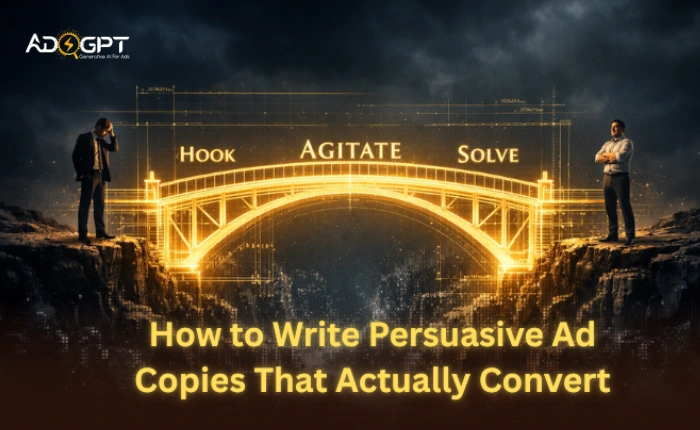
Hook
The most essential part of the persuasive ad copies are their hook; if the hook fails, the rest of your content remains invisible.
‘Your vacuum sucks. And not in a good way.”
This headline works because it creates an immediate internal reflection.
The strategy of a hook here is holding a mirror to the reader’s current reality and forcing them to look at it.
In professional terms, a hook is a pattern interrupter.
Think of it like this: most people spend their day in a “trance” of scrolling or walking. A hook in a persuasive ad copy is a firm but friendly hand on the shoulder that says, “Wait—this is for you.” It isn’t just a sentence; it’s a promise of value. It tells the reader that the next 30 seconds of their time will be worth more than the 30 seconds they just spent.
To make a good hook that works both for a boardroom and a living room, you can follow this
- Be specific, not vague. Instead of writing “We have great tools,” say “The only tool you need to save 2 hours a day.”
- Agitate a truth: use a plain English fact that everyone knows,but nobody says (e.g., “Most coffee tastes like burnt paper. Ours doesn’t.”)
- The “So What?” Test: read your headline loudly. If the reader can say, ‘So what?’ your hook isn’t sharp enough; it needs to feel urgent. This is how professional persuasive ad copies stand out.
How to use it
Once the hook is ready, place it where it cannot be missed at the very top of your print ad, the first line of your social media caption, or the boldest text of your ad.
Pro tip: don’t try to be too clever or mysterious. A professional is too busy for riddles. Clear is always better than clever.
Agitation
After stopping the audience with the hook, you get their undivided attention, but attention alone is not enough to sell. Don’t sell the product; emotion does. Persuasive ad copies know how to move from product to person seamlessly:
“Ever spent your entire Sunday morning pushing a machine around, only to realize the floor still feels gritty under your feet?”
This is how it works: it moves the conversation from the product (the vacuum) to the person (their reputation).
- For the status-conscious buyer, this hits like a fear of a lower standard, which is making them appear less elite in front of peers.
- For the everyday homeowner, this hits like the social anxiety of being judged by the neighbors and families.
You are not just describing a dirty floor but the feeling of being caught off guard; you are making the problem personal.
Agitation is the psychological process at the heart of many top persuasive ad copies—reminding the customer why they are unhappy in the first place. Most people live with their problems until they become invisible. Agitation acts as a magnifying glass; it takes a small, dull ache and reminds the reader of the actual cost of the problem.
In professional terms, it is creating a gap of discontent between where they are and where they want to be.
How to make a master-level agitation
- Use feeling words. Don’t just talk about the facts; talk about the frustration, embarrassment, exhaustion, or wasted hours.
- Paint a scene; place the reader in a particular moment instead of saying “old cars break.” Say, “That moment your engine sputters just as you’re pulling onto the highway for a big meeting.”
- remind them that the problem is going to get worse, which can cost them their reputation
How to use it
The agitation follows immediately after the hook; it serves as the bridge that justifies why your solution is necessary.
Pro-Tip: Don’t be “mean” or “judgmental.” Be empathetic. Your voice should sound like a friend who says, “I’ve been there, and I know exactly how much that sucks.”
Solution
After stopping them with a hook and making them magnify their problem, introduce the rewarding part of the ad: the rescue. The solution in persuasive ad copies doesn’t list features; it paints the “after” picture:
“The Vortex 5000 doesn’t just clean; it restores your home’s pride.”
It reframes the product; the piece of plastic and metal transforms into a savior.
- For the status-conscious buyer, it promises to overcome over-effort; it’s about a high-standard result that reflects well on leadership.
- For the everyday homeowner, it promises pride over chores; it’s about feeling good when they walk through their front door.
The strategy here is a bridge that shows them how to move from pain to peace. In persuasive copy, the solution is not a list of features. It is a rescue mission.
Think of it like this: If the problem is a dark room, the solution isn’t “a 60-watt lightbulb with a glass casing.” The solution is the light. The Hero Concept means you position your product as the singular thing that makes the “Agitation” disappear. You aren’t selling a “thing”; you are selling the “after” picture.
How to make a good solution
- Kill the Jargon: Don’t say “Proprietary Suction Technology.” Say, “Deep-cleaning power that hits the dirt you didn’t even know was there.”
- Focus on the Transformation: Use the “So What?” test again. If the feature is “Fast Charging”, the Hero Solution is “Ready to go before your first cup of coffee is finished.”
- Position it as the Rescue: Use words that imply relief, such as restore, reclaim, protect, or simplify.
How to use it: the solution arrives the moment the reader is most frustrated by the agitation.
Make the transition seamless. Use words like “That’s why we created…” or “Finally, there’s a better way.” This makes your product feel like the logical, inevitable answer to their problem.
The CTA (The Closer)
This is the finish line in persuasive ad copies.
“Get 20% off today—clean better, live lighter.”
It is a combination that promises low-friction instruction with a high-value benefit.
For the Value-Driven Decision Maker:
“20% off today” appeals to logic—it rewards fast, rational decision-making and clear ROI.
For the Comfort-Seeking Buyer:
“Clean better, live lighter” is an emotional promise of ease, calm, and a better home experience.
CTA is a bridge to ownership.
It acts as an open door at the end of the hallway; most people are naturally hesitant—they don’t want to make a mistake. A professional CTA removes that “choice paralysis” by giving one and only one clear instruction. It tells the reader exactly what to do next to make the “Agitation” disappear and the “Hero” arrive.
How to make a CTA
- Use Action Verbs: Start with “Get,” “Start,” “Claim,” “Join,” or “Download.” Avoid weak phrases like “Click here for more info.”
- Add Urgency or Scarcity: Give them a reason to act now instead of “someday” (e.g., “Today only”, “Limited spots”, or “While supplies last”).
- Remind Them of the Win: Don’t just say “Buy.” Remind them why.
Persuasive ad copies always pair the CTA with an emotional and logical win for maximum impact.
Pro-Tip: Keep it Singular. If you ask them to “Follow us on Instagram AND visit our website AND call for a quote,” they will do nothing. Give them one door to walk through.
Also read
AI Ads Manager: Optimize Your Ads With Artificial Intelligence
How To Spot Bad Ads Before They Damage Your Brand
How to Make Ads Like a Pro
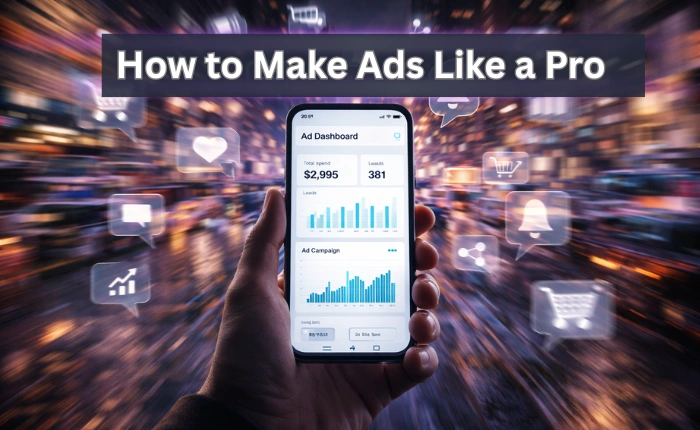
Understanding the persuasive ad copy is powerful, but having the time to build it from scratch every day is entirely challenging. For the professional managing a firm or the local owner running a shop, the “marketing brain” often feels like a heavy weight added to an already full day. No one should have to stay up past midnight staring at a blank screen, trying to turn passion into the “perfect words.
There is a platform that can save you from all this: AdsGPT.
How to Generate Persuasive Ad Copies With AdsGPT
Creating persuasive ad copy is not just about writing attractive words; it’s about understanding what makes people stop, think, and take action. That’s where AdsGPT comes in.
AdsGPT is designed to deeply understand persuasive advertising principles. It helps businesses craft compelling ad copies that grab attention, connect emotionally, and drive conversions, without sounding forced or overly salesy.
How AdsGPT Helps You Create Persuasive Ads
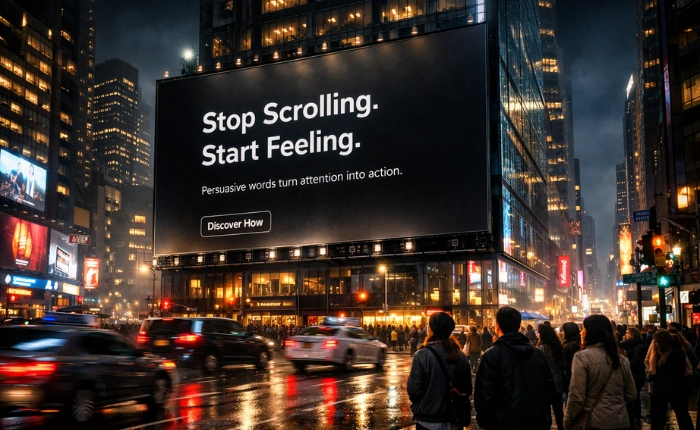
1. Finds the Perfect Hook
When you’re struggling to come up with an attention-grabbing opening, AdsGPT generates strong hooks that make people stop scrolling. It understands what triggers curiosity and interest in your target audience.
2. Identifies Customer Pain Points
Persuasive ads work best when they reflect the customer’s real struggles. AdsGPT analyzes your input and describes problems with empathy and clarity, making your audience feel understood.
3. Position Your Product as the Solution
Instead of simply “selling,” AdsGPT turns your product or service into a clear, relatable solution. It shows how your offer solves a specific problem, whether you’re pitching in a boardroom or advertising to everyday customers.
4. Saves Time While Maintaining Quality
Writing high-converting ad copy takes time and creative energy. AdsGPT reduces that effort by generating structured, persuasive messages quickly, while keeping the tone professional, clear, and impactful.
Why Use AdsGPT for Persuasive Ad Copies?
Business is not just about selling; it’s about offering something meaningful that solves a need. AdsGPT helps you communicate that value effectively. It gives you back valuable time, so you can focus on running and growing your business, while your messaging remains persuasive, polished, and authentic.
Conclusion
Persuasive ad copies don’t work because they are clever.
They work because they are structured.
When you understand how to write persuasive ad copies using the clear sequence Hook, Agitation, Solution, and CTA, you stop relying on guesswork and hopes that the ad will work, but start intentionally guiding attention, emotions, and actions.
Great persuasive advertising isn’t about shouting louder or launching more campaigns; it is about saying the right thing at the right psychological moment. The best persuasive ad copies don’t feel like ads at all; they feel like someone finally understood the problem and offered a way out.
Let them realize that yes, we are actually helpful. See
The hard work of building the business is already done. Now, with the right structure in place, the message can finally do the heavy lifting. It’s time to stop searching for the “perfect words” and start trusting the perfect system.
The strategy is set, the weight is lifted, and the connection is ready to be made.
FAQ
- How to make an ad persuasive?
To make an ad persuasive, structure it perfectly and blend it with psychology. The most effective ads follow a sequence: hook, agitation, solution, and CTA. This approach guides attention, stirs emotions, and drives action.
- Is it important to be a writer to draft persuasive ad copies?
Not at all. Understanding the basic structure and psychology behind persuasive ads is more important than talent. Once you know the framework, you can draft persuasive ad copies easily. Tools like AdsGPT make it even easier by handling the heavy lifting for you.
- How long does it take to create persuasive ad copies?
Manually, it can take hours to brainstorm and refine every part of the ad. With the right system like AdsGPT, you can generate scroll-stopping ad copy in minutes, without sacrificing quality or persuasion.
- What makes a persuasive ad great?
A good ad gets the attention of the customer, but a great ad moves people emotionally and logically, turning awareness into action. A great persuasive ad feels personal, empathetic, and necessary like someone finally understood the problem and offered a solution.
- How can I make sure my ad converts?
Conversion comes from clarity, empathy, and timing. Stop guessing. Use the Hook → Agitation → Solution → CTA framework, and let a system like AdsGPT ensure every step is executed precisely, saving you time and money.

MOST POPULAR