Key Numbers at a Glance
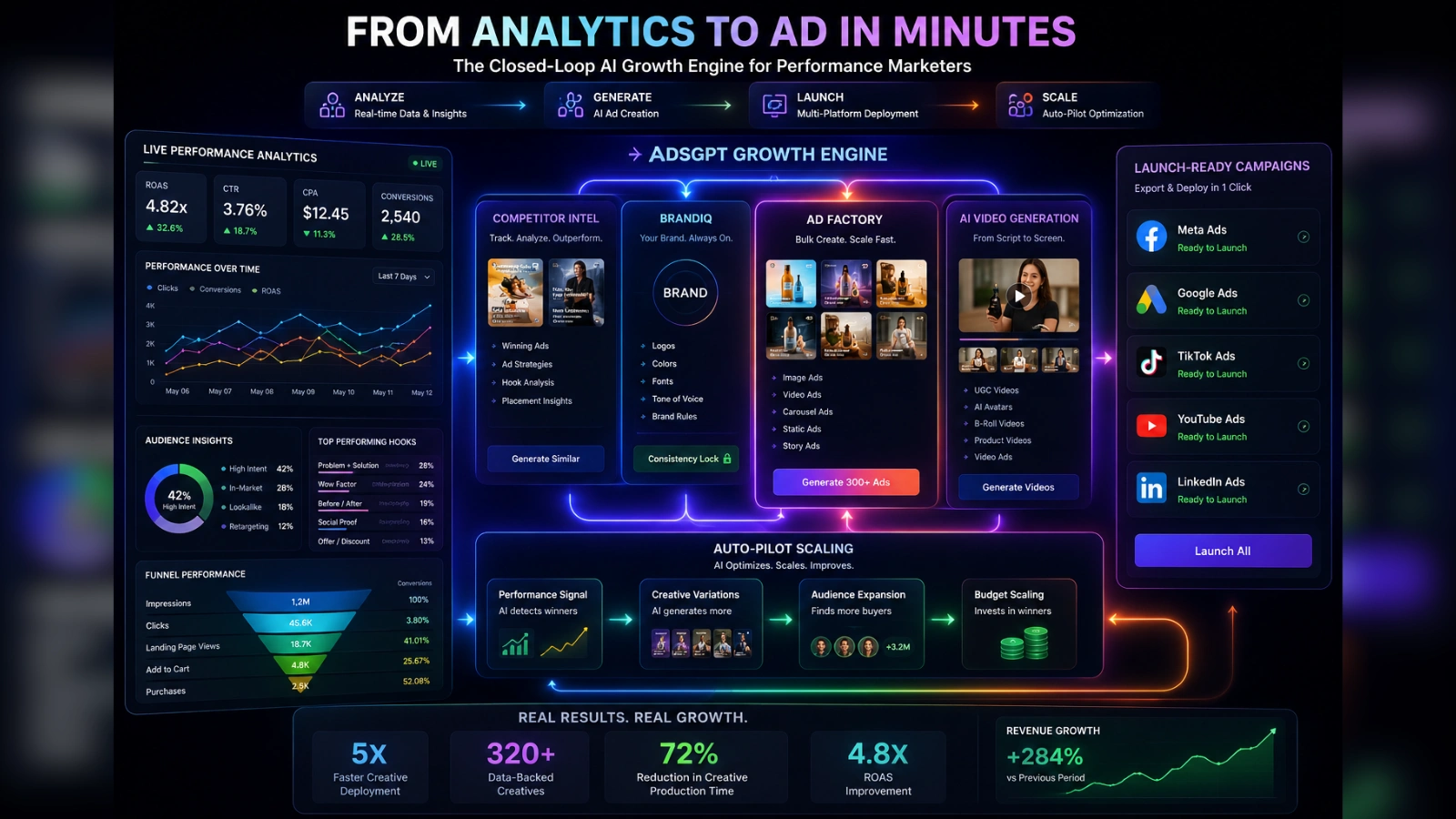
5X faster creative deployment | 320+ data-backed creatives in 60 days | 72% reduction in creative lag | 4.8X ROAS improvement
Every performance marketer knows this feeling: your dashboard is full of signals, your audience insights are sharp, and your CTR data is pointing directly at what needs to change. But the creatives? Still stuck in a queue somewhere between a designer’s to-do list and a Slack thread that has gone cold.
This is the story of how one aggressive, growth-focused marketer broke that cycle. Using marketing data analytics as fuel, they rebuilt their entire creative workflow around speed, consistency, and continuous learning. The result was not just better ads. It was a fundamentally different way of operating.
“Insights were immediate. Creative execution was delayed. And in performance marketing, delay kills ROAS.”
In a hurry? Listen to the blog instead!
The Problem: Data-Rich, Creative-Slow
Most teams have more data than they know what to do with. The bottleneck is rarely insight. It is execution.
This marketer was running multi-platform acquisition campaigns across Meta, Google, and TikTok. They had access to everything: CTR breakdowns, funnel drop-off data, audience overlap reports, and conversion trend analysis. In other words, strong marketing data analytics coverage across the board.
But data alone does not launch ads. The real bottlenecks looked like this:
- Creative teams could not keep pace with the speed of performance insights
- Winning audience hooks were identified too late to act on them
- New ad variations required days, sometimes weeks, to produce
- Scaling a winning ad meant restarting production from scratch
- Brand consistency broke down under rapid iteration pressure
- Video testing was expensive and slow, relying on external creators
The data was doing its job. The creative pipeline was not. And every day that gap stayed open, the budget was being spent on stale creatives while the real opportunity sat in a spreadsheet.
The Strategy: One System, Closed Loop
Instead of treating data and creative as two separate functions, the marketer built a single continuous system where marketing data analytics fed directly into creative generation, and the output of each campaign immediately informed the next round.
Here is how the pieces came together:
- Competitor intelligence: Live campaign data was layered with competitor ad insights to identify top-performing hooks, creative fatigue signals, and winning visual structures before launching anything new
- Brand memory: A central brand layer stored logo, colors, tone, and messaging rules, so every generated creative stayed on-brand even when producing hundreds of variations at once
- AI-powered production: From a single strategic brief, the team generated static ads, video ads, UGC formats, platform-specific creatives, and audience-specific copy simultaneously
- AI content marketing at scale: Rather than briefing external creators for video, AI-generated UGC hooks, avatar ads, and B-roll explainers replaced the need for filming entirely
- Automatic scaling: When a winner emerged, the system recreated the framework, generated fresh iterations, and expanded audience variants without restarting production
The flywheel looked like this:
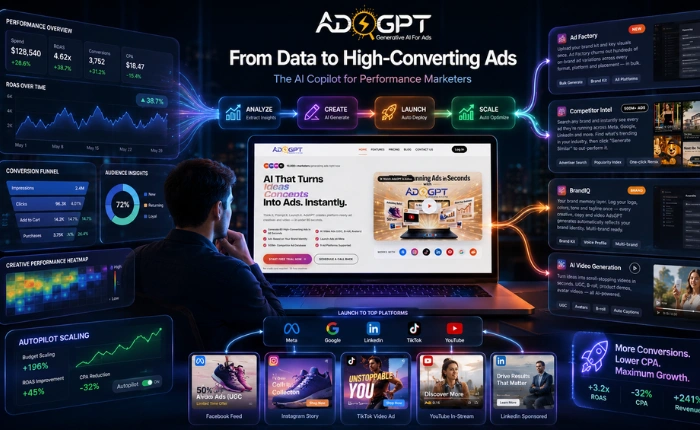
Analyze → Generate → Launch → Scale → Repeat
This is what real marketing data analytics integration looks like. Not a dashboard you check once a week. A system that acts on data the moment it is available.
Spotlight: How AdsGPT Made This Possible
This entire workflow ran on AdsGPT, an AI content marketing platform built specifically for performance marketers who cannot afford the gap between insight and execution.
AdsGPT connects your analytics directly to creative production. Here is what that looks like in practice:
- Generate 60 high-converting ads in 60 seconds, across every platform
- Access a 500M+ competitor ad database to see what is already winning in your niche
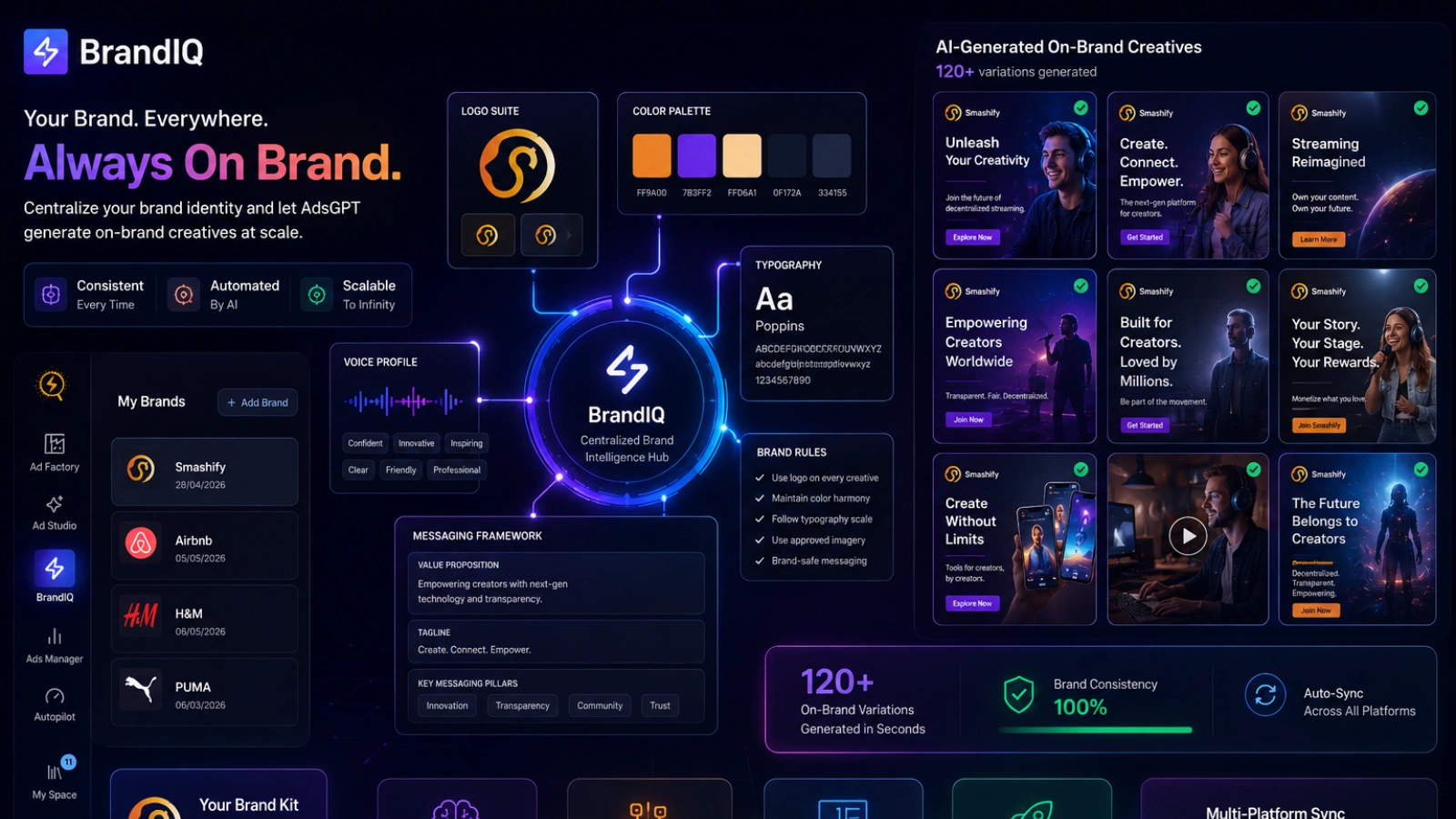
- Use BrandIQ to store your brand identity once, and have every creative reflect it automatically
- Create UGC videos, AI avatars, and B-roll content without any external creators
- Launch directly to Meta from inside the platform, no manual exporting needed
1M+ ads generated. 100K+ campaigns optimized. 9 ad platforms supported.
Start free at adsgpt.io. No credit card required. 35 free creatives included.
How AI Content Marketing Changed the Execution Game
Traditional creative workflows treat each ad as a project: brief, design, revise, approve, launch. That model works when you are running one campaign a month. It collapses when your marketing data analytics is telling you to test five new hooks this week.
AI content marketing removes the bottleneck entirely. Here is what changed in practice:
- A single brief could produce dozens of on-brand variations in minutes, not days
- Video production no longer required casting, filming, or editing, reducing cost by over 80%
- Platform-specific sizing was handled automatically, removing manual resizing from the workflow
- Copy and visual testing could happen in parallel rather than sequentially
- Every creative generated reflected up-to-date marketing data analytics insights, not last week’s brief
This is the real promise of AI content marketing: not just speed, but the ability to keep creative quality and brand consistency intact even at volume. The marketer was no longer choosing between fast and good. They had both.
Read More:
5 Ways AI Marketing Tools Benefit Your Campaigns
Before and After: What Actually Changed
The operational shift was visible across every part of the business.
Before:
- Data silos across platforms
- Creative bottlenecks every week
- Slow, expensive video testing
- Brand inconsistency at scale
- Delayed campaign scaling
- Reactive, not proactive
After:
- Unified analytics and creative system
- AI-driven production on demand
- Instant video generation in-house
- Brand memory applied automatically
- Auto-pilot campaign scaling
- Continuous optimization cycle
The marketer did not just improve their campaigns. They replaced a fragmented operation with a growth engine that runs on marketing data analytics and executes through AI content marketing tools.
The Results: 60 Days of Real Numbers
The outcomes were not marginal improvements. They were a structural step-change.
- 320+ creatives launched, all grounded directly in performance data
- 72% faster execution, from campaign analysis to live ad deployment
- 4.8X ROAS growth, driven by continuous data-informed iteration
- 5X faster creative cycles compared to the previous workflow
- Massive production cost savings without sacrificing creative volume or quality
These numbers came from a system that treated marketing data analytics not as a reporting function but as an execution engine. Every creative decision was backed by data. Every campaign launch was informed by what had already worked. And every scaling decision happened automatically, without restarting the production process.
That is what separates teams that use analytics from teams that are powered by them.
What This Means for Your Campaigns
If your marketing data analytics are telling you one thing and your creative output is delivering another, the problem is not the data. It is the distance between insight and execution. Here is what closing that distance actually requires:
- A creative system that can act on data in hours, not weeks
- AI content marketing tools that maintain brand consistency at any volume
- Video capabilities that do not depend on external production teams
- Competitor intelligence built into the creative brief process
- An auto-scaling mechanism so winners compound rather than plateau
None of this requires a larger team. It requires a better system. One where marketing data analytics and creative production are not two separate departments but a single connected loop.
From Dashboard to Revenue, in Minutes
Performance marketing moves too fast for outdated creative workflows. The marketers winning right now are not the ones with the best data. They are the ones who can act on it fastest.
If your analytics are ahead of your creative, the gap is costing you ROAS every single day. Closing that loop is not a future project. It is the most important operational change you can make right now.
Your data already knows what to do. The question is how fast your creative can keep up.
Ready to close the loop? Start free on AdsGPT and generate your first 35 creatives today. No credit card required.

MOST POPULAR