LinkedIn ad copy became a running joke inside this SaaS startup’s marketing team.
Not because the ads were bad.
Because by the time campaigns finally went live, half the momentum was already gone.
One launch made that painfully obvious. The team had everything lined up. Sales were ready. A competitor had just changed pricing, which triggered a wave of conversations across the market. Search intent was climbing fast, and the company had a strong angle to respond with.
Monday morning, the campaign brief was approved.
By Thursday afternoon, the LinkedIn ads were finally live.
Nobody failed at their job. That was the frustrating part. Brand review wanted tone adjustments. Legal flagged one sentence. A stakeholder requested a softer CTA. Every comment sounded reasonable on its own.
Together, though, they slowed the campaign just enough to miss the moment.
The numbers changed almost immediately. CPL climbed. Engagement softened. The audience felt colder. Internally, people blamed targeting, budget, and even the offer itself.
The real issue surfaced later.
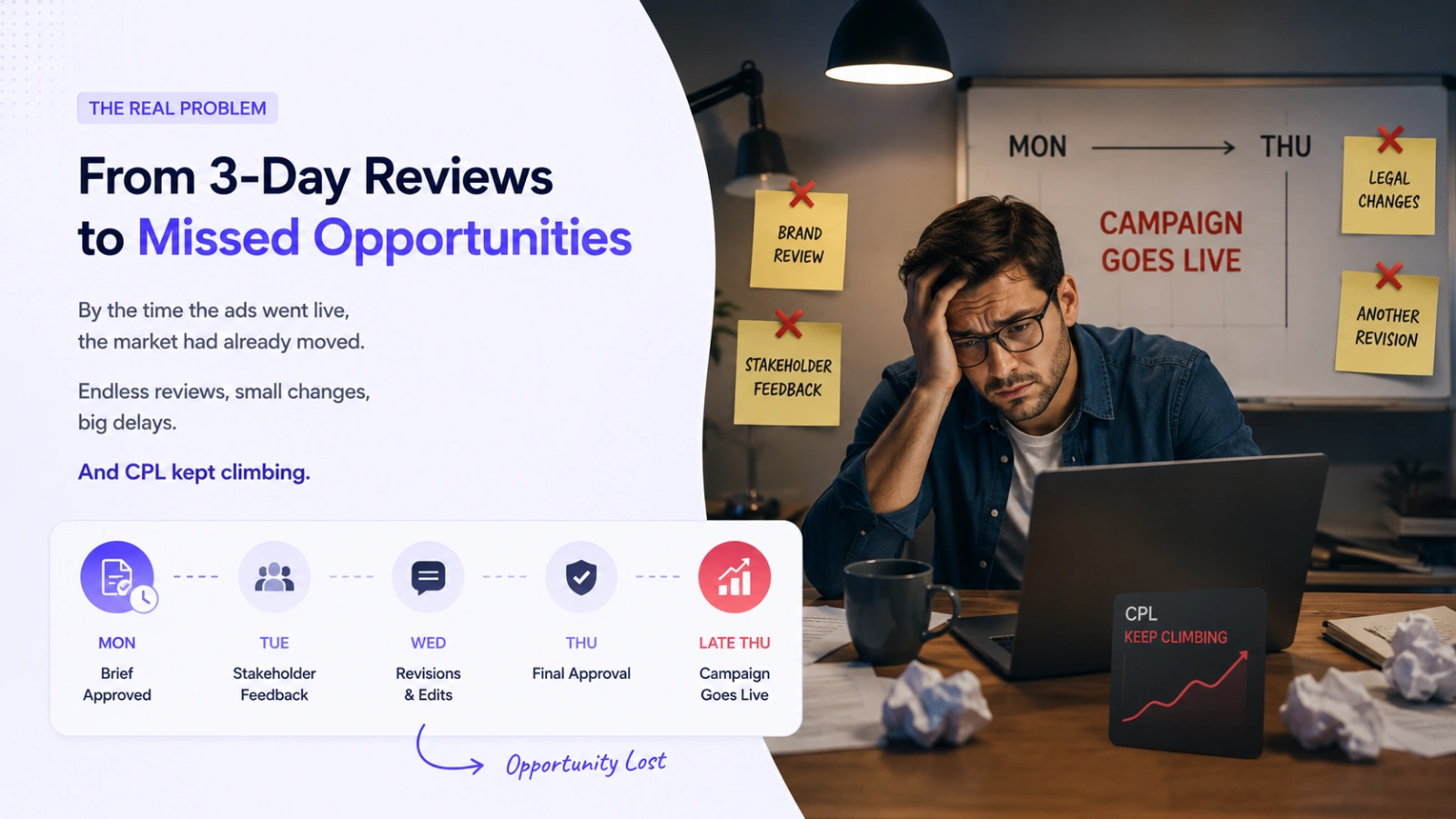
The team realized that producing LinkedIn ads had quietly become the slowest part of their growth engine.
Not strategy. Not media buying. Not creative ideas.
Just the process of getting campaigns written, reviewed, approved, and launched before the market moved on.
Read Aloud!
SaaS Teams Have Always Had a LinkedIn Ads Problem – and It Was Never the Budget
Most underperforming LinkedIn ads get blamed on the obvious things first. Budget. Audience targeting. Offer quality.
Those factors matter. They are rarely the full story.
In B2B SaaS, the bigger constraint has often been copy velocity.
Think about how many angles a single product can support. A CRM platform alone might appeal to sales leaders focused on forecasting, RevOps teams managing attribution, or founders trying to shorten sales cycles.
Each audience needs different messaging.
Each message deserves its own LinkedIn ad copy variation.
Now compare that reality to how most SaaS teams actually build campaigns. One writer creates the draft. A manager reviews it. Brand leaves comments. Legal adjusts a sentence. Another revision follows. By the end, the campaign launches with two safe variations and limited testing potential.
That is not enough for LinkedIn’s system to learn meaningfully.
It also creates a hidden strategic problem.
When producing new variations becomes slow, teams stop experimenting. Weak hooks survive because nobody has enough time to test stronger alternatives.
The issue was never simply ad spend.
The real bottleneck was producing enough review-ready LinkedIn ad copy quickly enough to compete.
What Actually Changed: How These Teams Started Building LinkedIn Ad Copy Differently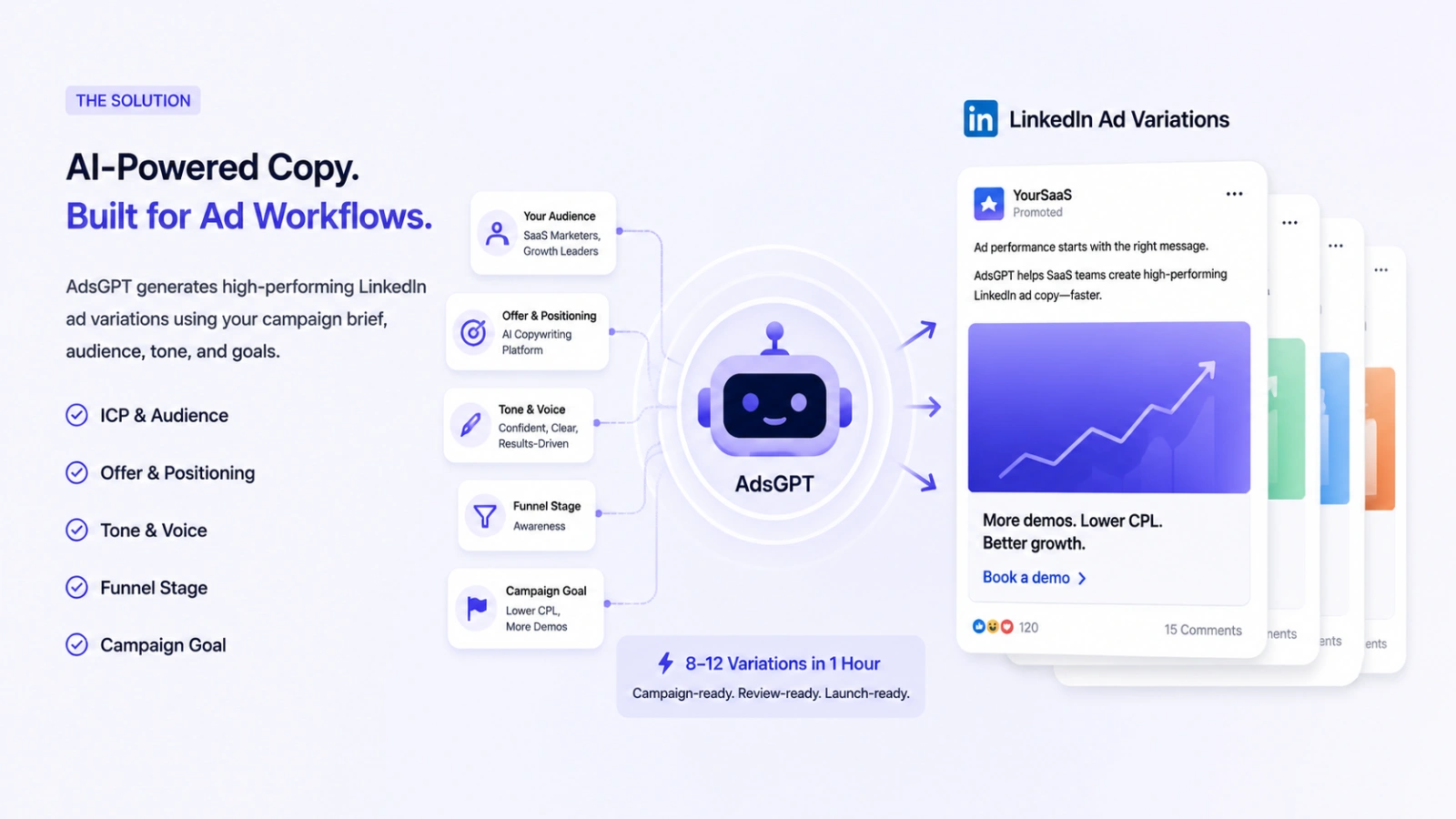
The breakthrough did not come from hiring more writers.
It came from changing how LinkedIn ad copy was created in the first place.
Instead of relying on a traditional brief-write-review-revise cycle, the team adopted AdsGPT, an AI copywriting platform designed specifically for ad workflows.
That distinction mattered immediately.
Generic AI tools could generate LinkedIn ads quickly, but the messaging often lacked strategic depth. The copy sounded acceptable while saying very little. Hooks felt broad. Messaging lacked specificity. Most variations blended.
AdsGPT approached the process differently.
The platform generated LinkedIn-ready ad variations using campaign context, ICP details, funnel stage, and tone requirements. Instead of disconnected snippets, the team received structured campaign-ready outputs.
The workflow for building LinkedIn ads changed fast.
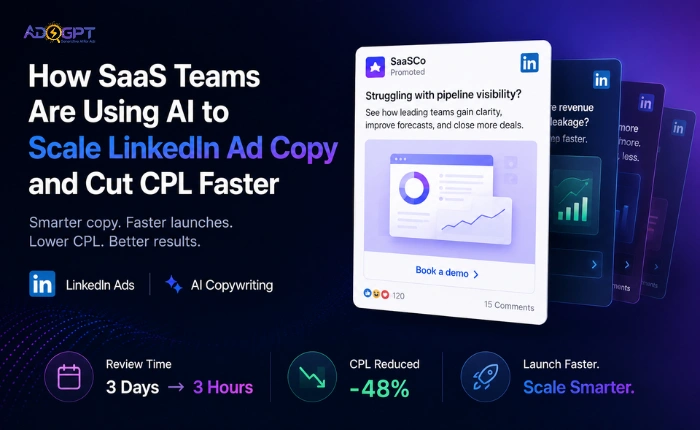
Before AdsGPT, one campaign could take a week to finalize and still produce only two ad variations.
After implementation, marketers uploaded a brief, selected audience parameters, and received eight to twelve LinkedIn ad copy variations within an hour. Most arrived close enough to brand standards that review cycles became dramatically shorter.
That changed internal behavior, too.
Reviewers stopped spending time rewriting sentences. Instead, they focused on choosing strategic angles worth testing first.
Once the review process stopped acting as a bottleneck, campaign velocity increased naturally.
From Campaign Brief to Live LinkedIn Ad in Under Three Hours
The LinkedIn ads workflow became surprisingly simple.
Marketers started with a campaign brief containing ICP details, campaign objectives, offer positioning, tone guidelines, and funnel stage information.
AdsGPT processed the brief and generated multiple LinkedIn ad copy variations automatically.
Every variation arrived formatted for LinkedIn Campaign Manager and grouped by hook type, including stat-led, pain-point-led, outcome-led, and question-led angles.
That detail mattered more than expected.
Reviewers were no longer approving random copy variations. They were evaluating strategic positioning choices.
What once required a week to launch LinkedIn ads now was done before lunch.
From brief to live campaign in under three hours.
Why LinkedIn Rewards More Copy Variation Than Most Teams Realize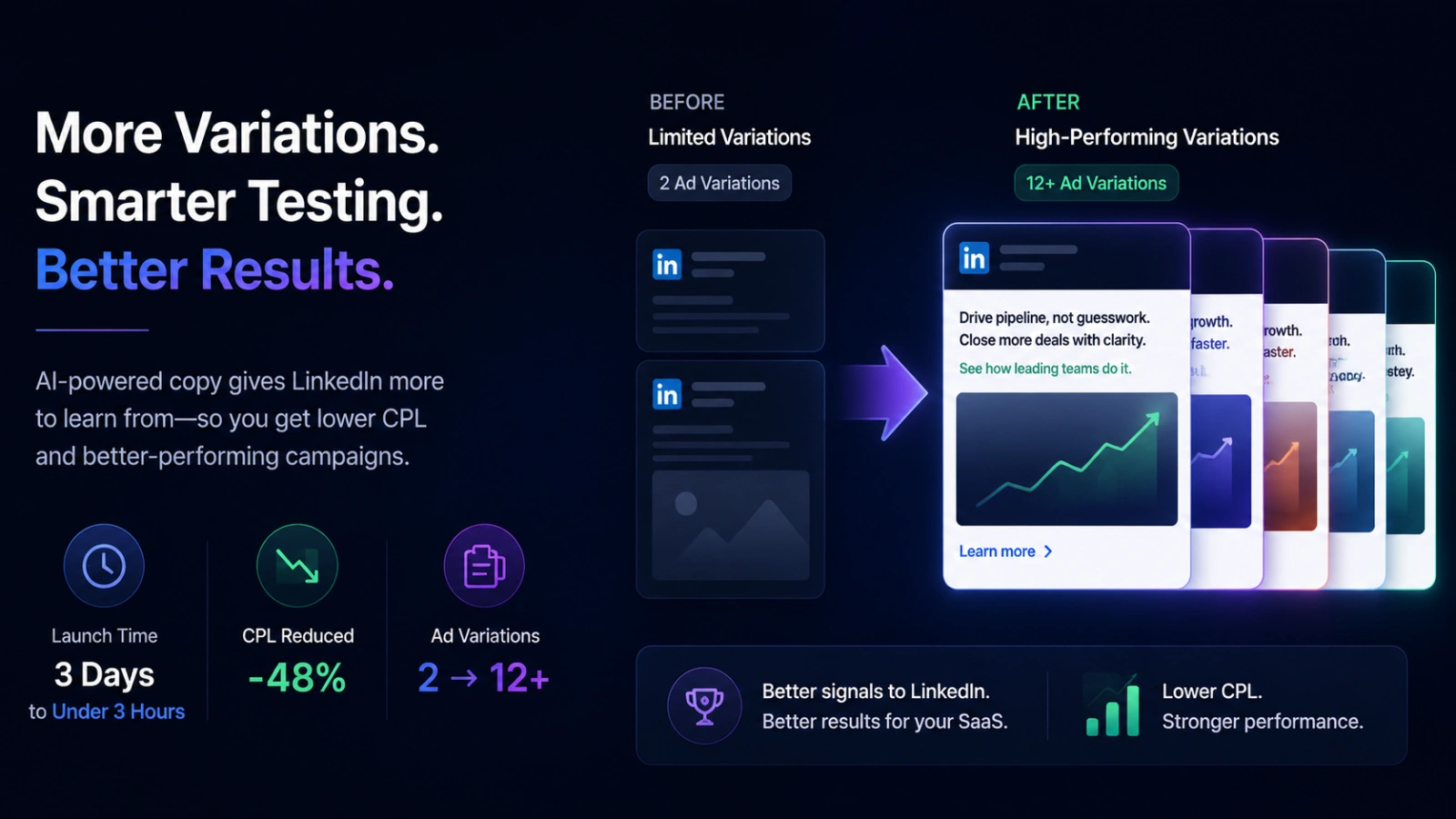
LinkedIn’s advertising system performs better when it has more variation to evaluate.
If you launch one headline and one body copy combination, the platform has very little data to work with. But when campaigns include multiple strategic angles, LinkedIn can identify which message resonates with which audience segment.
That matters especially in B2B SaaS.
A CFO reacts differently from a VP of Engineering. Procurement teams care about different risks than department managers. Even when the ICP overlaps, buyer motivations rarely do.
More LinkedIn ad copy variations allow the algorithm to surface those differences faster.
This is where many SaaS teams accidentally limit themselves. They launch two safe versions because producing additional B2B ad creatives manually feels expensive and slow.
As a result, they never discover which message actually drives stronger performance.
That is why teams running more LinkedIn ads usually learn faster than teams relying on only two or three variations.
Real Campaigns, Real Numbers: What the Improvement Actually Looked Like
One HR tech SaaS company provided a clear example of the impact.
Their LinkedIn ads testing process remained limited because producing new creative variations took too long. Review cycles averaged four business days, and testing remained limited because generating more creative required too much production time.
After switching workflows, the company began launching eight to twelve variations per campaign.
Review cycles dropped to same-day approval because the copy arrived pre-structured and aligned with brand guidelines.
Within six weeks, CPL dropped by 34%.
The biggest insight was not audience-related. The winning improvement came from messaging itself. Outcome-led hooks like “Cut employee onboarding time in half” significantly outperformed feature-focused copy for mid-market buyers.
The gain was not just faster production.
It was faster learning.
The Four Mistakes That Cancel Out Your Gains Before They Start
Scaling LinkedIn ads does not automatically improve campaign performance.
A few mistakes remove the advantage quickly.
The first is generating variations that all say the same thing differently. Changing wording without changing the underlying angle gives LinkedIn nothing meaningful to optimize against.
The second is skipping brand review because the AI output feels “finished.” In B2B SaaS, tone accuracy and claim precision still matter.
Another common mistake is pausing campaigns too early. LinkedIn needs enough impression volume to identify winning combinations, especially across multiple audience segments.
The final mistake is treating the first AI-generated output as final messaging. Strong B2B ad creative usually improves through multiple testing and feedback cycles.
The best teams treat AI outputs as evolving strategic inputs, not finished assets.
How AdsGPT Helps SaaS Teams Scale LinkedIn Ads Faster
At some point, the challenge becomes operational.
How do you consistently produce LinkedIn ad copy at the speed modern testing requires without hiring a larger team?
That is the gap AdsGPT was built to solve.
Unlike general AI copywriting tools, AdsGPT focuses specifically on advertising workflows. The platform understands LinkedIn formatting requirements, CTA structures, character limits, and professional audience expectations natively.
That changes the usefulness of the output.
Instead of receiving generic text blocks that require heavy editing, teams receive structured campaign-ready assets.
Key capabilities include:
- Generating multiple LinkedIn ad copy variations from a single brief
- Organizing hooks by strategic angle
- Formatting outputs for Campaign Manager automatically
- Applying brand voice guidelines consistently
- Supporting rapid iteration using performance feedback
The operational impact becomes noticeable quickly.
Marketers spend less time producing first drafts and more time evaluating strategic direction. Reviewers spend less time correcting formatting issues. Campaigns move faster without sacrificing message quality.
The value is not simply speed.
It is decision-ready output.
The Deeper Shift: Why the SaaS Teams Winning on LinkedIn Think Like Publishers
The biggest shift in LinkedIn ads production is not technological.
It is philosophical.
Winning SaaS marketing teams no longer treat LinkedIn ad copy as a fixed campaign asset created once and left untouched. They treat messaging as a continuous production system.
That mindset changes everything.
Instead of protecting a small number of carefully approved ads, teams produce larger volumes of B2B ad creative, test aggressively, study performance signals, and feed those insights back into the next campaign cycle.
The process becomes iterative rather than static.
That is how publishers operate. Constant production. Constant testing. Constant refinement.
AI simply makes that model accessible to smaller teams.
What once required agency support and weeks of turnaround time can now happen inside a single workday.
LinkedIn’s algorithm is already capable of identifying buyer intent patterns.
The real question is whether marketers are giving it enough variation to learn from.
The Number Worth Checking Right Now
Look at how many LinkedIn ads are actively testing genuinely different messaging angles.
Not reworded versions.
Different hooks. Different strategic angles. Different buyer motivations.
If the number is under six, there is likely untapped performance sitting inside your current workflow.
The SaaS teams that moved from two variations to twelve did not increase ad spend first.
They increased learning speed.
AdsGPT helped them do it faster by removing the operational friction that normally slows LinkedIn ad copy production down.
FAQs About LinkedIn Ads and AI Copywriting
How can AI improve LinkedIn ads performance?
AI helps teams create more LinkedIn ads variations faster, which improves testing volume, speeds up optimization, and helps identify higher-converting messaging angles earlier.
Why do SaaS teams struggle to scale LinkedIn ads?
Most SaaS teams slow down because writing, reviewing, and approving LinkedIn ads manually takes too much time, limiting campaign testing and iteration.
Can AI-generated LinkedIn ads still match brand voice?
Yes. Tools like AdsGPT use tone guidelines and campaign context to generate LinkedIn ads that stay aligned with brand messaging and formatting requirements.

MOST POPULAR