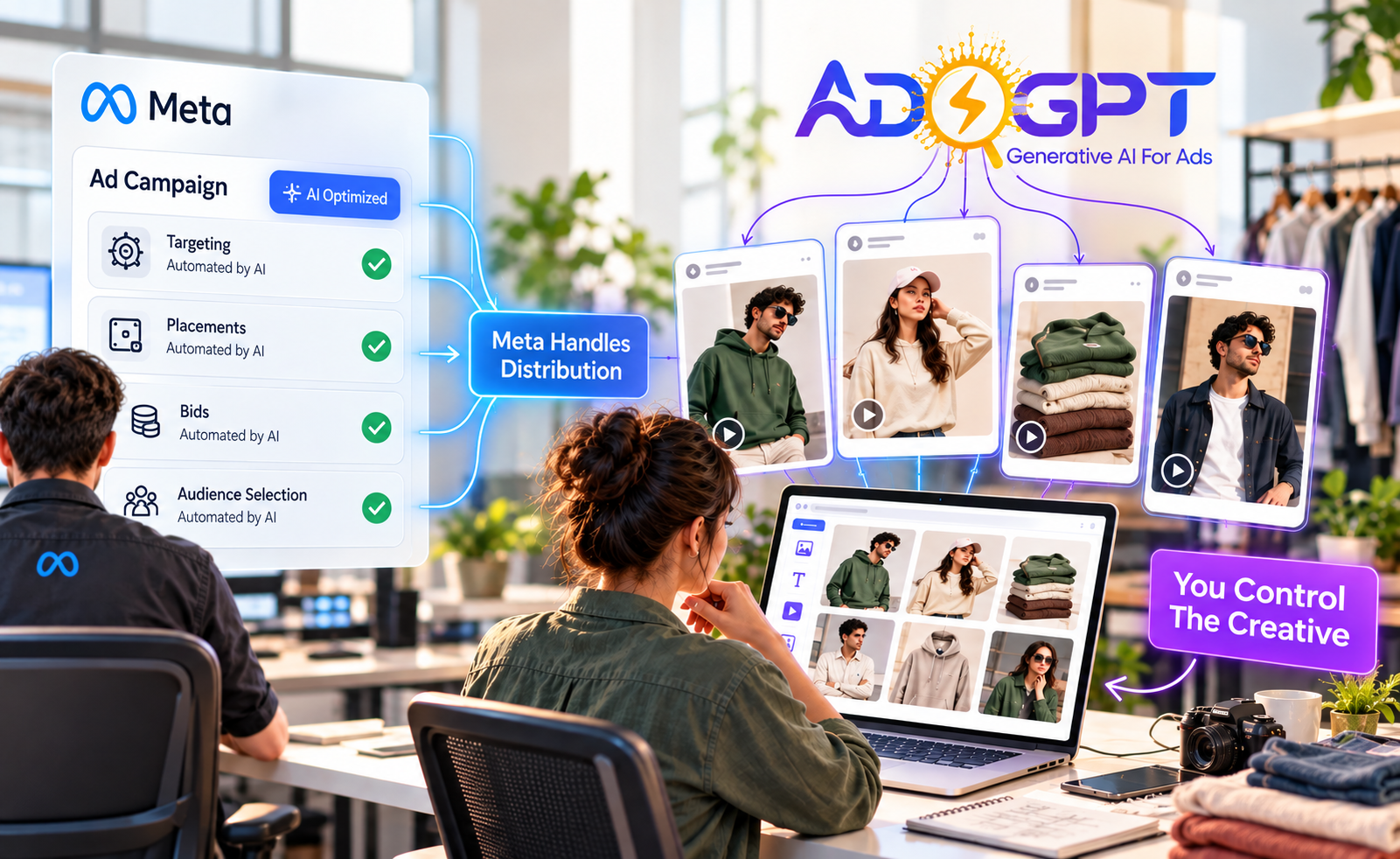
Meta automated your targeting. Then your placements. Then, in early 2026, it merged manual and Advantage+ campaign creation into a single unified flow where AI-driven defaults are pre-selected before you click anything. The lever you used to spend 70% of your time pulling- audience segmentation, bid strategy, placement selection- is effectively gone. That’s why an AI ad creative generator isn’t a nice-to-have in 2026; it’s the only production lever you still control. The machine handles distribution. You control what the machine is given to work with.
So what’s left? Creative. That’s it. And most growth teams still treat it like a finishing touch.
Listen to the blog:
Why Creative Was Always the Real Game, and Marketers Kept Missing It
This is not a new truth that automation revealed. Nielsen’s Project Apollo research found that 65% of a brand’s sales lift from advertising comes from the creative itself, the single largest driver, ahead of both media spend and targeting. That number has been publicly available for years, and the industry largely ignored it because optimizing creative was hard and optimizing audiences was dashboardable.
More recent data narrows the gap but doesn’t change the conclusion. Research published by Flighted in 2026 puts creative quality’s contribution to digital ad sales lift at 56%, still the dominant variable, still ahead of targeting and media allocation. Two different methodologies, a decade apart, landing in the same territory. The signal is unambiguous.
The same Nielsen analysis notes that media’s contribution to sales rose to 36% from 15% over eleven years, so media still matters. But if you’re running Advantage+ and letting Meta’s AI handle spend allocation and audience expansion, you’ve largely outsourced that share. What you’re competing on, by default, is the creative signal you feed the machine.
And that signal does more than win clicks. After privacy changes eroded explicit interest targeting from 2021 onward, Meta began using computer vision and engagement patterns to identify your ideal audience from the creative itself. Strong creative generates clean signals. Weak creative generates noise. The ad isn’t just a persuasion tool anymore; it’s the primary mechanism by which Meta figures out who to show it to.
The Real Cost of Slow Creative Production
Here’s the failure mode that repeats constantly: a team runs a campaign, one or two creatives get traction, they scale spend, and then the creative fatigues in week three. The team scrambles to produce replacements, loses a week to briefing, revisions, and export wrangling, and watches CPMs climb the whole time. Meta’s algorithm doesn’t wait. It needs fresh creative to keep learning.
The bottleneck was never strategy. It was production velocity.
WordStream’s cross-industry benchmarks put average Facebook ad CTR at 0.90%, but that figure masks enormous variance. Legal tops the category list at 1.61%, and the spread between a strong creative and a mediocre one within the same vertical is wider still. The team that can test ten creative concepts in a week has a structural advantage over the team that tests two.
That’s the only advantage left to win on.
Also Read!
What “Owning the Creative Lever” Actually Looks Like
Not hiring more designers. Building a production system. There’s a meaningful difference.
AdsGPT is built around exactly this problem: compressing the time between “we need a new creative” and “it’s live in ad manager.” The platform generates image ads, UGC videos, B-roll clips, and AI avatar ads from a single prompt in batch, not one at a time, in batch. That’s the operational difference that matters when Meta’s algorithm is waiting for input.
The workflow that most teams underuse is the competitor remix loop. AdsGPT lets you search across 500 million+ competitor ads, identify what’s getting traction in your vertical, and one-click remix those formats for your brand. You’re not copying. You’re using proven creative structures as a starting point, then generating your own variations on top. It’s the same instinct a good creative director has: “that hook structure works, let’s test it with our product,” , but it runs in minutes, not days.

A Practical Framework: The Three-Phase Creative System
Phase 1, Competitive Signal (Day 1 of Any New Campaign)
Before writing a single brief, spend thirty minutes in the competitor intel database. You’re looking for two things: format patterns (are top performers in your category using UGC video or static image?) and hook structures (what’s the first two seconds doing?). The goal isn’t to find inspiration; it’s to identify what the algorithm has already rewarded in your vertical. That’s a different exercise from brainstorming.
One mechanism worth internalizing: Flighted’s research found that leading with social proof in the first three seconds– reviews, ratings, user testimony- measurably improves scroll-stop rates. Map that against what you see in your vertical’s top performers. The overlap is where you build your hook.
Phase 2, Batch Generation, Not Sequential Review
The instinct is to generate one creative, review it, iterate, then generate the next. This instinct is expensive. Generate in batch, five to ten concepts at once across different formats. AdsGPT’s Ad Factory is built for this: you feed a prompt, it outputs a range of creative types sized to spec for your target platform. You’re not picking the “best” one in isolation. You’re building a test slate. Try Ad Factory free: 35 creatives, no card required →
Worth noting: platform-specific character limits and formatting rules mean the same copy cannot run unchanged across channels. Google Ads demands clarity and precision; Meta and LinkedIn tolerate more expressive messaging. AdsGPT auto-adapts per channel on export, which removes an entire category of manual rework from the production loop. If you want a deeper look at how an AI ad copy generator handles platform-specific constraints, that’s worth reading before you set up your first batch.
Also non-negotiable in 2026: 85% of users watch video without sound. Text overlays and vertical formatting aren’t creative choices; they’re table stakes. A batch that ignores either will underperform before the algorithm even gets a chance to learn from it.
Phase 3, Scale Winners, Kill Losers Fast
Once something performs, use the Click Recreate function to generate five fresh variations immediately. Don’t wait until the original fatigues. By the time CTR starts dropping, you’ve already lost a week of efficient spend. The performance metrics to track- click-through rate, conversion rate, cost-per-click, return on ad spend- will tell you when a creative is hitting its ceiling. That’s your trigger to remix, not a signal to pause and rethink strategy.
AdsGPT’s Autopilot feature handles the continuous auditing side: it runs around the clock reviewing Meta ad performance and optimizing, with an undo log so you’re not flying blind. That matters. Automation without a rollback mechanism is just expensive gambling.
The Format Question Everyone Gets Wrong
Static image versus video is not the right question. The right question is: what does trust look like for my product category?
AdsGPT reports that its UGC Video Ads convert up to 4× better than polished brand content, a first-party marketing claim, not an audited benchmark, and worth treating as directional rather than guaranteed. But the mechanism makes sense. Polished creative signals “brand.” UGC signals “person like me who tried this.” For DTC products where purchase anxiety is high, the latter often wins.
UGC-style creative fatigues faster because it relies on novelty and authenticity cues. The moment a UGC ad starts feeling scripted or over-produced, the trust signal collapses. That’s why production velocity matters here most of all. You need a steady stream of fresh UGC-format creative, not one expensive video shoot every quarter. For a breakdown of how creative fatigue actually develops on Meta and the signals to watch, that post is the most practical starting point.
AI Avatar Ads and Product B-roll Video serve different functions. B-roll works for YouTube Shorts, Reels, and product showcases where you’re demonstrating rather than testifying. Avatars work when you need human presence without the UGC aesthetic. The format choice should follow what stage of the funnel you’re hitting and what kind of social proof is most credible for your category, not what’s easiest to produce.
What This Means for Teams Who Are Still Briefing Designers
Design skill isn’t irrelevant. A strong creative director still adds real value in setting the strategic brief and evaluating output. What becomes irrelevant is the execution bottleneck, the back-and-forth between brief and final export that historically consumed most of the calendar time.
AdsGPT positions itself as a replacement for designers, copywriters, video editors, and competitor research teams in the production workflow. The 80% lower production cost versus a traditional agency workflow is a first-party marketing figure, not an audited result, but the directional logic holds. If you’re paying agency rates for creative production while Meta’s AI is handling targeting, you’re over-investing in the wrong part of the stack.
The teams winning right now are running creative testing daily. Not weekly. Daily. That cadence was previously impossible without either a large in-house team or a large agency retainer. The tooling has changed the math. For reference on what a systematic creative fatigue fix looks like in practice, including the rotation cadences that actually hold up under daily testing pressure, that’s the companion piece to this one.
The One Mistake That Undermines All of This
Generating creative in volume means nothing if you don’t have a structured testing protocol. Produce fifty creatives in a week and launch them all at once into the same ad set with overlapping audiences and no clean control, and you’ll learn nothing. Meta’s algorithm will pick a winner, but you won’t know why it won.
Keep your test slates to three to five creatives per ad set. Let each run long enough to accumulate meaningful signal. CTR tells you hook performance. Conversion rate tells you landing page alignment. ROAS tells you the full-funnel story. Then use what you learned to sharpen the next batch prompt. The loop between data and creative brief is where the actual optimization happens. The tool handles production; you handle the learning. A structured approach to prompting your AI ad creative generator is what separates teams that compound on results from teams that spin their wheels.
Meta’s automation is a tailwind, not a strategy. Feed it better creative, and it performs better. That’s the only equation that matters in 2026.
MOST POPULAR