It was six weeks before enrollment season, and the marketing team at a mid-sized EdTech company had a problem nobody wanted to say out loud: their campaigns weren’t ready.
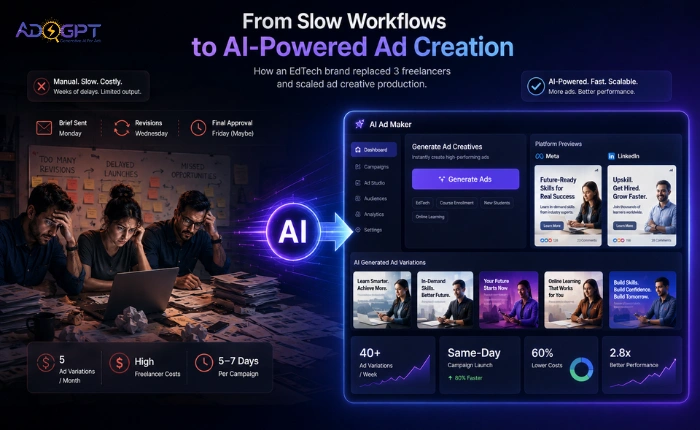
Meta and LinkedIn ads kept getting pushed back. Briefs went to freelancers on Monday. Revisions came back Wednesday. Final assets were approved on Friday – if they were lucky.
By the time campaigns went live, the timing window had already shifted. The team had a solid media buying strategy, but it didn’t matter. They were losing the race to their own production queue. What they needed wasn’t more budget. They needed a smarter AI ad maker.
Read Aloud!
Why the EdTech Brand Started Looking for an AI Ad Maker
The signs had been building for months.
Freelancer costs kept climbing as the team requested more rounds of revisions.
Messaging felt inconsistent across platforms – one ad sounded urgent, the next sounded casual, and neither felt intentional. Creative testing was almost nonexistent because there simply weren’t enough variations to test.
The core issue wasn’t the quality of the freelancers. It was the structure. A three-person freelance setup – one for copy, one for design, one for platform variations – created handoff delays at every step.
Approvals stacked up. Revisions multiplied. The team was producing maybe five ad creative assets per month, which made meaningful A/B testing nearly impossible.
The problem was not media buying. The real bottleneck was producing enough ad creative fast enough to test properly. Once the team acknowledged that, the search for an AI ad maker began in earnest.
The Hidden Problem With Freelance-Based Ad Production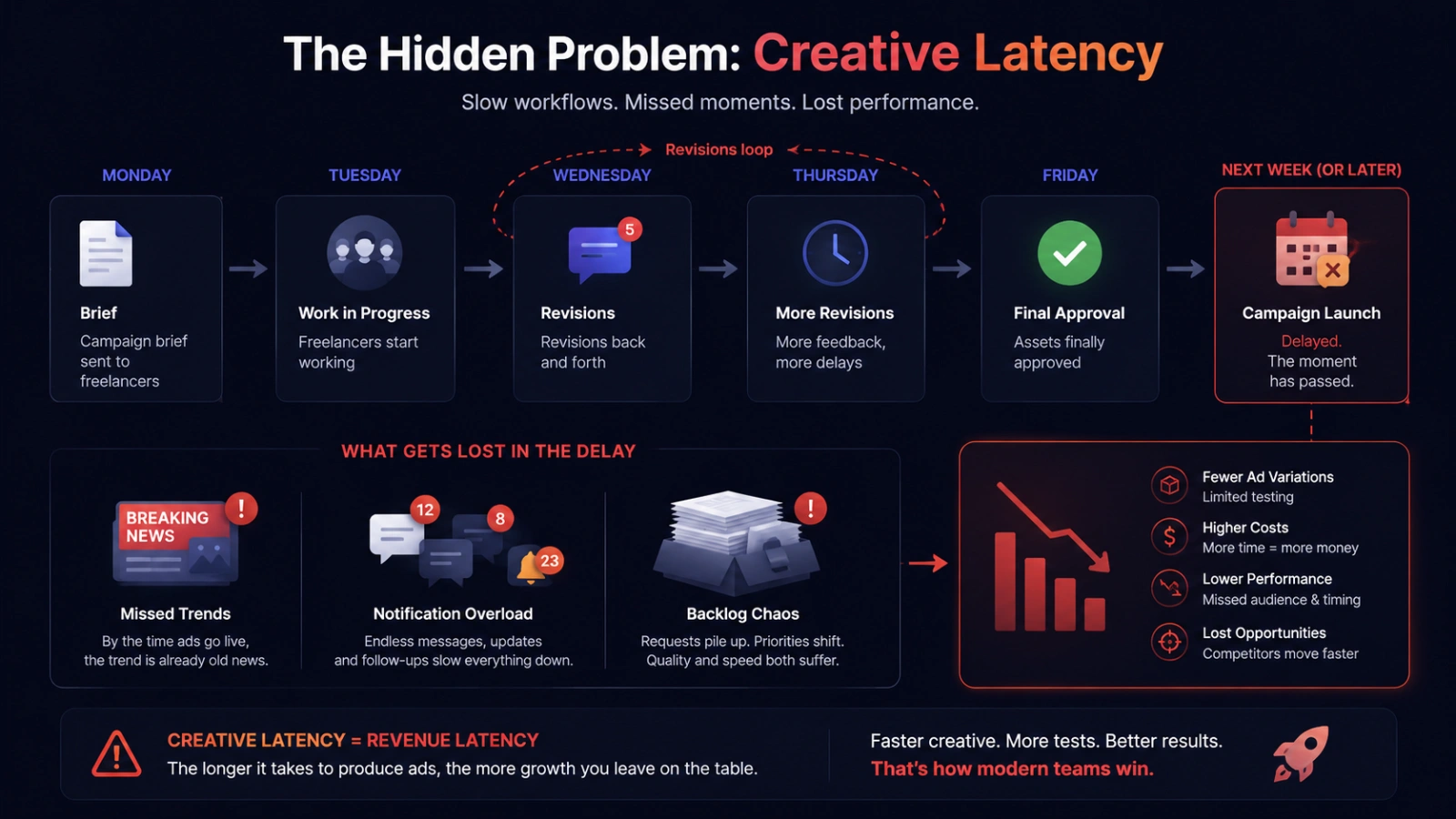
The weekly workflow looked predictable on paper. Brief sent Monday. Revisions on Wednesday. Assets finalized Friday.
Campaigns launched the following week – if nothing slipped. But things always slipped.
A trend surfaced mid-week that would’ve made a great hook. A competitor launched something new that deserved a direct response. A webinar wrapped up with a strong quote perfect for an ad. None of it made it into the queue in time. By the time assets were ready, the moment had passed.
Modern teams increasingly identify this as “creative latency” – the gap between a good idea and a live ad. It’s not a talent problem. It’s a systems problem. An AI content generator eliminates that lag.
The EdTech team didn’t realize how much creative latency was costing them until they started tracking how often campaigns launched late versus on time. The answer was uncomfortable.
What Changed After Switching to an AI Ad Maker
The team implemented AdsGPT, an ad maker built specifically for paid campaigns.
The workflow shifted immediately. Instead of writing a brief and waiting, the team uploaded campaign context directly – their ideal customer profile, tone guidelines, platform requirements, and messaging priorities.
Within minutes, they had multiple campaign-ready outputs: stat-led hooks, pain-point angles, outcome-focused copy, and platform-specific formatting for both Meta and LinkedIn. What used to take a week took an afternoon.
The difference from generic AI content generator tools was immediately clear. AdsGPT didn’t produce drafts that needed heavy editing. It produced structured ad creative with hooks, body copy, and CTAs already formatted for the platform. Approvals moved faster because there was less guesswork. The creative director wasn’t fixing tone – she was choosing between options.
From 5 Ad Variations Per Month to 40 Per Week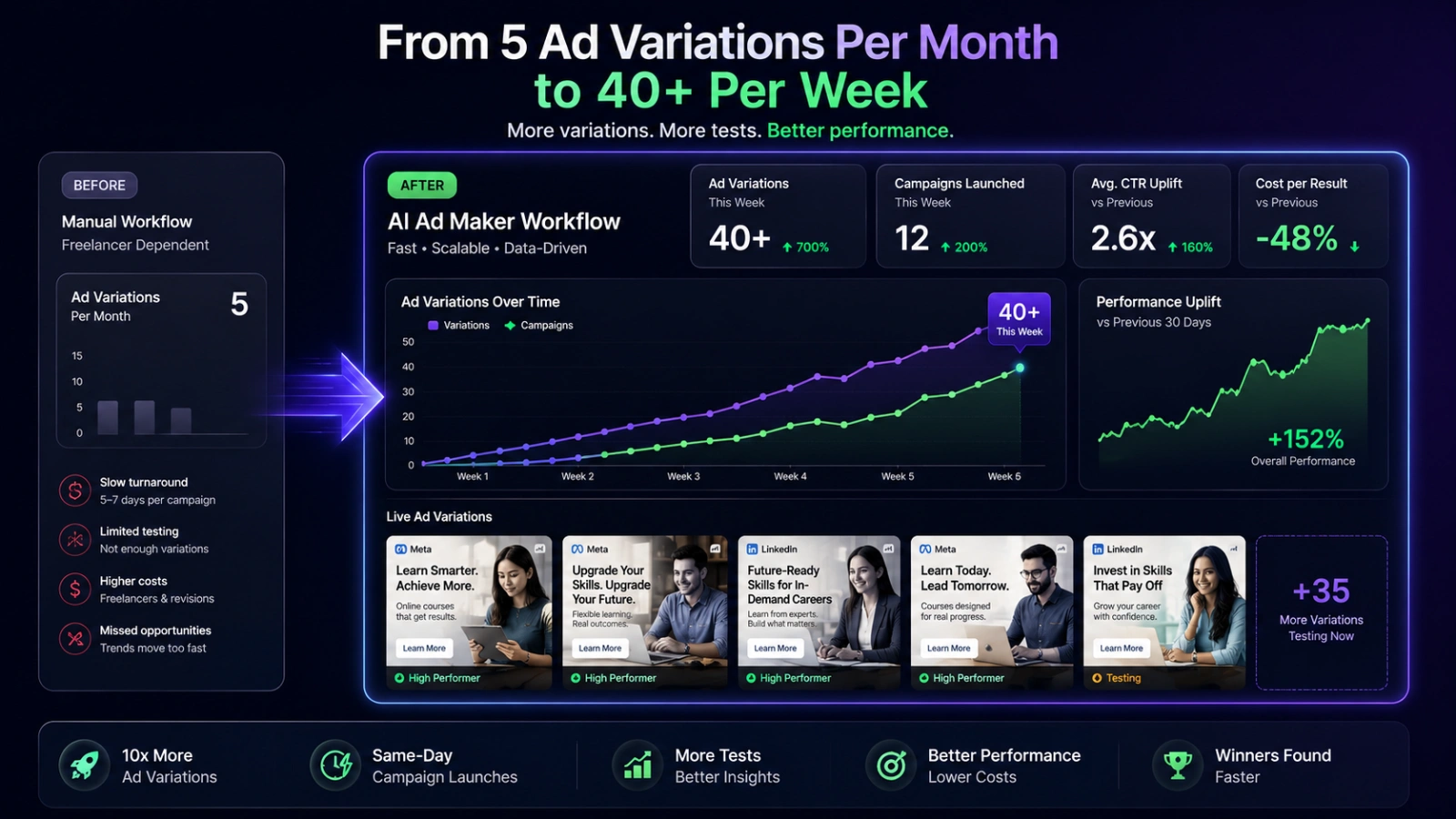
The numbers shifted fast. Within the first month, the team’s creative output multiplied. The launch cycle dropped from five days to same-day for most campaigns. Freelancer costs fell by roughly 60 percent. And weekly testing volume increased dramatically – from fewer than five variations to more than 40.
The team started organizing their ad creative around distinct audience angles rather than generic messaging. They ran stat-led hooks for prospecting audiences, pain-point creatives for retargeting, student outcome messaging for younger demographics, and parent-focused angles for families researching programs.
High-performing teams have shown this pattern consistently: increasing testing velocity – not just ad spend – is what drives better campaign results. More creative variations give platforms more signal. More signal means faster optimization. The AI ad maker didn’t just reduce costs. It changed how the team approached testing altogether.
Why More Ad Creative Improved Campaign Performance
Meta and LinkedIn both reward creative variation. Their algorithms learn faster when they have more options to test against different audience segments. A single ad running to a cold audience gives the platform almost nothing to work with. Twenty variations give it a map.
The EdTech team discovered that different buyer motivations required genuinely different creative approaches. Parents researching programs for their kids responded to reassurance and career outcome data.
Students in the 22–28 age range responded to speed – how fast they could finish, how quickly they could see results. Pricing-focused messaging landed differently depending on whether the viewer was paying out of pocket or had employer support.
The AI ad maker made it practical to build all of these variations at once rather than picking one angle and hoping. More variation meant the platform could identify audience-message fit faster, which translated directly into better performance metrics.
The Results After 90 Days
After three months, the team’s CPL dropped noticeably, CTR improved across both platforms, and production costs were a fraction of what they’d been with the freelance model. But those weren’t the numbers the team talked about most.
The biggest improvement was not lower costs. Instead, the team learned faster than ever before. Over 90 days, they ran more experiments than they had in the previous year. Different hooks started revealing clear audience patterns.
Soon, new messaging combinations began outperforming every campaign they had tested earlier. By the end, the company had built a creative playbook grounded in real performance data rather than assumptions.
AI-assisted ad creative production increasingly helps brands reduce turnaround time while scaling output – and this case matched that pattern exactly. The speed of iteration became a genuine competitive advantage.
The 4 Mistakes Teams Make With AI Ad Makers
Not every team that adopts an ad maker sees results this quickly. Most of the time, the gap comes down to a few avoidable mistakes:
- Generating variations that say the same thing. Volume without genuine differentiation doesn’t help the algorithm or the audience. Each variation should test a distinct angle.
- Skipping human review. The AI ad maker handles production speed. A strategist still needs to review outputs for brand alignment and accuracy before anything goes live.
- Launching too few creatives. Teams sometimes run three variations and call it a test. Meaningful testing requires enough variation for the platform to learn. Five is a starting point, not a finish line.
- Treating AI output as a final strategy. An AI content generator accelerates execution. It doesn’t replace the strategic thinking about who you’re targeting and what actually matters to them.
Human strategic direction still matters, even in AI-assisted creative workflows. The teams getting the most out of these tools are the ones using AI to execute faster on smarter strategies – not outsourcing the thinking entirely.
Why the Best Marketing Teams Now Think Like Publishers
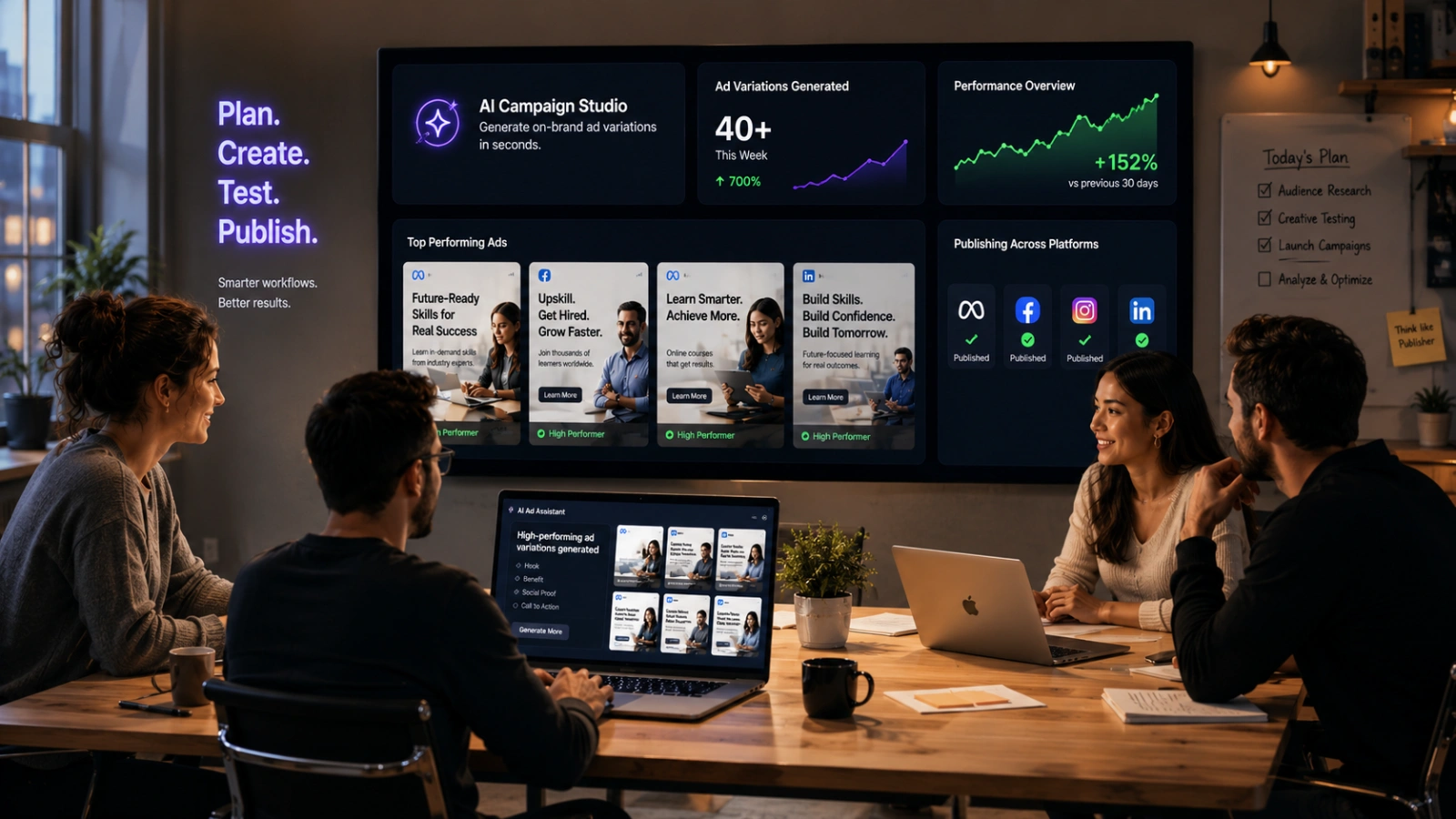
The most effective marketing teams aren’t running campaigns anymore. They’re running creative systems. They publish constantly, iterate continuously, and treat every ad as a data point rather than a finished product.
An AI ad maker makes that operating model accessible to smaller teams. You don’t need a large in-house creative department or an expensive agency to maintain high creative volume. You need a clear strategy, a solid brief process, and a tool that can execute quickly.
Winning teams now optimize for learning speed rather than campaign perfection. They’d rather launch ten imperfect variations and learn from them than spend two weeks perfecting one ad that might not work. The AI ad maker compresses the production cycle enough to make that approach practical for teams of any size.
The Real Advantage Was Never Just Cost Savings
Replacing three freelancers was a side effect. The real win was what happened after – a marketing team that could test faster, learn faster, and adapt faster than their competitors.
The AI ad maker compressed the production cycle that had been slowing everything down. Smaller teams can now operate at creative volumes that used to require much larger budgets and headcounts. That’s a structural shift, not just a workflow improvement.
If your ad creative pipeline is still the bottleneck between your strategy and your results, it’s worth taking a closer look at what an AI ad maker can actually do for your team.
Frequently Asked Questions
What does an AI ad maker do?
An ad maker helps marketing teams generate ad copy, visuals, and campaign variations faster using automation and structured creative workflows. Instead of waiting days for freelancer output, teams can produce platform-ready ad creative in minutes.
Can an AI ad maker replace freelancers?
Many brands now use AI tools to reduce reliance on freelancers for repetitive ad production while keeping strategy and final review in-house. For high-volume, fast-turnaround creative work, an AI ad maker handles most of what freelancers previously covered.
How does AI improve ad creative testing?
AI helps teams launch more ad creative variations quickly, allowing platforms like Meta and LinkedIn to optimize campaigns faster. More variations give the algorithm more signal, which speeds up audience-message matching and improves overall performance.
Is an AI content generator useful for paid ads?
Yes. An AI content generator can help teams create hooks, headlines, CTAs, and audience-specific messaging variations at scale. The best tools go beyond generic copy generation and produce structured, campaign-ready outputs formatted for specific platforms.
MOST POPULAR