Every e-commerce brand eventually faces the same budget decision: where do paid ads actually work? Facebook has been the default answer for years: massive reach, sophisticated targeting, and a full-funnel advertising ecosystem. But Pinterest ads have been quietly building a case that deserves serious attention, particularly for brands in visually driven categories where purchase intent runs high, and competition runs lower.
The comparison is not straightforward because the two platforms serve different psychological moments. Facebook intercepts users mid-scroll, inserting ads into a social feed not primarily designed for shopping. Pinterest, by contrast, is a platform people open specifically to plan, discover, and shop, making advertising on Pinterest a fundamentally different proposition from interrupting a social feed.
This guide breaks down both platforms across every dimension that matters for e-commerce: targeting, ad formats, costs, conversion performance, creative requirements, and competitive intelligence. By the end, you will have a clear picture of which platform fits your brand, your budget, and your funnel stage, and how to use both together if your strategy calls for it.
What Are Pinterest Ads?
Pinterest is a visual discovery platform where users actively search for ideas, inspiration, and products across categories, including home decor, fashion, beauty, food, DIY, weddings, and travel.
Unlike most social platforms, Pinterest users arrive with intent; they are planning a kitchen renovation, looking for outfit ideas, or researching products they are considering buying.
Pinterest advertising places promoted pins directly into those search results and interest feeds. Because users are already in a discovery mindset, the psychological context for advertising on Pinterest is fundamentally more receptive than on platforms where ads interrupt social media activity.
The platform has approximately 550 million monthly active users globally, with a demographic skew toward women aged 25 to 54, a group with significant purchasing power and a strong overlap with e-commerce buying behavior.
Pinterest’s own research consistently shows that a high proportion of its users come to the platform to shop, making it one of the most commercially oriented major social platforms despite its relatively smaller audience size.
The High-Intent Shopping Advantage
The core advantage of Pinterest ads for e-commerce is purchase intent. When someone searches for “boho living room ideas” on Pinterest, they’re often in the early stages of a purchase journey that will eventually include furniture, textiles, art, and accessories. A promoted pin appearing in that search result is contextually relevant in a way that a Facebook ad about the same products, appearing between posts from friends and news, typically isn’t.
This inherent advantage translates into a longer content lifespan. A well-performing organic pin can drive traffic for months or years after it’s posted. Promoted pins benefit from the same extended discovery window, which means your creative investment works harder and longer on Pinterest than on Facebook, where ad fatigue requires constant creative refreshment.
What Are Facebook Ads?
Facebook’s advertising platform is the most sophisticated paid social system in the world. With over three billion monthly active users across Facebook and Instagram advertising, it offers reach that no other platform can match and an ad targeting infrastructure built on two decades of behavioral data collection.
Facebook ads operate on an interruptive model: users scroll through a social feed primarily for content from friends, family, and followed pages, and ads appear within that stream. The targeting sophistication compensates for the lower purchase intent. Facebook can identify users who have recently visited your website, engaged with similar brands, or exhibited behavioral patterns that correlate with purchase readiness.
For e-commerce, Facebook’s greatest strength is its retargeting capability. Dynamic product ads that follow users after they’ve visited your product pages, abandoned carts, or purchased in a related category can achieve conversion rates that far exceed cold-audience advertising on any platform. The full-funnel infrastructure, from awareness through retargeting to loyalty, is more mature and more capable on Facebook than anywhere else.
Pinterest Ads vs Facebook Ads: Core Differences
Here’s a structured overview of how the two platforms compare across the metrics e-commerce brands care about most.
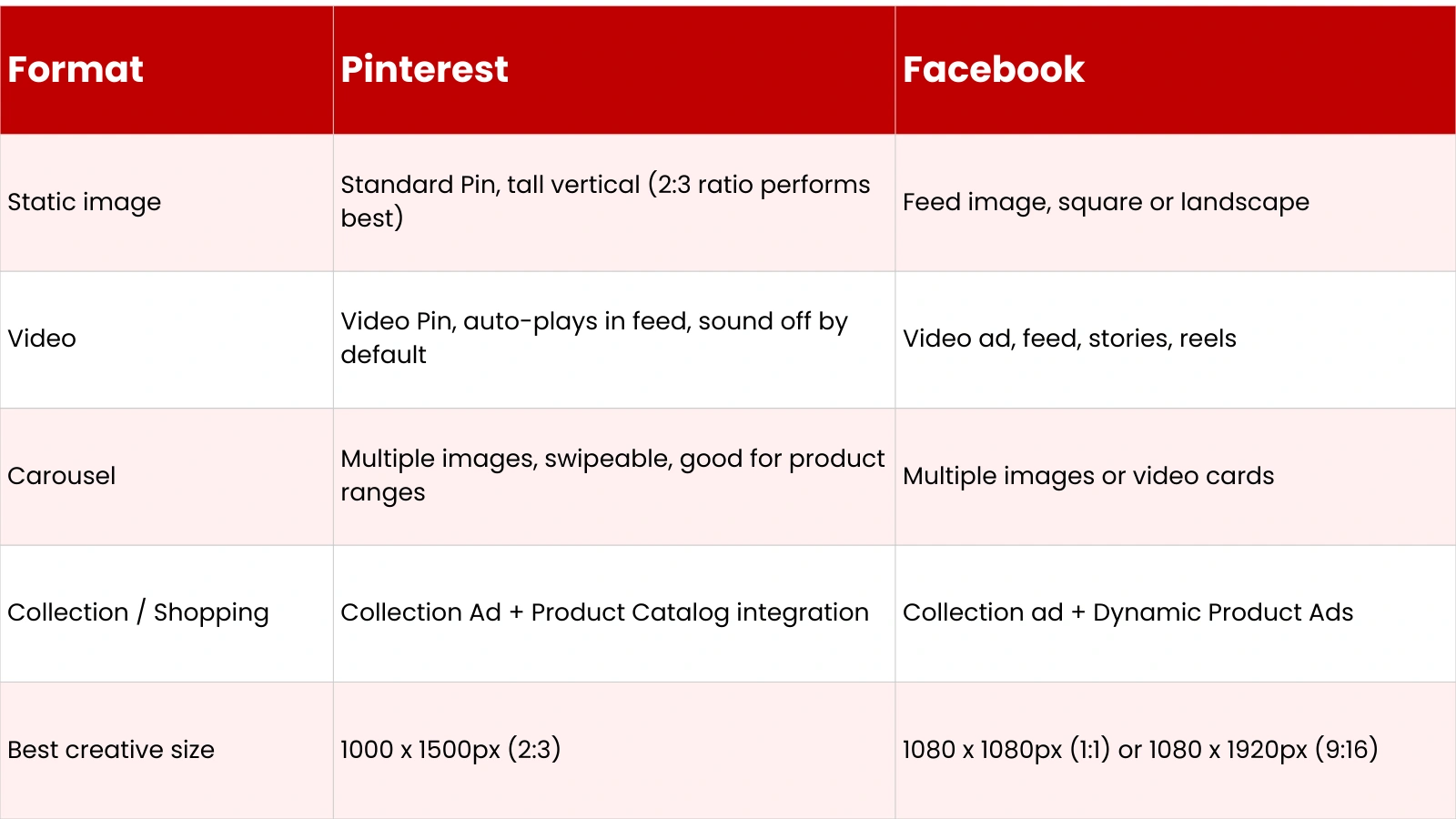
The table above reflects general benchmarks; actual performance varies significantly by niche, creative quality, targeting approach, and campaign optimization. Treat these as directional rather than precise.
Audience Targeting: Pinterest Ads vs Facebook Ads
Pinterest Keyword and Interest Targeting
Pinterest targeting works more like search advertising than social advertising. You can target users based on the keywords they search for, the interests associated with their pinning behavior, and contextual placement within specific categories. This keyword-first approach is what creates the high-intent environment that distinguishes Pinterest advertising from other social platforms.
Actalike audiences, Pinterest’s equivalent of Facebook’s lookalike audiences, allow you to reach new users who behave similarly to your existing customers or website visitors. Pinterest’s retargeting capabilities have improved significantly, allowing website visitors, email list matches, and engagement-based audiences to be retargeted with relevant promoted pins.
Facebook Interest, Behavioral, and Custom Targeting
Facebook’s targeting is more granular and more powerful for bottom-of-funnel work. Custom audiences built from website pixel data, customer lists, and app activity allow precise retargeting. Lookalike audiences derived from those custom audiences can scale winning campaigns efficiently. Interest and behavioral targeting layers allow you to reach cold audiences with a level of specificity that Pinterest’s keyword model doesn’t replicate.
The trade-off is signal degradation. iOS privacy changes have reduced Facebook’s ability to track off-platform behavior, which has affected retargeting accuracy and attribution reliability. Pinterest, which relies more on on-platform intent signals, has been less affected by these changes.
Pinterest Ad Formats and Facebook Ad Formats Compared
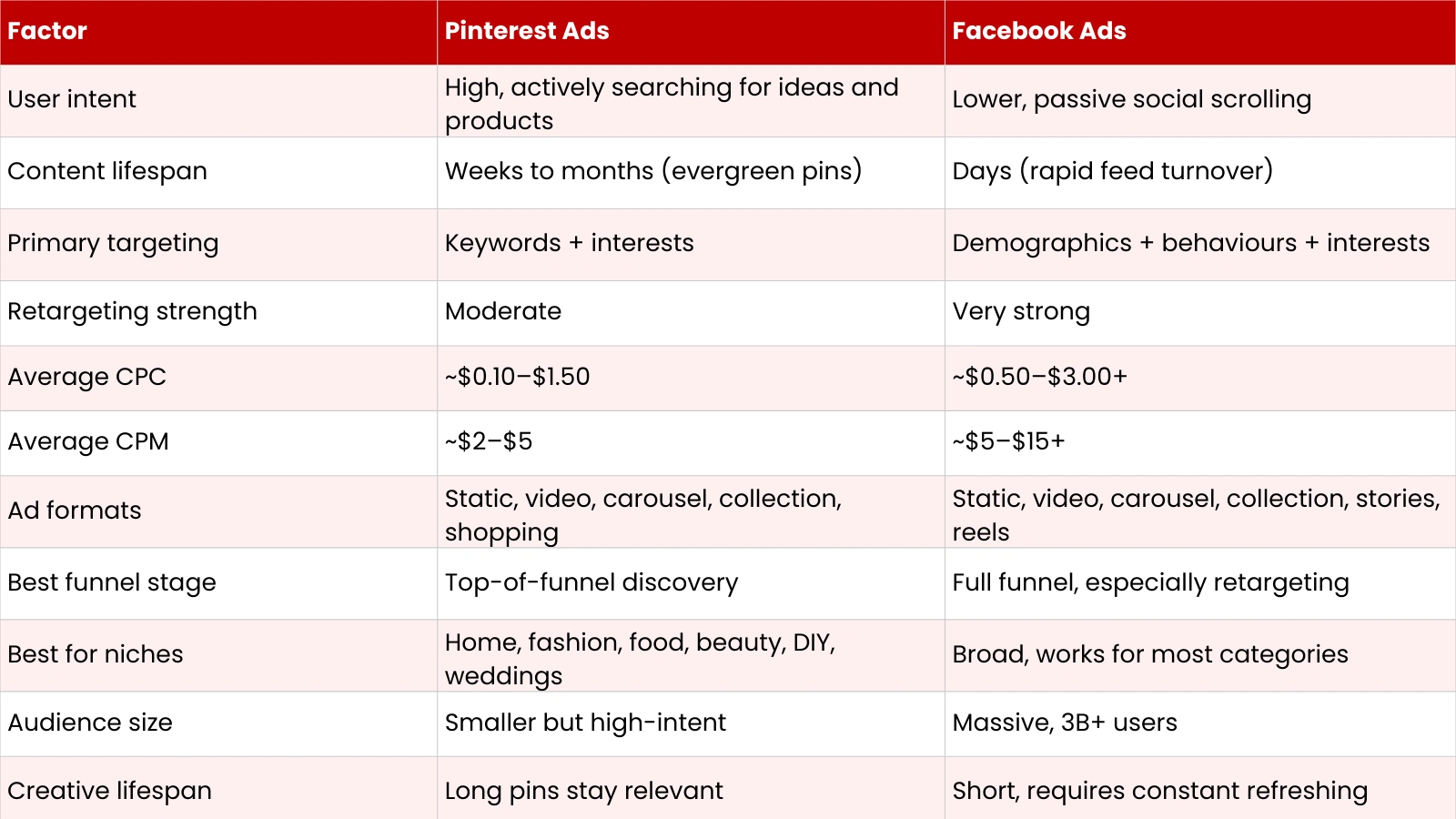
Both platforms offer a similar core set of ad formats, but the creative specifications and performance patterns differ meaningfully.
Pinterest Ad Types That Perform Best for E-commerce
Shopping ads, which pull directly from your product catalog and appear in search results and related pins, are among the highest-performing Pinterest ad types for e-commerce. They reach users who are actively searching for products similar to yours and appear in a context where purchase intent is already high.
Video pins perform strongly for brand awareness and product demonstration, particularly in categories like beauty, food, and home decor, where showing the product in use drives inspiration. Carousel ads work well for showcasing product ranges or multiple colorways. Collection ads, which feature a hero image or video alongside a curated product grid, are effective for driving traffic to category pages.
Creative best practice on Pinterest favors vertical formats (2:3 ratio), lifestyle imagery over plain product shots, and text overlay that communicates the value proposition without relying on the user to read a caption. Pins with clear, legible text overlays consistently outperform those without, particularly in search placements.
Facebook Ad Types That Drive E-commerce Conversions
Dynamic product ads, automatically generated ads that show users products they’ve viewed or similar items based on their behavior, are Facebook’s most powerful e-commerce format. They require a properly implemented pixel and product catalog, but once set up, they run with minimal manual management and consistently produce strong ROAS for retargeting campaigns.
Video ads and reels work well for top-of-funnel awareness and product education. Collection ads with a video hero and scrollable product grid perform well for category-level campaigns. For cold audiences, user-generated content formatted as native-looking feed posts tends to outperform polished studio creative; authenticity reduces the ad-feel that triggers scrolling past.
Campaign Setup: Pinterest Ads Manager vs Facebook Ads Manager
How to Advertise on Pinterest: Setup Overview
The Pinterest Ads Manager is straightforward relative to Facebook’s more complex interface. Creating a campaign involves selecting an objective (awareness, consideration, or conversion), defining your targeting by keyword and interest, setting bids and budget, and uploading creative. Pinterest’s Pinterest tag, its equivalent of the Facebook pixel, needs to be installed on your site for conversion tracking and retargeting to work properly.
The interface is cleaner and less overwhelming than Facebook’s, which makes it accessible for advertisers who are new to paid social. The trade-off is fewer optimization levers; Pinterest’s campaign management tools are less granular than Facebook’s, which can be a limitation for experienced advertisers who want precise control over bidding and audience management.
Facebook Ads Manager Setup
Facebook’s Ads Manager is more powerful and more complex. The campaign structure, campaign, ad set, and d allow granular control over objectives, budgets, targeting, placements, and creative at each level. Automated features like Advantage+ Shopping Campaigns have simplified some of the setup burden, but getting the most from Facebook’s system still requires more expertise than Pinterest’s.
Meta Pixel implementation, catalog setup, and conversion event configuration are prerequisites for effective e-commerce campaigns. When properly set up, the optimization infrastructure is significantly more sophisticated than Pinterest’s, but the setup investment is also higher.
Cost Comparison And ROI: Pinterest Ads vs Facebook Ads
Pinterest ads generally offer lower CPCs and CPMs than Facebook, which reflects both the smaller audience size and the lower competition for ad inventory. Average CPCs on Pinterest run approximately $0.10 to $1.50, depending on category and targeting; Facebook CPCs typically range from $0.50 to $3.00 or more for competitive e-commerce categories.
Lower cost-per-click doesn’t automatically translate to better ROI; what matters is the cost per acquisition relative to customer lifetime value. Pinterest’s higher purchase intent can produce strong conversion rates for relevant niches, but Facebook’s retargeting precision often delivers better ROAS for bottom-of-funnel campaigns where the audience is already warm.
A realistic expectation for most e-commerce brands: Pinterest performs better for top-of-funnel discovery and brand awareness at a lower cost. Facebook performs better for retargeting and conversion campaigns where precise audience matching justifies the higher CPM. Running both platforms in tandem, using Pinterest for discovery and Facebook for closing, often produces better blended ROAS than either platform alone.
Also Read!
Competitor Research: Pinterest Ad Spy vs Facebook Ad Library
Finding Winning Pinterest Ads
Pinterest doesn’t have an official public ad library equivalent to Facebook’s. Third-party Pinterest ad spy tools, platforms that index promoted pins across categories, and let you search by niche, keyword, or brand, fill this gap. These tools allow you to research which ad creatives are running in your category, identify offer angles that appear frequently (suggesting they’re working), and analyze the visual style and copy patterns of successful competitors.
Even without a dedicated spy tool, Pinterest’s own search results surface promoted pins that are currently running. Searching your primary category keywords in Pinterest while logged out, or from an account with a clean history, shows you the paid placements your competitors are winning. The creative patterns you observe across multiple competitors are a useful signal for what the algorithm is rewarding in your niche.
Facebook Ad Library
Facebook’s Ad Library is a free, official tool that allows anyone to search and view all ads currently running on Facebook and Instagram for any brand or keyword. It shows creative, copy, call to action, running dates, and in some cases, spend ranges. For e-commerce competitive research, it’s one of the most useful free tools available. You can see exactly what your competitors are testing, how long they’ve been running specific ads (a proxy for performance), and which offers and angles they’re prioritizing.

Can You Use Pinterest Ads and Facebook Ads Together?
Yes, and for many e-commerce brands, the most effective strategy uses both platforms at different funnel stages rather than choosing one over the other.
The natural split is Pinterest for discovery and Facebook for conversion. A user discovers your brand through a Pinterest shopping ad while searching for inspiration in your category. They visit your website but don’t purchase. Facebook’s dynamic product ads then retarget that user with the specific products they viewed, appearing in their feed over the following days. The two platforms work with each other’s strengths rather than competing.
Cross-platform attribution is the operational challenge. Customers who touch both platforms before converting will appear differently in each platform’s reporting, band oth will claim the conversion. Using a third-party attribution tool or relying on your e-commerce platform’s order attribution data gives a more accurate picture of how each channel is contributing to overall revenue.
Budget allocation for a combined strategy typically starts with a higher share on Facebook (where retargeting infrastructure drives immediate returns) and scales Pinterest spend as the brand grows its organic presence and builds larger retargeting pools from Pinterest traffic.
Pros And Cons: Pinterest Ads Vs Facebook Ads
Pinterest Ads: Advantages and Best Use Cases
- High purchase intent, users are actively planning and shopping, not passively scrolling
- Lower CPCs and CPMs, less competition for ad inventory than Facebook in most categories
- Longer content lifespan, pins continue driving traffic weeks or months after posting
- Less creative fatigue, ads don’t need to be refreshed as frequently as Facebook creative
- Strong for visually driven niches: home decor, fashion, beauty, food, DIY, weddings, fitness
Best for: brands in visual categories targeting women 25–54, top-of-funnel discovery campaigns, brands with smaller budgets looking for efficient awareness spend, and businesses whose products fit naturally into the planning and inspiration mindset Pinterest users bring to the platform.
Pinterest Ads: Limitations
- Smaller total target audience than Facebook, reach caps sooner in niche categories
- Less sophisticated retargeting than Facebook, bottom-of-funnel performance is weaker
- Slower optimization, campaigns take longer to exit the learning phase due to lower volume
- Not ideal for impulse purchases, broadly horizontal products, or B2B categories
Facebook Ads: Advantages and Best Use Cases
Massive reach, 3 billion+ users across Facebook and Instagram
- Best-in-class retargeting, dynamic product ads, and custom audiences drive strong ROAS
- Fast campaign optimization, high volume produces quicker learning and iteration
- Works for almost any product category, niche, or business model
- Full-funnel infrastructure, awareness through loyalty in a single platform
Best for: brands that need fast scale, retargeting-heavy funnels, impulse purchase products, and businesses that have already built warm audiences through email lists or website traffic.
Facebook Ads: Limitations
- Higher CPMs and CPCs in competitive e-commerce categories
- Requires frequent creative refresh to avoid ad fatigue
- Attribution challenges following iOS privacy changes
- Steeper learning curve for campaign management
Try AdsGPT
AdsGPT is an AI advertising tool created to help marketers create, research, and optimize ads faster. It focuses mainly on generating ad creatives, writing AI ad copy, and providing campaign insights for platforms like Pinterest, Facebook, Google, and more.
Instead of building ads manually, you input your brand details, product info, and audience, and the tool generates ready-to-use ads within seconds.
It’s built to save time on creative production and help advertisers launch campaigns more efficiently.
Simple Features of AdsGPT
1. AI Ad Creative Generator
AdsGPT can automatically create ad visuals for campaigns.
You can:
- Generate product ad images
- Create multiple design variations
- Produce platform-ready creatives
- Customize visuals with your brand details
No design skills are required — creatives are generated instantly.
2. Ad Copy Generation
The platform also writes ad text using AI.
It can generate:
- Headlines
- Primary ad copy
- Product messaging
- CTA lines
Copy is tailored for different platforms and campaign goals.
3. Competitor Ad Inspiration (Ad Spy-Style Feature)
AdsGPT includes competitor research support.
You can:
- Study competitor ads
- Use existing ads as inspiration
- Generate similar creatives in your brand style
This helps with ad ideation and positioning.
4. Platform-Specific Customization
Ads can be generated for multiple ad networks, including:
- Meta (Facebook & Instagram)
- LinkedIn and others
Creatives are automatically optimized for placement and size.
5. Multiple Creative Outputs
You can generate several creatives at once for testing.
This helps advertisers:
- Run A/B tests faster
- Experiment with different angles
- Scale creative production quickly
6. Brand Memory & Personalization
AdsGPT allows you to store brand details like:
- Logo
- Brand description
- Visual style
The AI then applies these automatically across creatives for consistency.
7. Analytics & Insights
The tool also includes analytics features such as:
- Ad performance tracking
- Market trend insights
- Engagement analysis
- CTA performance comparison
These insights help improve campaign optimization.
AdsGPT is mainly designed to reduce manual work in paid advertising and speed up campaign execution.

Final Verdict: Which Is Better for E-commerce?
Neither platform is universally better; the right answer depends on your niche, your budget, your funnel, and your audience.
Choose Pinterest ads as your primary channel if your products fit naturally into visually driven, inspirational categories; if your target audience skews toward women aged 25 to 54; if you’re working with a limited budget and need efficient top-of-funnel reach; or if your brand benefits from the long content lifespan that Pinterest’s discovery model creates.
Choose Facebook ads as your primary channel if you need fast scale and broad reach; if retargeting is central to your conversion strategy; if your product category is horizontal rather than niche; or if you’ve already built warm audiences that Facebook’s targeting can reach with precision.
Use both if your budget allows. The full-funnel combination, Pinterest for discovery, Facebook for retargeting and conversion, is the most effective structure for e-commerce brands in compatible categories. It’s not about which platform wins. It’s about using each platform for the job it does best.
Frequently Asked Questions
Are Pinterest Ads cheaper than Facebook Ads?
Generally yes. Pinterest ads typically have lower CPCs (around $0.10 to $1.50) and lower CPMs (around $2 to $5) than Facebook, where CPCs can range from $0.50 to $3.00 or more for competitive e-commerce categories. Lower cost doesn’t always mean better ROI; it depends on your conversion rate and how well your product fits the Pinterest audience.
Do Pinterest Ads convert better for e-commerce?
For top-of-funnel discovery in visually driven niches, Pinterest often outperforms Facebook on cost efficiency. For bottom-of-funnel retargeting and conversion campaigns, Facebook’s dynamic product advertisements typically deliver stronger ROAS. The platforms are better compared by funnel stage than by overall conversion rate.
How much budget do you need for Pinterest Ads?
Pinterest recommends a minimum of $5 per day per campaign for traffic and awareness objectives. For conversion campaigns, a budget of $20 to $50 per day gives the algorithm enough volume to optimize. Most e-commerce brands see meaningful data within two to four weeks at this spend level. Lower budgets are possible, but produce slower learning.
What is the best Pinterest ad format for e-commerce sales?
Shopping ads, which pull from your product catalog and appear directly in search results, are generally the highest-performing Pinterest ad format for driving direct e-commerce sales. Collection ads perform well for category-level campaigns. Video pins work best for brand awareness and product education in visually engaging categories like beauty, food, and home decor.

MOST POPULAR